


Humanoid robots able to perform tasks from grape harvesting to welcoming visitors were front and center at France’s Vivatech trade fair, with European firms looking to fill niches beyond what dominant Chinese giants can offer.
French company Enchanted Tools was showing off its Mirokai, a “social” robot with long orange ears and wide blue eyes.
Able to communicate in more than 50 languages, prototypes of the Paris-based firm’s machine are already out in the wild, welcoming people to hospitals and airports, marketing chief Richard Malterre said on a stage at Vivatech, which ran from Wednesday to yesterday.
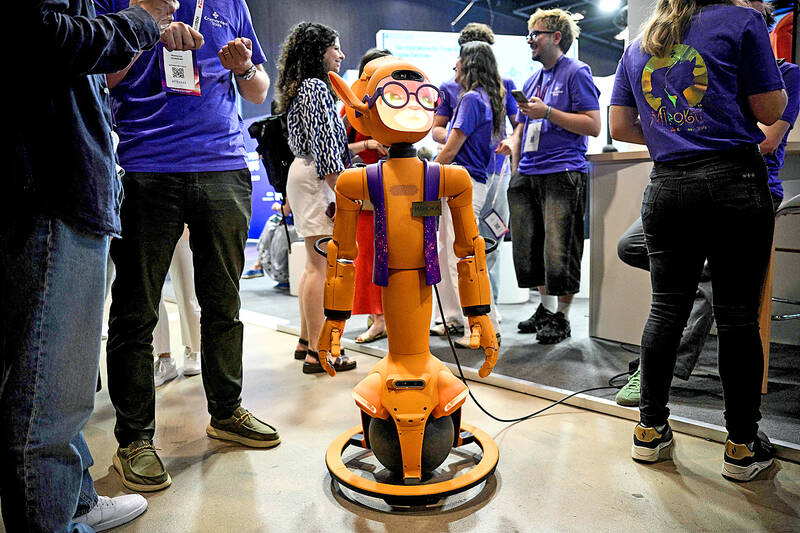
Photo: AFP
The start-up hopes its first mass-produced models will arrive by the end of this year.
“At least 60 percent of the robot is manufactured in Europe and we’re fighting to keep it that way,” Malterre told reporters.
However, some of the artificial intelligence (AI) robotics know-how is “not necessarily available” in Europe, he said, such as the graphics processors from Santa Clara, California-based chip giant Nvidia that power Mirokai’s brain as well as the broader generative AI boom.
When it comes to sheer robotics production capacity, China is unrivalled thanks to companies including Unitree Robotics (杭州宇樹科技) and Agibot Innovation (Shanghai) Technology Co (智元創新).
Their androids’ tightly choreographed displays wowed visitors to Vivatech, the latest fair to show them off in the past few months.
About 87 percent of the 13,000 humanoid robots deployed worldwide last year rolled off Chinese production lines, according to the UK-based consultancy Omdia.
“China is definitely on the forefront” as its companies increasingly show off “dark factories,” at which robots work largely without human supervision, said Joern Buss, a robotics expert at the Brussels-based consultancy Arthur D. Little.
Nevertheless, Europe is “catching up” behind Japan and South Korea, Buss said, boasting “some good robotics players” including long-standing firms.
New players on the European scene include Metzingen, Germany-based Neura Robotics, which builds humanoid industrial and household robots, as well as a platform for training them to carry out human tasks.
The company recently announced it had raised US$1.4 billion.
“We get requests for everything, even dentists, everyone is calling us and asking if they can have a robot as a supporter, because they can’t find people,” Neura chief executive officer David Reger told reporters.
Like other advanced economies around the world, Europe faces an ageing population that could squeeze the labor supply in manufacturing and services.
Reger called robots like Neura’s the continent’s “last chance,” saying that “Europe does require this economic pillar to sustain” itself.
He cited familiar challenges for European tech firms including tight regulations and a tougher search for financing than competitors in the US.
However, Reger has no plans to uproot Neura’s business, which is collaborating with German car component suppliers Bosch and Schaeffler on factory automation.
He vaunts Neura’s order book of more than US$1 billion.
“If all robot production goes to Japan or China, that could be a big problem when it comes to sovereignty,” said Francesco Ferro, CEO of Barcelona, Spain-based PAL Robotics.
His company was at Vivatech showing off its latest models.
One is a black biped that has been dubbed Kangaroo, while the Tiago machine is fitted with jointed arms that have been put to use in logistics as well as picking grape harvests.
Robotics developers use vast quantities of data to train their machines’ movements and they collect still more information as they carry out their tasks.
The continent should aim to create “a totally European supply chain, without thinking only about price,” as that could lead prospective clients to buy Chinese robots, Ferro said.
That would risk seeing valuable or sensitive data “falling into the wrong hands,” he warned.
French-American start-up Genesis AI plans to re-shore production of its Eno multifunctional robot next year after making it in China.
Prospective customers include “the big industrial base in France, Italy and Germany,” Genesis AI cofounder Theophile Gervet told reporters.
Enchanted Tools’ Malterre also believes the demand exists.
“I’m confident in our ability and creativity to endure,” he said. “We need to be ready for a fight, not throw in the towel.”
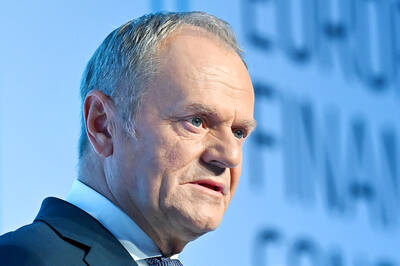
Poland is betting on a flood of investments and technology transfers from Taiwanese companies to reengineer its US$1 trillion economy. Polish Prime Minister Donald Tusk said yesterday that Poland will no longer be “just an assembly hub” as it pursues further investments from the likes of Foxconn Technology Group (富士康). The firm, whose full name is Hon Hai Precision Industry Co (鴻海精密), last month agreed to build electric vehicles (EVs) in the European Union nation and now could be a partner in a semiconductor venture, he said. The government’s aim is to boost manufacturing and the country’s high-tech chops in an era

Taiwan remained the sixth-largest net creditor nation in the world last year, despite a fall of more than 10 percent in its net international investment position (NIIP) over the year, the central bank said yesterday. The NIIP is the difference between a country’s external financial assets and its external financial liabilities. Taiwan’s external financial assets hit US$3.27 trillion at the end of last year, up US$275.75 billion or 9.2 percent from a year earlier, the central bank said in its annual NIIP report. The growth largely reflected an increase in holdings of overseas marketable securities by residents in Taiwan, as well as a
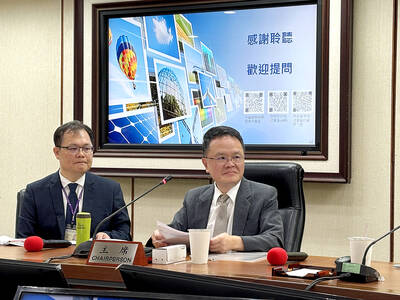
BAD FAITH LITIGATION? The two companies, owned by a California-based private equity firm, could be seeking licensing fees or a settlement payout with the suit Taiwan Intellectual Property Office (TIPO) Director-General Liao Cheng-wei (廖承威) said yesterday he suspected that two firms suing contract chipmaker Taiwan Semiconductor Manufacturing Co (TSMC, 台積電) for patent infringement are “patent trolls.” A patent troll refers to a company that buys patents not for manufacturing products, but to sue other companies for compensation, accusing them of using its patents. Patent trolls, formally called Non-Practicing Entities or Patent Assertion Entities, were responsible for more than 50 percent of lawsuits in the US last year, costing targeted businesses tens of billions of US dollars a year, according to the US-based LegalCharity Web site. Asked whether
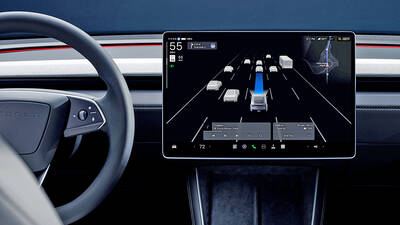
Tesla Motors Taiwan Ltd (台灣特斯拉) said yesterday that it has submitted an application for its supervised full self-driving (FSD) system to the Vehicle Safety Certification Center, taking a first step toward making the feature available in Taiwan. The system requires drivers to remain attentive and ready to take immediate control at all times, and does not make a vehicle fully autonomous, the company said. It has been trained using anonymous driving data collected from 8.5 million Tesla vehicles worldwide, it said. Each newly delivered vehicle can access a “lifetime” of driving scenarios through the system, it added. Tesla said FSD (Supervised) is available


 RSS
RSS