


Tesla Motors Taiwan Ltd (台灣特斯拉) said yesterday that it has submitted an application for its supervised full self-driving (FSD) system to the Vehicle Safety Certification Center, taking a first step toward making the feature available in Taiwan.
The system requires drivers to remain attentive and ready to take immediate control at all times, and does not make a vehicle fully autonomous, the company said.
It has been trained using anonymous driving data collected from 8.5 million Tesla vehicles worldwide, it said.

Photo courtesy of Tesla Motors Taiwan Ltd
Each newly delivered vehicle can access a “lifetime” of driving scenarios through the system, it added.
Tesla said FSD (Supervised) is available or approved in 13 countries and regions: the US, Canada, China, Mexico, Puerto Rico, Australia, New Zealand, South Korea, the Netherlands, Lithuania, Estonia, Denmark and Belgium.
The company said that the system is undergoing road testing in Japan, including in major metroplexes such as Tokyo, Yokohama and Osaka.
Tesla announced that it would discontinue its one-time purchase option for FSD at 11:59pm on June 30.
The change would not affect customers who have already purchased the plan, while Tesla owners and new buyers can still purchase it before the deadline, the company said.
Tesla said owners of vehicles equipped with Hardware 3.0, which is not compatible with FSD (Supervised), would be eligible to transfer their FSD entitlement to a newly purchased Tesla free of charge if they take delivery by Sept. 30 and have purchased the plan for their current vehicle by June 30.
Taiwan’s regulations on driver assistance systems require drivers to remain in control of their vehicles and keep their hands on the steering wheel at all times.
Taiwan Semiconductor Manufacturing Co (TSMC, 台積電) yesterday reported record revenue of NT$416.975 billion (US$13.17 billion) for last month, putting the world’s largest contract chipmaker on track to set a record for quarterly revenue. Last month’s figure surpassed March’s record NT$415.19 billion and represented increases of 1.5 percent from April and 30.1 percent from a year earlier. For the first five months of the year, TSMC generated NT$1.96 trillion in revenue, up 30 percent year-on-year, it said in a statement. TSMC has forecast second-quarter revenue of between US$39 billion and US$40.2 billion, representing sequential growth of about 10 percent and year-on-year growth of about

Infineon Technologies AG is preparing to open its largest single investment, a 5 billion euro (US$5.8 billion) semiconductor factory built with the help of EU subsidies, as the bloc seeks to boost chip production. The power chip fab, which is an extension of the German company’s Dresden campus, is scheduled to open on July 2, Infineon chief operating officer Alexander Gorski said this week at the site. The project is a major recipient of EU Chips Act funds, receiving about 1 billion euros in subsidies. The new plant represents a rare success for the bloc’s flagship semiconductor law, which was drawn up during
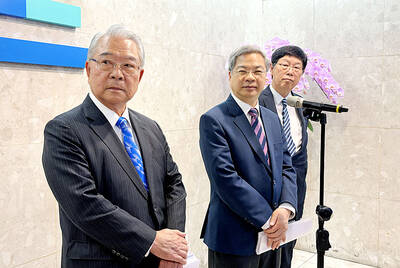
PATENT PROBE: US lawmakers called for a ban on imports of chips made by TSMC if they are found to infringe on US patents, with a preliminary ruling expected soon Minister of Economic Affairs Kung Ming-hsin (龔明鑫) yesterday expressed confidence in Taiwan Semiconductor Manufacturing Co’s (TSMC, 台積電) compliance with patent regulations after reports linked the company to a patent infringement lawsuit in the US. US Representative Ryan Zinke, and US senators Tim Sheehy, Roger Marshall and Bernie Moreno urged the US International Trade Commission in a May 22 letter to ban imports of chips made by TSMC if they are found to infringe on US patents, Axios reported on Wednesday. An administrative law judge is expected to issue a preliminary ruling this month, with the commission potentially making a final decision in

Taiwanese authorities are considering much stricter export controls on artificial intelligence (AI) chip sales to China to further align with US measures, according to people familiar with the matter, an effort to address semiconductor smuggling that risks drawing a rebuke from Beijing. The idea is to give authorities more legal tools to address diversion of advanced hardware, like AI servers with Nvidia Corp chips, from Taiwan to China. Such sales are already banned under US regulations unless companies get Washington’s permission, per curbs the US first imposed in 2022 to prevent Beijing from using advanced Nvidia processors to gain a military


 RSS
RSS