


Taiwanese authorities are considering much stricter export controls on artificial intelligence (AI) chip sales to China to further align with US measures, according to people familiar with the matter, an effort to address semiconductor smuggling that risks drawing a rebuke from Beijing.
The idea is to give authorities more legal tools to address diversion of advanced hardware, like AI servers with Nvidia Corp chips, from Taiwan to China. Such sales are already banned under US regulations unless companies get Washington’s permission, per curbs the US first imposed in 2022 to prevent Beijing from using advanced Nvidia processors to gain a military edge.
Taiwan, however, doesn’t consider unauthorized AI chip exports to China to be a crime. While Taiwanese authorities do warn the potential sellers that they may be breaking US rules should they proceed, the only legal recourse through the island’s courts is to charge suspected smugglers with violations of other, existing local laws.
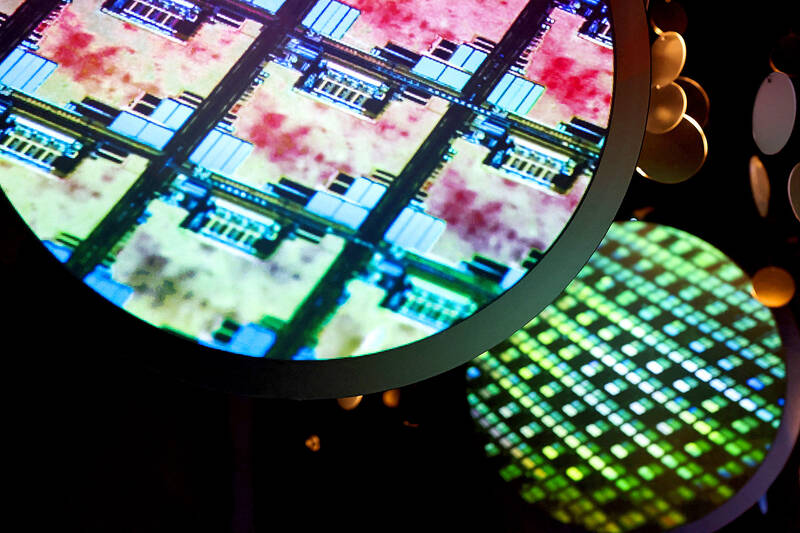
Photo: I-hwa Cheng, AFP
This can be a harder bar to meet, narrowing the scope of cases Taiwan can currently pursue. Taiwanese authorities made their first known detentions of alleged chip smugglers last month, on charges of falsifying documents.
But now, as part of ongoing trade talks with the US, Taipei officials are considering imposing much stronger AI chip controls that would restrict sales to all customers in China, not just specific companies on an export blacklist that includes the likes of Huawei Technologies Co (華為), said the people, who requested anonymity to discuss a sensitive matter. That would enable Taiwan to prosecute AI chip smuggling to China as a criminal violation for the first time.
If implemented, the controls would be among the most far-reaching measures so far from President William Lai’s (賴清德) administration to safeguard Taiwan’s technological and national security interests, as Taipei tests its own comfort levels with more assertive policies — and manages pressure from American officials on multiple fronts.
There remains a lot to be ironed out. Taiwan has agreed to directionally follow the US approach and is likely to curb China sales of AI chips with processing power above a certain threshold — much like Washington does, one of the people said.
But Taipei has not entirely decided on how far it will go to adopt American policies, according to the person, who added that there are still details to finalize before senior officials on both sides can review and sign off on the potential deal.
Any move to curb AI chip sales is likely to trigger a response from Chinese President Xi Jinping’s (習近平) government. Last year, when Taiwan blacklisted Huawei and Semiconductor Manufacturing International Corp (SMIC, 中芯), China’s top chipmaker, a Chinese Foreign Ministry spokesperson said that “the DPP authorities’ kneeling and ingratiating themselves with the US will only hurt and ruin Taiwan’s interests,” referring to Lai’s ruling Democratic Progressive Party.
New restrictions against China also may impact industry officials in Taiwan, which is home to the vast majority of the world’s AI chip manufacturing — and many of the companies that assemble Nvidia processors into servers, which are installed by the thousands in data centers to train and run AI models. Taiwan authorities haven’t accused any companies of wrongdoing.
It’s a delicate balance — and leaders in Taipei have already expressed discomfort restricting an industry that’s made Taiwan the world’s fifth-largest stock market.
Last year, Taiwan curbed AI chip exports to South Africa during a spat about the location of the island’s de facto embassy there — only to reverse course two days later. Minister of Foreign Affairs Lin Chia-lung (林佳龍) said shortly afterward that Taiwan doesn’t want to weaponize semiconductors, while noting that “if our counterparts harms our interests, we will need to respond.” Beijing criticized Taiwan’s actions at the time.
Last month, when Taiwan arrested suspected chip smugglers on document falsification charges, the press release mentioned neither the alleged pass-through location — Japan — nor authorities’ suspicion that the defendants had already successfully sent at least one batch of servers there before ultimately shipping them to Hong Kong.
At the same time, Lai pledged last year to address unspecified US concerns on export controls. Under his administration, Taiwanese authorities have adopted an increasingly hawkish position on protecting the island’s tech sector.
In April, a Taiwan court sentenced a Tokyo Electron Ltd engineer to a decade in jail for stealing proprietary data from Taiwan Semiconductor Manufacturing Co (TSMC, 台積電), the chipmaker to Nvidia and beating heart of the Taiwanese economy. In November last year, prosecutors raided the residences of a former TSMC executive suspected of leaking trade secrets to Intel Corp.
In June last year, after years of Washington telling Taipei that Chinese chip champion Huawei is aiding the mainland People’s Liberation Army, the Lai administration came to that determination itself. It blacklisted both Huawei and its production partner SMIC, barring Taiwanese firms from doing business with the Chinese entities without government permission.
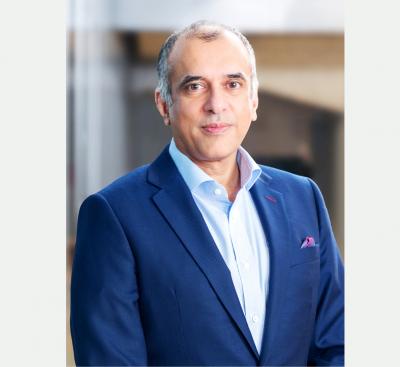
HSBC Holdings PLC is deepening its commitment to Taiwan as the economy emerges as one of the bank’s fastest-growing markets globally, driven by an artificial intelligence (AI) investment boom, expanding cross-border trade, and rising wealth creation. “The advantage that Taiwan has is a growth story linked to the semiconductor and broader AI industries, strong underlying corporate performance, and wealth creation,” said Surendra Rosha, HSBC’s co-chief executive for Asia and the Middle East, in an exclusive interview with the Taipei Times on June 2, during this year’s HSBC Taiwan Conference. That combination has helped HSBC cement its position as the most profitable international

Hon Hai Precision Industry Co (鴻海精密) yesterday said it would work with US chipmaker Intel Corp to jointly develop and deploy next-generation artificial intelligence (AI) infrastructure and intelligent computing platforms in a move to capture booming demand for AI computing systems. Hon Hai, also known as Foxconn Technology Group (富士康), said in a statement that the partnership would combine its global manufacturing scale, system integration expertise and AI data center deployment capabilities with Intel’s strengths in processor architecture, silicon technologies and software ecosystem. The companies said they plan to work on equipment used in AI data centers, including server racks powered by
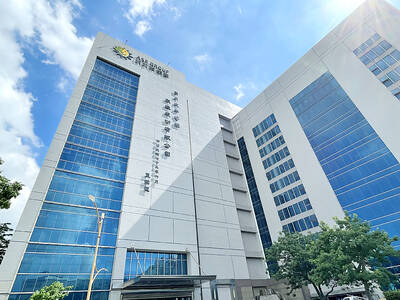
The average pay to employees by ASE Technology Holding Co (日月光投控) was the highest among the companies listed on the local main board last year, while contract chipmaker Taiwan Semiconductor Manufacturing Co (TSMC, 台積電) ranked seventh, the Taiwan Stock Exchange (TWSE) said on Monday. Data compiled by the exchange showed ASE Technology, the world’s largest chip packaging and testing services provider, paid its employees an average of NT$6.28 million (US$199,746) last year, up 40 percent from a year earlier. TSMC, the world’s largest contract chipmaker and the most profitable company in Taiwan, paid its employees NT$4.09 million on average, up
Taiwan Semiconductor Manufacturing Co (TSMC, 台積電) is now ranked ninth among the world’s 100 most valuable companies after its market capitalization more than doubled over the past year, PricewaterhouseCoopers (PwC) Taiwan said in a report last month. TSMC’s market capitalization surged 101 percent year-on-year to US$1.427 trillion as of March 31, the accounting and consulting firm’s 2026 Global Top 100 Companies by Market Capitalization report said. The gain catapulted the world’s largest contract chipmaker from 12th place to ninth in the rankings, and it was the fastest-growing among the global top 10, it said. TSMC was the only Taiwanese company among the top


 RSS
RSS