


The cars navigating Brazil’s crowded streets currently powered by sugarcane or corn-based ethanol could before long run on a cornucopia of fuels made from grains, tubers and other exotic feedstocks.
A new wave of biofuel innovation is sweeping the nation, with developers in unexpected corners of the country’s farm sector encroaching on decades of domination by sugarcane producers in ethanol markets, betting on everything from staple crops including wheat or barley to waste products such as discarded foodstuffs.
“The future of the energy transition is not a world of ‘ors,’ it’s a world of ‘ands,’” said Alexandre Breda, low carbon technology manager for Shell’s Brazil unit, which is researching the viability of agave as a biofuel.
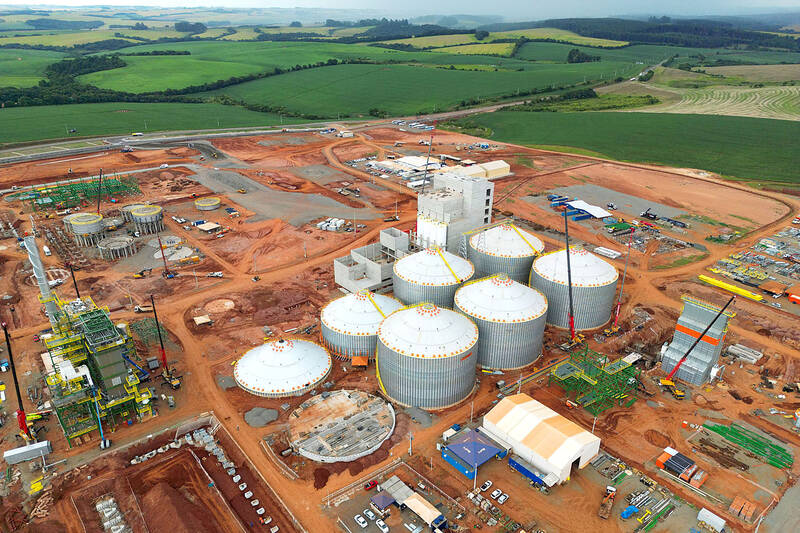
Photo: Reuters
“We need the sugarcane and the corn and the agave and the wheat and all the different biomass. One single feedstock will not bring the answer,” Breda said.
Brazil’s roughly US$20 billion ethanol industry is second only to the US, and it has long been known for its fleet of “flex-fuel” passenger cars that can run on a 30 percent mandatory blend of ethanol mixed into gasoline, or ethanol alone.
The country’s “third wave” of biofuel innovation from major industry producers and start-ups promises even more variety than the sugarcane and corn inputs that have dominated fuel production. The activity is bolstering production of crops such as sorghum, and could do the same for wheat and other products just as ethanol plants have done for Brazilian sugarcane and corn.
About 28.5 billion liters, or 71 percent, of Brazilian ethanol would come from sugarcane this year, while 11.2 billion liters will come from corn, the Energy Research Company said.
The country’s biggest biodiesel producer, Be8, is investing 1.7 billion reals (US$328.61 million) in a plant to produce wheat-based fuel. The biorefinery in Rio Grande do Sul is expected to launch in March next year, becoming Brazil’s first large-scale plant using wheat and other winter grains as biofuels, with a goal to produce 220 million liters per year.
“Rio Grande do Sul was left out of both the first wave of ethanol production, which was sugarcane, and the second wave, which was corn,” Be8 founder and CEO Erasmo Carlos Battistella said at the company’s biodiesel plant Passo Fundo. “Now a third wave is coming, driven by developing technologies that will use the raw materials we have here.”
In Brazil’s north and northeast, where corn ethanol has grown quickly, sugarcane ethanol producers are wary of new feedstocks and overproduction in general as they struggle with sugar prices near six-year lows.
“Now is not the time for expansion and investment in raw materials for ethanol,” said Renato Cunha, chief executive of regional cane-ethanol producers’ association NovaBio.
The disorderly growth of corn ethanol had hurt the market, Cunha said, adding: “You can’t just think you’re going to produce ethanol and sell it all.”
Other observers said the government’s rising biofuel mandate and broader adoption of 100 percent ethanol pumps serving Brazil’s flex-fuel passenger cars would support production.
The government is expected to boost the mandatory percentage of ethanol in gasoline to 32 percent this month, which would boost annual ethanol demand by about 1 billion liters, industry group UNICA said.
Bioenergia Brasil head Mario Ferreira Campos Filho predicted that 40 percent to 45 percent of Brazil’s ethanol production could come from grains in five to six years.
“Not even half of the municipalities in Rio Grande do Sul have ethanol-only pumps,” he said. “The possibility of having your own production allows you to open the market up.”
Be8 expects to meet 23 percent of gas station ethanol demand in the state once its plant is operational.
Biofuel demand is squeezing extra income out of previously unloved products in Brazil’s economy.
Using wheat and other winter cereals for ethanol might encourage more plantings for crops with historically limited commercial appeal, said Giovani Stefani Fae, head of technology transfer in state research agency Embrapa’s wheat unit.
Wheat ethanol, like corn, produces a key coproduct after fermentation and evaporation. The protein-rich leftovers, called dried distiller grains, are used for livestock feed, giving those producers an additional revenue stream that sugarcane ethanol cannot provide.
Be8’s plant is expected to produce 155,000 metric tonnes of dried distiller grains and 27,000 tonnes of wheat gluten. Producers in Sao Paulo state have discovered a similar process for turning excess sweet potatoes into ethanol and animal feed.
Currently, those potatoes “are effectively left in the field because it isn’t even viable to harvest them,” Agropecuaria Vista Alegre industrial manager David de Carlo Fernando Junior said, adding that the industry helps guarantee that whatever is planted would be harvested.
Major soybean processors such as Caramuru and CJ Selecta are squeezing more profit out of Brazil’s top crop by making ethanol from the soy molasses that results from processing soymeal.
Even food bound for the garbage heap is included. Environmental services company Ambipar is using food waste such as unwanted soft drink syrups and other discarded items to produce about 2.4 million liters of ethanol annually, although that is a fraction of the country’s 40 billion liter output.
In Brazil’s semi-arid north, Shell is investing 100 million reals to research whether agave, used to make tequila and mezcal, could be a feedstock.
If successful, the project could unlock new biofuel opportunities in similar regions worldwide, Breda said.
“If you can produce tequila, you can produce ethanol,” he said. “Everything ferments to something.”

Taiwanese firms have increased investment in the Philippines in recent years as Manila’s ties with Washington deepen and global supply chains continue to shift away from China, an expert at the Chung-Hua Institution for Economic Research (CIER, 中華經濟研究院) said yesterday. The Philippines had not been among Taiwanese investors’ top choices in Southeast Asia, CIER Taiwan ASEAN Studies Center director Kristy Hsu (徐遵慈) said at a seminar in Taipei. However, Taiwan’s investment in the country has grown significantly since the COVID-19 pandemic, reaching US $257 million last year, a high in recent years, she said. Although Taiwan’s total investment in the Philippines still lags

Intel Corp regards Taiwan Semiconductor Manufacturing Co (TSMC, 台積電) as a longstanding partner, as the US chipmaker would continue outsourcing production of advanced chips to TSMC, Intel chief executive officer Lip-Bu Tan (陳立武) said yesterday. “I don’t look at people as competitors. I look at the collaboration... Nvidia is also, you know, a good friend,” Tan told a news conference following his keynote speech at the Computex trade show in Taipei. “It’s a very trusted partnership for us... We are a big, top customer for them, and we’re going to continue doing that,” he said, referring to TSMC, the world’s largest foundry

Artificial intelligence (AI) agents would supplant smartphones as the center of people’s digital lives, fundamentally reshaping personal devices and driving a major computing upgrade cycle, Qualcomm Inc CEO Cristiano Amon said yesterday. In his keynote speech for this year’s Computex trade show in Taipei, Amon said that the rise of "agentic AI" — AI systems capable of reasoning, planning and carrying out tasks autonomously — would transform how people interact with technology across phones, PCs, vehicles and wearable devices. Describing the technology as the next major evolution in computing, Amon said that "2026 is the year of agents.” For decades, smartphones have sat

The average pay to employees by ASE Technology Holding Co (日月光投控) was the highest among the companies listed on the local main board last year, while contract chipmaker Taiwan Semiconductor Manufacturing Co (TSMC, 台積電) ranked seventh, the Taiwan Stock Exchange (TWSE) said on Monday. Data compiled by the exchange showed ASE Technology, the world’s largest chip packaging and testing services provider, paid its employees an average of NT$6.28 million (US$199,746) last year, up 40 percent from a year earlier. TSMC, the world’s largest contract chipmaker and the most profitable company in Taiwan, paid its employees NT$4.09 million on average, up


 RSS
RSS