


Taiwan yesterday launched a one-stop banking initiative aimed at making it easier for foreign residents to access financial services, designating six banks to provide streamlined account opening, credit card and international transfer services.
The National Development Council (NCD) certified six participating institutions: CTBC Commercial Bank Co (中國信託銀行), E.Sun Commercial Bank Ltd (玉山銀行), Taipei Fubon Commercial Bank Co (台北富邦銀行), Taishin International Bank Co (台新銀行), Mega International Commercial Bank Co (兆豐銀行) and First Commercial Bank Ltd (第一銀行). Together, they offer the services at 17 designated branches across Taiwan.
Speaking at a launch ceremony in Taipei, NDC Deputy Minister Jan Fang-guan (詹方冠) said foreign residents have long faced difficulties opening bank accounts, obtaining credit cards and making international wire transfers.
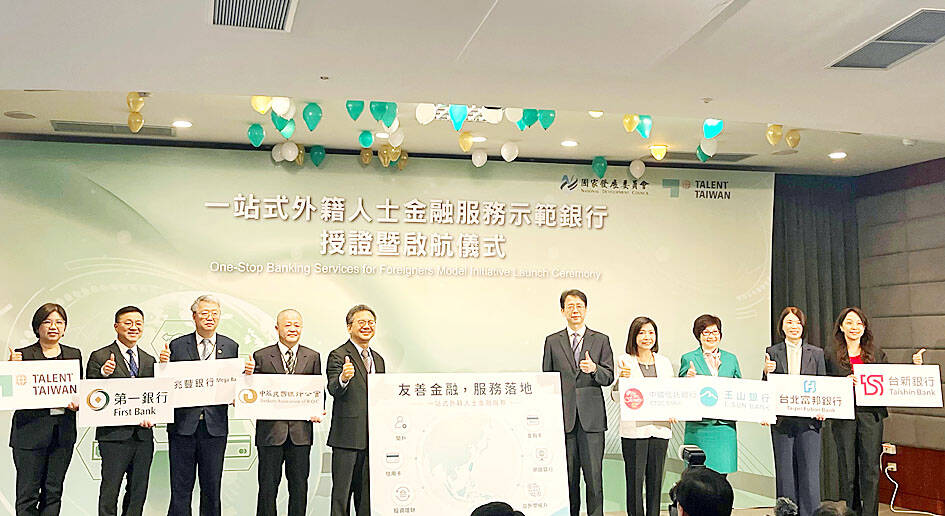
Photo: CNA
Many newcomers without a local credit history have been denied credit cards or asked to provide a Taiwanese guarantor, creating a significant barrier for international professionals settling in Taiwan, Jan said.
Taiwan has attracted a growing number of foreign professionals since the implementation of the Act for the Recruitment and Employment of Foreign Professionals (外國專業人才延攬及僱用法) in 2018, with more than 15,000 Employment Gold Cards issued to date, he said.
Under the initiative, participating banks would be encouraged to accept overseas proof of income and foreign tax records when reviewing credit card applications, and waive Taiwanese guarantor requirements.
Banks would also introduce online appointment systems that allow customers to submit documents and discuss their needs in advance, enabling services such as account opening, credit card applications, wire transfer setup and multi-currency banking to be completed in a single visit.
In addition, designated branches would establish dedicated counters and assign specialist staff to assist foreign clients.
Chang Chia-kuei (張嘉魁), deputy director-general of the Financial Supervisory Commission’s Banking Bureau, said that more than 2,000 branches offered bilingual services as of the end of last year, while more than 80 percent of ATMs supported multiple languages.
The council said that it would continue to refine the program and work with other government agencies on measures such as housing and education support to improve Taiwan’s attractiveness to international talent.

Cairo’s new monorail slices across the city skyline, running above the familiar chaos of blaring horns and aging buses’ exhaust fumes that mark rush hour below. The US$4.5 billion monorail, opened this month, is among Egypt’s most prominent new transport projects, part of a debt-funded infrastructure drive criticized for sapping state finances while bringing limited benefits to most of the country’s 109 million people. “It feels like you’re in a different country,” said Ramy Sayed, a restaurant manager, aboard a driverless Innovia 300 train. “No noise, no traffic, we’re not used to this.” The eastern line runs 56km from the bustling middle-class

Taiwanese firms have increased investment in the Philippines in recent years as Manila’s ties with Washington deepen and global supply chains continue to shift away from China, an expert at the Chung-Hua Institution for Economic Research (CIER, 中華經濟研究院) said yesterday. The Philippines had not been among Taiwanese investors’ top choices in Southeast Asia, CIER Taiwan ASEAN Studies Center director Kristy Hsu (徐遵慈) said at a seminar in Taipei. However, Taiwan’s investment in the country has grown significantly since the COVID-19 pandemic, reaching US $257 million last year, a high in recent years, she said. Although Taiwan’s total investment in the Philippines still lags

Intel Corp regards Taiwan Semiconductor Manufacturing Co (TSMC, 台積電) as a longstanding partner, as the US chipmaker would continue outsourcing production of advanced chips to TSMC, Intel chief executive officer Lip-Bu Tan (陳立武) said yesterday. “I don’t look at people as competitors. I look at the collaboration... Nvidia is also, you know, a good friend,” Tan told a news conference following his keynote speech at the Computex trade show in Taipei. “It’s a very trusted partnership for us... We are a big, top customer for them, and we’re going to continue doing that,” he said, referring to TSMC, the world’s largest foundry

Artificial intelligence (AI) agents would supplant smartphones as the center of people’s digital lives, fundamentally reshaping personal devices and driving a major computing upgrade cycle, Qualcomm Inc CEO Cristiano Amon said yesterday. In his keynote speech for this year’s Computex trade show in Taipei, Amon said that the rise of "agentic AI" — AI systems capable of reasoning, planning and carrying out tasks autonomously — would transform how people interact with technology across phones, PCs, vehicles and wearable devices. Describing the technology as the next major evolution in computing, Amon said that "2026 is the year of agents.” For decades, smartphones have sat


 RSS
RSS