


Taiwanese companies across the artificial intelligence (AI) supply chain yesterday said they expect robust growth ahead as AI investment accelerates, but warned that bottlenecks are emerging in areas ranging from memory chips and advanced packaging to semiconductor material analyses.
At a Taiwan Stock Exchange (TWSE) news conference held alongside Computex Taipei, executives from chip designer Alchip Technologies Ltd (世芯電子), memory maker Nanya Technology Corp (南亞科技), semiconductor analysis provider Msscorps Co (汎銓科技) and substrate supplier Unimicron Technology Corp (欣興電子) outlined the challenges facing the industry’s next stage of expansion.
One emerging issue is the analysis of semiconductor materials, which Msscorps said would become increasingly important as chipmakers move toward more advanced process technologies.
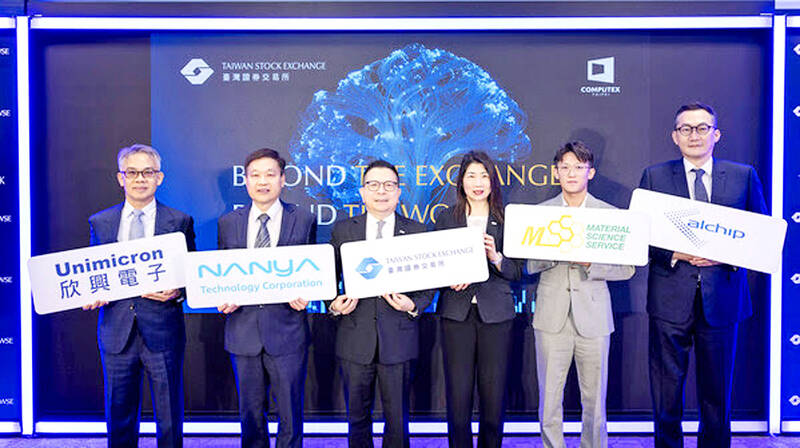
Photo courtesy of the Taiwan Stock Exchange
“Materials are becoming the next scaling bottleneck,” MSS USA Corp chief executive officer Gene Liu (柳淳浩) said, adding that the shift to angstrom-era processes and AI-driven computing is increasing demand for advanced characterization technologies, proprietary analytical expertise and expanded laboratory capacity.
MSS USA Corp is Msscorps’ US subsidiary.
The comments came as demand grows across Taiwan’s AI semiconductor ecosystem.
Nanya Technology senior vice president Joseph Wu (吳志祥) said that AI demand is expected to support annual industrywide DRAM bit growth of more than 20 percent in the next few years.
To capitalize on the trend, Nanya Technology plans to increase research and development spending by up to 70 percent and double its output in the next few years through capacity expansion, Wu said.
The company recently completed a US$2.5 billion private placement and has about US$5.8 billion in cash, which would support its expansion plans, he said.
At Unimicron Technology, financial division director Victor Hsu (徐興源) said that AI-related business is expected to account for more than 60 percent of the company’s revenue this year.
The rapid upgrade cycle for AI chips and servers is driving demand for advanced Ajinomoto Build-up Film substrates and packaging materials, while increasing pressure on manufacturers to expand capacity, Hsu said.
Meanwhile, AI-related projects account for about 80 percent of Alchip Technologies’ revenue, chief financial officer Daniel Wang (王德善) said.
That reflects growing demand from cloud service providers for custom AI chips designed to improve efficiency and reduce infrastructure costs, Wang said.
The slowdown in Moore’s Law has made advanced packaging technologies such as 2.5D packaging and chip-on-wafer-on-substrate increasingly important, creating new capacity constraints across the industry, he said.
Moore’s Law is based on observations that the number of transistors on a microchip doubles about every two years.
The news conference was part of TWSE’s efforts to showcase Taiwan’s semiconductor ecosystem during Computex.
The TWSE said it expects about 40 initial public offering applicants this year, about 40 percent of which would be AI-related.

Cairo’s new monorail slices across the city skyline, running above the familiar chaos of blaring horns and aging buses’ exhaust fumes that mark rush hour below. The US$4.5 billion monorail, opened this month, is among Egypt’s most prominent new transport projects, part of a debt-funded infrastructure drive criticized for sapping state finances while bringing limited benefits to most of the country’s 109 million people. “It feels like you’re in a different country,” said Ramy Sayed, a restaurant manager, aboard a driverless Innovia 300 train. “No noise, no traffic, we’re not used to this.” The eastern line runs 56km from the bustling middle-class

Taiwanese firms have increased investment in the Philippines in recent years as Manila’s ties with Washington deepen and global supply chains continue to shift away from China, an expert at the Chung-Hua Institution for Economic Research (CIER, 中華經濟研究院) said yesterday. The Philippines had not been among Taiwanese investors’ top choices in Southeast Asia, CIER Taiwan ASEAN Studies Center director Kristy Hsu (徐遵慈) said at a seminar in Taipei. However, Taiwan’s investment in the country has grown significantly since the COVID-19 pandemic, reaching US $257 million last year, a high in recent years, she said. Although Taiwan’s total investment in the Philippines still lags

Intel Corp regards Taiwan Semiconductor Manufacturing Co (TSMC, 台積電) as a longstanding partner, as the US chipmaker would continue outsourcing production of advanced chips to TSMC, Intel chief executive officer Lip-Bu Tan (陳立武) said yesterday. “I don’t look at people as competitors. I look at the collaboration... Nvidia is also, you know, a good friend,” Tan told a news conference following his keynote speech at the Computex trade show in Taipei. “It’s a very trusted partnership for us... We are a big, top customer for them, and we’re going to continue doing that,” he said, referring to TSMC, the world’s largest foundry

Artificial intelligence (AI) agents would supplant smartphones as the center of people’s digital lives, fundamentally reshaping personal devices and driving a major computing upgrade cycle, Qualcomm Inc CEO Cristiano Amon said yesterday. In his keynote speech for this year’s Computex trade show in Taipei, Amon said that the rise of "agentic AI" — AI systems capable of reasoning, planning and carrying out tasks autonomously — would transform how people interact with technology across phones, PCs, vehicles and wearable devices. Describing the technology as the next major evolution in computing, Amon said that "2026 is the year of agents.” For decades, smartphones have sat


 RSS
RSS