


The rise of agentic artificial intelligence (AI) is creating a new computing architecture that would reshape everything from personal computers to robots and data centers, Nvidia Corp CEO Jensen Huang (黃仁勳) said today.
Speaking to international media in Taipei a day after delivering the opening keynote at Nvidia GTC Taipei, Huang described AI agents — systems capable of reasoning, using tools and carrying out tasks autonomously — as a fundamental shift in how computing systems are designed and operated.
"There's a new computing pattern," Huang said. "The architecture of an application. And this application is called an agent."
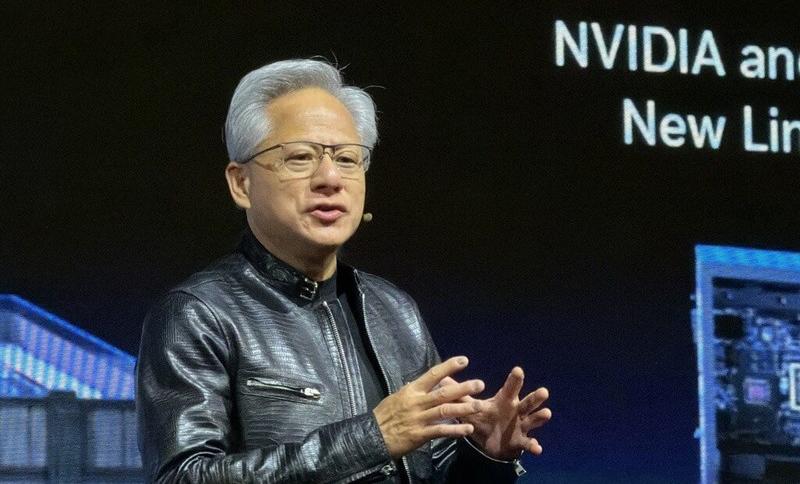
Photo: CNA
Unlike traditional software, which follows predefined instructions, agentic AI systems can understand context, reason through problems, access memory and use external tools to complete tasks, he said.
The same underlying architecture can be applied across a wide range of systems, from cloud-based AI services and enterprise servers to self-driving vehicles, humanoid robots and personal computers, Huang said.
"Every edge device will become autonomous. Every edge device will have agentic systems," he said, citing personal computers, self-driving vehicles and telecommunications infrastructure as examples.
The world's installed base of PCs, in particular, would need to be reinvented for the AI era, Huang said.
"This is really a new beginning, a new line of computers," Huang said. "It's an assistant, not a tool."
One example of that approach is RTX Spark, an AI-focused PC platform developed through collaborations involving Nvidia, MediaTek Inc (聯發科) and Microsoft Corp.
Introduced during yesterday’s keynote, the system is powered by Nvidia's N1X chip and is designed to run AI agents locally rather than relying entirely on cloud services.
Huang also suggested that many households could eventually run AI agents on dedicated local systems, much as they own home theater equipment today.
"Today, that computer sits there waiting for us to use it," he said. "In the future, when we leave it, it's doing stuff."
Those systems would likely operate as part of a broader distributed computing model spanning local devices, home servers and cloud infrastructure, Huang said.
Future AI applications would run across both cloud and edge environments instead of choosing one or the other, with tasks automatically distributed to wherever they can be performed most efficiently, he said.
Beyond PCs, Huang sees the same agentic architecture extending to autonomous vehicles, industrial machines and robots.
The next major wave of AI development would likely be "physical AI," in which reasoning-based AI systems operate in real-world environments and perform physical tasks, he said.
Self-driving vehicles and humanoid robots are among the most visible examples of physical AI.

Cairo’s new monorail slices across the city skyline, running above the familiar chaos of blaring horns and aging buses’ exhaust fumes that mark rush hour below. The US$4.5 billion monorail, opened this month, is among Egypt’s most prominent new transport projects, part of a debt-funded infrastructure drive criticized for sapping state finances while bringing limited benefits to most of the country’s 109 million people. “It feels like you’re in a different country,” said Ramy Sayed, a restaurant manager, aboard a driverless Innovia 300 train. “No noise, no traffic, we’re not used to this.” The eastern line runs 56km from the bustling middle-class
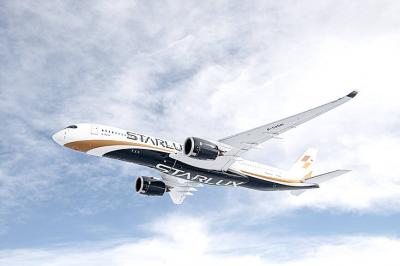
Starlux Airlines Co (星宇航空) today unveiled a long-haul network expansion plan at a shareholders’ meeting in Taipei, including direct flights to Barcelona, Spain, and Zurich, Switzerland, as well as a service connecting Taipei, Sydney and New Zealand. Starlux is to become the first Taiwanese carrier to offer non-stop services to the two European cities, while the inaugural oceanic route is expected to expand transit opportunities within the Australia-New Zealand market, Starlux said. Flight services to Chicago, Dallas, Washington and New York are under evaluation, the airline added. Prior to the shareholders’ meeting, the airline earlier this year announced that it would be
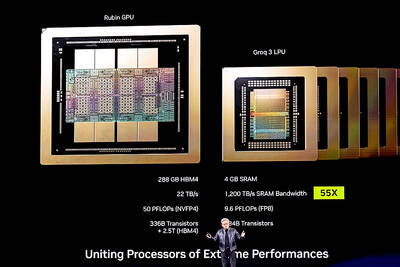
Taiwanese prosecutors suspect that three people successfully smuggled at least one shipment of Nvidia Corp artificial intelligence (AI) chips to China after first exporting them to Japan, people familiar with the matter said. The trio was detained last week by the Keelung District Prosecutors’ Office for allegedly falsifying documents related to exports of Super Micro Computer Inc servers containing advanced Nvidia chips, which the US has barred from sale to China without a license from Washington. The move marked Taiwan’s first public crackdown on AI chip diversion after years of pressure from the US to take a more active role in curtailing
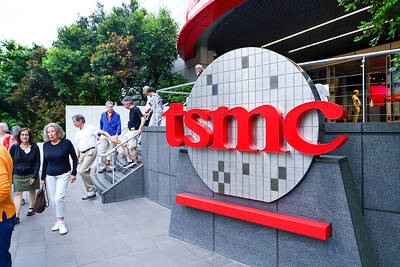
Taiwan Semiconductor Manufacturing Co (TSMC, 台積電) employee bonuses are likely to grow more than 30 percent this year, in line with the past few years as the company’s profits continue to set new records, an anonymous source cited TSMC chairman C.C. Wei (魏哲家) as saying yesterday. TSMC, the world’s largest contract chipmaker, is committed to taking care of its workers, the source said, citing Wei’s meeting with employees yesterday morning. Wei also expressed gratitude to employees for their contribution to the company’s improving bottom line, the source added. Since 2023, TSMC’s employee bonuses have grown at an annual rate of


 RSS
RSS