


Tomatoes, ubiquitous in everything from fast-food burgers to haute cuisine, are taking on a new role beyond the plate: A nagging reminder of rising costs.
Prices for the produce have soared more than any other food product over the past year to cement a spot as one of the consumer headaches du jour.
“The tomato has become a symbol of something much deeper,” says Isaac Bernal Carbajo, a New York City chef who lamented life’s “simplest pleasures” falling victim to price increases. “Something as basic as buying fresh vegetables is starting to become a serious financial decision for many families.”
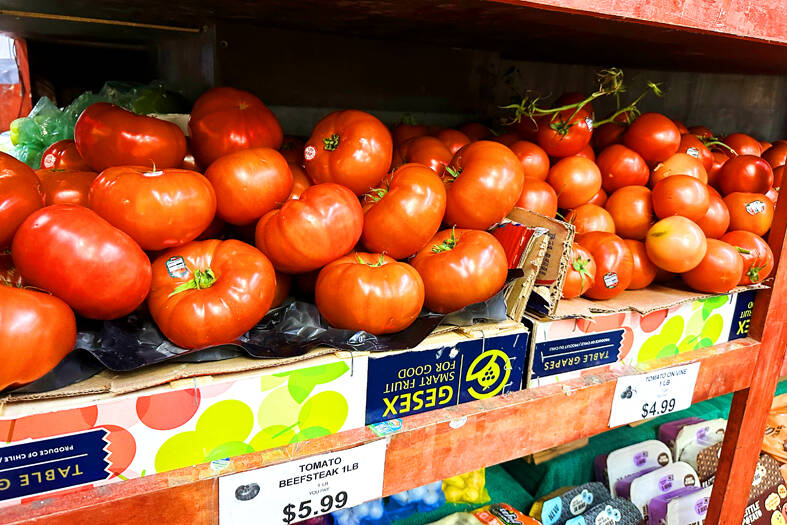
Photo: AP
Tomato prices are up about 40 percent over a year ago, according to the Consumer Price Index, dwarfing increases for other groceries, including coffee (up 18.5 percent), beef roasts (up 17.8 percent) and frozen fish and seafood (up 12 percent), among other products that have become symbols of America’s affordability squeeze.
A separate inflation gauge released Thursday showed that overall prices increased 3.8 percent in April from a year earlier, the highest reading in about three years.
Alongside crop yields, experts blame price increases for tomatoes, in part, on two pillars of US President Donald Trump’s second-term policies: the Iran war and tariffs. The war spiked gas prices and increased shipping costs. Meanwhile, the US withdrew from a deal allowing duty-free imports of tomatoes from Mexico, which grows most of the US supply.
Usha Haley, a Wichita State University economist, says it is “a perfect storm of trade policy, extreme weather and Mideast policy.”
American tomato farmers cheered the withdrawal from the tomato deal last July, saying it would help rebuild their withering industry. However, for consumers, it is been painful. Although the US withdrew from the Mexico tomato deal in July, it took time to see the impact in the produce aisle, with more imports in late winter and early spring.
When the tomatoes arrived, they were hit with a 17 percent tariff.
“Tariffs are undeniably a big driver of the price inflation,” says Brett Massimino, a Virginia Commonwealth University business professor. “Because the US relies on Mexico for the majority of its tomato supply, any changes in trade policy can have a large impact.”
US tariffs collected on tomatoes ballooned from just US$16,424 in 2024 to about US$4.6 million, according to federal data, a staggering 27,879 percent increase.
As the cost trickles down, outraged shoppers have pulled out their phones in the produce aisle, shooting videos lamenting costs they said quadrupled, with some people vowing to plant a garden to avoid prices of up to US$8 per pound. The impact has been most pronounced for businesses that rely on tomatoes as a key ingredient in their kitchens.
MarginEdge, which tracks prices for restaurants, says grape tomatoes have increased most — 65 percent in just a month — but prices have gone up across all types of tomatoes.
Phillip Coles, a supply chain management professor at Lehigh University, said prices should drop later in the year when domestically grown tomatoes are harvested. Higher prices, he says, would “induce farmers to increase planting to meet the demand, but this takes longer because of the lead time.”
Meanwhile, it is translating to a big hit for businesses such as Snarf’s Sandwiches, which puts a tomato in nearly every sandwich it makes.
Wayne Humphrey, chief operating officer of Snarf’s, which operates dozens of stores in Colorado, Missouri and Texas, said cases of tomatoes went from costing him US$27 to US$93 in the space of a year, piled on top of rising expenses for other ingredients including bread and beef, as well as increased labor costs.
“That single ingredient now costs us more than [US]$1.7 million in additional spend annually,” Humphrey said. “The math is getting harder to ignore.”
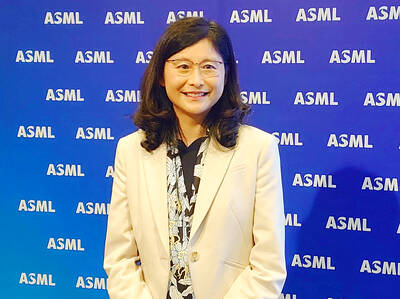
Netherlands-based semiconductor equipment supplier ASML Holding NV yesterday said that it is planning to hire an additional 1,000 people in Taiwan this year in response to growing demand from clients. ASML had previously planned to recruit 600 people this year, but that the plan has been adjusted upward, ASML vice president and ASML Taiwan general manager Grace Wang (汪佳慧) told reporters. ASML has a workforce of more than 4,500 in Taiwan, accounting for about 10 percent of its global total, Wang said. This year’s recruitment campaign would focus on adding people in the customer support, manufacturing and supply chain domains to assist ASML
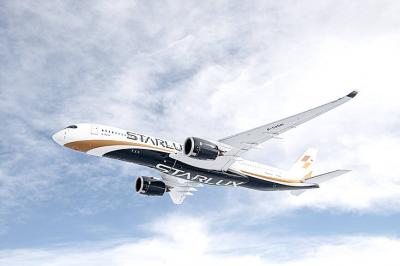
Starlux Airlines Co (星宇航空) today unveiled a long-haul network expansion plan at a shareholders’ meeting in Taipei, including direct flights to Barcelona, Spain, and Zurich, Switzerland, as well as a service connecting Taipei, Sydney and New Zealand. Starlux is to become the first Taiwanese carrier to offer non-stop services to the two European cities, while the inaugural oceanic route is expected to expand transit opportunities within the Australia-New Zealand market, Starlux said. Flight services to Chicago, Dallas, Washington and New York are under evaluation, the airline added. Prior to the shareholders’ meeting, the airline earlier this year announced that it would be
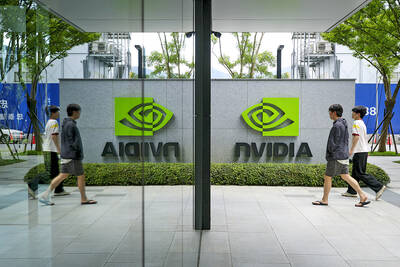
UNDER MICROSCOPE: Taiwan detained three people who allegedly conspired to buy servers in Taiwan and export them using fraudulent documentation, prosecutors said Nvidia Corp chief executive officer Jensen Huang (黃仁勳) on Saturday urged Super Micro Computer Inc to tighten up on compliance after Taiwan detained three people this week for allegedly making fraudulent declarations about artificial intelligence (AI) servers made by its US partner. The development marked the nation’s first crackdown on semiconductor smuggling, which grew after the US slapped restrictions on exports of high-end chips such as Nvidia AI accelerators to China. Nvidia is “rigorous” in explaining regulations to all of its partners, Huang told reporters after arriving in Taipei. “Ultimately Super Micro has to run their own company,” he said in response to
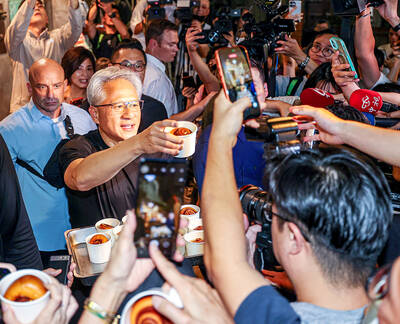
Nvidia Corp yesterday announced that CEO Jensen Huang (黃仁勳) would attend an employee meeting in Taipei tomorrow to celebrate the launch of the company’s Taiwan headquarters project. Huang would attend a gathering at the site of Nvidia’s planned headquarters in Beitou Shilin Technology Park (北投士林科技園區), the company said in a statement. After arriving in Taiwan on Saturday last week, Huang told reporters that he plans to meet with Quanta Computer Inc (廣達) chairman Barry Lam (林百里) and Taiwan Semiconductor Manufacturing Co (TSMC, 台積電) chairman C.C. Wei (魏哲家), and would attend the groundbreaking ceremony for Nvidia’s Taiwan headquarters tomorrow. Nvidia has not yet applied


 RSS
RSS