


Africa’s next generation of power projects is increasingly being anchored around solar and wind power and battery storage, as governments and investors shift away from coal and large hydropower dams in search of cheaper, faster and more reliable power.
The shift is visible in a US$1.5 billion energy agreement between China and Zambia announced early this month that includes three separate 300MW projects spanning solar, wind and coal-fired power.
While the inclusion of coal underscores the continent’s need for stable baseload electricity, African countries facing rising fuel import bills as a result of the Iran war, unreliable grids and growing industrial demand are increasingly turning to renewable energy projects that can be deployed faster and more cheaply than traditional plants.
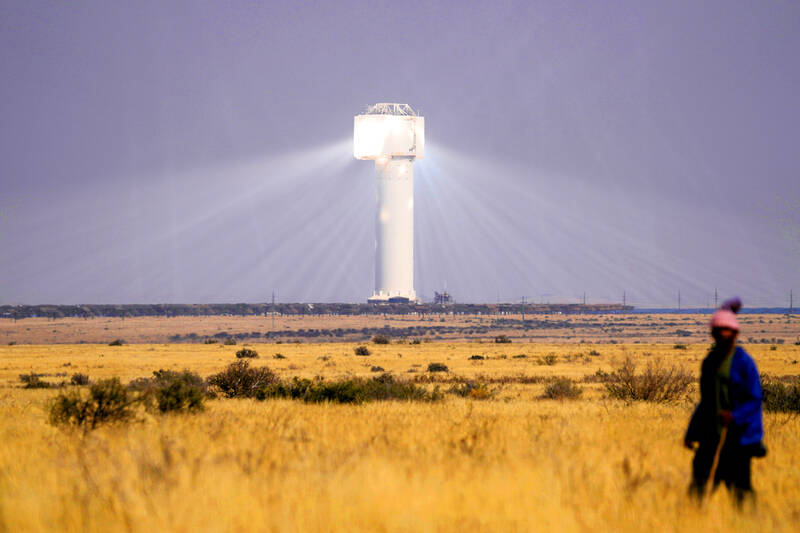
Photo: AP
SUN AND WIND
Of the 322 energy projects announced across Africa last year, 173 were solar projects, followed by hydropower with 46, wind with 34, gas with 22 and hybrid energy projects with 14, according to the energy research firm Electron Intelligence.
“Africa is not on the periphery of the global energy transition, it is sitting at its center,” said Mugwe Manga, climate finance lead at Financial Sector Deepening Kenya. “The continent holds the world’s best renewable resources, and the economics have now decisively turned in favor of clean energy.”
According to Olamide Niyi-Afuye, CEO of the Africa Minigrid Developers Association, the continent is undergoing a strategic shift in how energy infrastructure is being developed, with an emphasis on systems that can be deployed faster and expanded gradually with flexible financing.
Niyi-Afuye pointed to the growing role of solar within mini-grid systems.
According to the International Renewable Energy Agency, Africa added a record 11.3GW of renewable energy capacity in last year, three times as much as year before. South Africa, Egypt and Ethiopia accounted for much of the growth.
LOWER COSTS
Increasingly affordable technology is helping. Utility-scale solar power costs have dropped by nearly 90 percent globally since 2010, while onshore wind costs have fallen around 70 percent, making renewables the cheapest source of new-build electricity generation in many African markets.
“Renewable energy is now unequivocally the fastest, cheapest, and most bankable way to connect people, companies and economies to the megawatts they need to grow,” said Matt Tilleard, CEO of CrossBoundary Energy, which invests in renewable energy in Africa.
Much of the growth is through distributed solar and battery systems installed directly in mines, factories, telecom towers and homes.
“Most official statistics still measure the energy transition the old way, by counting megawatts connected to national grids,” he said. “But solar and batteries don’t need central utilities.”
Data from the Africa Solar Industry Association shows 23.4GW of operational solar projects had been tracked across Africa by the end of last year. However, Chinese export figures indicate 58.1GW of solar panels have been shipped to African countries since 2017, indicating solar adoption might be growing far faster than official figures account for.
FASTER RETURNS
Investors increasingly favor renewable projects because they can generate returns faster and with less exposure to global fuel price shocks.
“Solar and wind projects are especially attractive at this moment because they combine strong commercial fundamentals with relatively lower investment risk,” Niyi-Afuye said.
At the Kamoa-Kakula copper complex in the Democratic Republic of Congo, CrossBoundary Energy is developing a 233MW solar and battery project to supply one of Africa’s largest copper mines. Tilleard said the project moved from signing to more than 80 percent completion within a year. Coal-fired plants can take up to 12 years to complete, while major hydropower projects often require a decade or more.
“Investors deploy capital and see assets generating revenue within 18 months,” Tilleard said.
POLICY CHANGES
The continent’s renewable push is being accelerated by policy changes. Ethiopia was the first country to ban imports of internal combustion engine vehicles, spurring faster adoption of electric vehicles. In South Africa, relaxing limits on private power generation has opened the door to a surge in renewable energy projects.
Still, major obstacles remain. Many African utilities are in financial trouble. So lenders are wary of long-term power purchase agreements. Financing costs for renewable projects in Africa are up to triple those in advanced economies because of perceived country risk, according to the International Energy Agency.
Development finance institutions, including the African Development Bank and the International Finance Corporation, are helping bridge the gap with concessional loans, guarantees and risk-sharing structures.
“What remains is not a question of technology or cost,” Manga said. “It is a question of finance, political will and preparing bankable projects that will drive demand for power on the continent.”

Netherlands-based semiconductor equipment supplier ASML Holding NV yesterday said that it is planning to hire an additional 1,000 people in Taiwan this year in response to growing demand from clients. ASML had previously planned to recruit 600 people this year, but that the plan has been adjusted upward, ASML vice president and ASML Taiwan general manager Grace Wang (汪佳慧) told reporters. ASML has a workforce of more than 4,500 in Taiwan, accounting for about 10 percent of its global total, Wang said. This year’s recruitment campaign would focus on adding people in the customer support, manufacturing and supply chain domains to assist ASML

Starlux Airlines Co (星宇航空) today unveiled a long-haul network expansion plan at a shareholders’ meeting in Taipei, including direct flights to Barcelona, Spain, and Zurich, Switzerland, as well as a service connecting Taipei, Sydney and New Zealand. Starlux is to become the first Taiwanese carrier to offer non-stop services to the two European cities, while the inaugural oceanic route is expected to expand transit opportunities within the Australia-New Zealand market, Starlux said. Flight services to Chicago, Dallas, Washington and New York are under evaluation, the airline added. Prior to the shareholders’ meeting, the airline earlier this year announced that it would be

UNDER MICROSCOPE: Taiwan detained three people who allegedly conspired to buy servers in Taiwan and export them using fraudulent documentation, prosecutors said Nvidia Corp chief executive officer Jensen Huang (黃仁勳) on Saturday urged Super Micro Computer Inc to tighten up on compliance after Taiwan detained three people this week for allegedly making fraudulent declarations about artificial intelligence (AI) servers made by its US partner. The development marked the nation’s first crackdown on semiconductor smuggling, which grew after the US slapped restrictions on exports of high-end chips such as Nvidia AI accelerators to China. Nvidia is “rigorous” in explaining regulations to all of its partners, Huang told reporters after arriving in Taipei. “Ultimately Super Micro has to run their own company,” he said in response to

Nvidia Corp yesterday announced that CEO Jensen Huang (黃仁勳) would attend an employee meeting in Taipei tomorrow to celebrate the launch of the company’s Taiwan headquarters project. Huang would attend a gathering at the site of Nvidia’s planned headquarters in Beitou Shilin Technology Park (北投士林科技園區), the company said in a statement. After arriving in Taiwan on Saturday last week, Huang told reporters that he plans to meet with Quanta Computer Inc (廣達) chairman Barry Lam (林百里) and Taiwan Semiconductor Manufacturing Co (TSMC, 台積電) chairman C.C. Wei (魏哲家), and would attend the groundbreaking ceremony for Nvidia’s Taiwan headquarters tomorrow. Nvidia has not yet applied


 RSS
RSS