


Taiwan’s government should reassess its electricity demand projections, as power supply constraints have already affected Wistron Corp’s (緯創) plans to expand its artificial intelligence (AI) computing infrastructure, Wistron chairman Simon Lin (林憲銘) said yesterday.
Speaking to reporters after Wistron’s annual shareholders’ meeting, Lin said the company had originally planned to build its second computing center near its existing facility in Taipei’s Neihu District (內湖), but changed course after being informed of insufficient power supply.
Instead, the company decided to establish the facility at National Yang Ming Chiao Tung University in Tainan, he said.
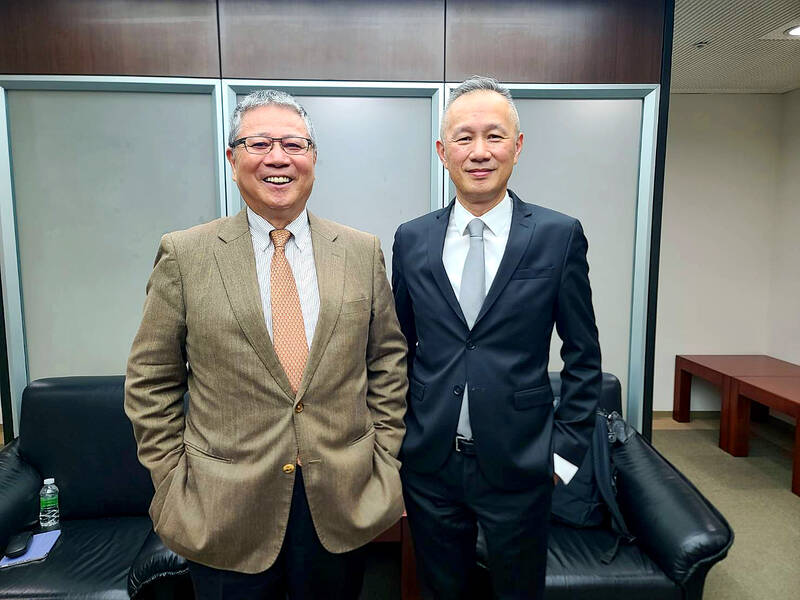
Photo: CNA
“Taiwan underestimated the electricity needed to support AI development at this early stage,” Lin said, adding that the government should rethink and adjust future electricity demand projections to accommodate rapidly growing power consumption from AI computing.
Concerns about Taiwan’s power supply have increasingly surfaced as demand from AI-related industries grows.
During an employee gathering in Taipei on Wednesday, Nvidia chief executive officer Jensen Huang (黃仁勳) used the occasion to remind Taipei Mayor Chiang Wan-an (蔣萬安) that Taiwan would need more power to support AI development.
“Mayor, we could use more energy in Taiwan,” Huang said. “Human labor needs rice, but our AI labor needs electricity.”
Wistron, one of Taiwan’s leading AI server manufacturers, is a key supplier in Nvidia’s AI hardware ecosystem.
According to Lin, the AI industry still has more than 10 times its current growth potential, and he rejected concerns that the sector was entering bubble territory.
Citing Huang’s outlook for the industry, he said companies that fail to adopt AI would face growing challenges as the technology becomes increasingly embedded in business operations.
AI applications have already begun gaining traction in Taiwan, particularly in the financial sector, where firms are using the technology for customer service and credit reviews, Lin said.
As AI adoption expands, demand for computing hardware such as graphics processing units (GPUs), central processing units (CPUs), tensor processing units (TPUs) and memory would continue to grow, Lin said.
Lin also rejected suggestions that Taiwan’s recent stock market gains reflected overheating, saying many large-cap technology stocks still trade at relatively modest valuations.
Despite the recent rally, most heavyweight stocks are not trading at particularly high price-to-earnings ratios, he said, noting that Taiwan Semiconductor Manufacturing Co (TSMC, 台積電) had previously traded at a price-to-earnings ratio of less than 20.
Taiwan’s industries remain fundamentally strong and play an indispensable role in global supply chains, Lin said, adding that the market’s performance reflects growing recognition of the country’s economic strength rather than speculative excess.

Netherlands-based semiconductor equipment supplier ASML Holding NV yesterday said that it is planning to hire an additional 1,000 people in Taiwan this year in response to growing demand from clients. ASML had previously planned to recruit 600 people this year, but that the plan has been adjusted upward, ASML vice president and ASML Taiwan general manager Grace Wang (汪佳慧) told reporters. ASML has a workforce of more than 4,500 in Taiwan, accounting for about 10 percent of its global total, Wang said. This year’s recruitment campaign would focus on adding people in the customer support, manufacturing and supply chain domains to assist ASML

UNDER MICROSCOPE: Taiwan detained three people who allegedly conspired to buy servers in Taiwan and export them using fraudulent documentation, prosecutors said Nvidia Corp chief executive officer Jensen Huang (黃仁勳) on Saturday urged Super Micro Computer Inc to tighten up on compliance after Taiwan detained three people this week for allegedly making fraudulent declarations about artificial intelligence (AI) servers made by its US partner. The development marked the nation’s first crackdown on semiconductor smuggling, which grew after the US slapped restrictions on exports of high-end chips such as Nvidia AI accelerators to China. Nvidia is “rigorous” in explaining regulations to all of its partners, Huang told reporters after arriving in Taipei. “Ultimately Super Micro has to run their own company,” he said in response to

Nvidia Corp yesterday announced that CEO Jensen Huang (黃仁勳) would attend an employee meeting in Taipei tomorrow to celebrate the launch of the company’s Taiwan headquarters project. Huang would attend a gathering at the site of Nvidia’s planned headquarters in Beitou Shilin Technology Park (北投士林科技園區), the company said in a statement. After arriving in Taiwan on Saturday last week, Huang told reporters that he plans to meet with Quanta Computer Inc (廣達) chairman Barry Lam (林百里) and Taiwan Semiconductor Manufacturing Co (TSMC, 台積電) chairman C.C. Wei (魏哲家), and would attend the groundbreaking ceremony for Nvidia’s Taiwan headquarters tomorrow. Nvidia has not yet applied

Huawei Technologies Co (華為) said it has come up with a new pathway to shorten its gap with industry leader Taiwan Semiconductor Manufacturing Co (TSMC, 台積電), potentially achieving a breakthrough in making advanced semiconductors without cutting-edge equipment. Right now there is about a five-year gap between what TSMC is capable of and what Huawei, together with its manufacturing partner Semiconductor Manufacturing International Corp (中芯), can produce. Huawei is to start making 1.4-nanometer chips by 2031 with its own “LogicFolding” technology, Huawei semiconductor chief He Tingbo (何庭波) said in a rare public appearance during a chip conference yesterday, while TSMC has


 RSS
RSS