


MediaTek Inc (聯發科) yesterday revealed that a data center client opted for Intel Corp’s advanced packaging technology to build an in-house customized artificial intelligence (AI) accelerator, marking the first adoption of the technology in MediaTek’s customized chip design portfolio.
Mediatek did not disclose the customer’s name, but analysts said the company is designing a tensor process unit — an AI application-specific IC (ASIC) — for Google.
The cloud services provider prefers Intel’s embedded multi-die interconnect bridge technology (EMIB) over the chip-on-wafer-on-substrate (CoWoS) technology offered by Taiwan Semiconductor Manufacturing Co (TSMC, 台積電), given substantial cost savings and capacity availability, analysts said.
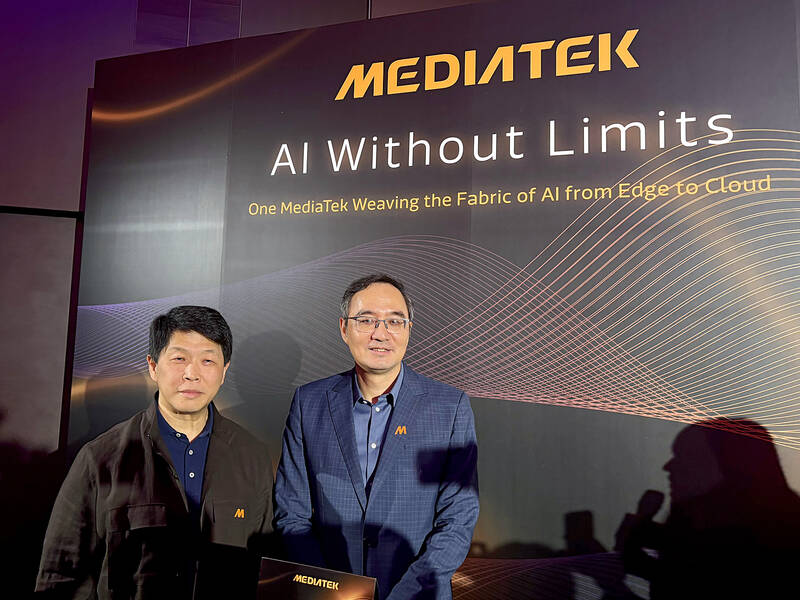
Photo: Lisa Wang, Taipei Times
“Since this is a customized chip, there are a variety of choices in terms of vendors. The customer might have taken all factors into consideration [before making the decision],” MediaTek co chief operational officer David Ku (顧大為) told reporters in Taipei yesterday.
However, the majority of chips still utilize TSMC’s CoWoS technology, Ku said.
The ASIC business is emerging as a new growth engine for the company, the world’s biggest mobile chip supplier, as the company expects it to contribute US$2 billion in revenue this year and multiple billion US dollars next year, attributable to acceleration in AI accelerator demand.
TSMC is a long-standing close foundry partner of MediaTek, MediaTek vice chairman and chief executive officer Rick Tsai (蔡力行) said in response to a shareholder’s question about the possibility of utilizing Intel’s foundry services in the US.
MediaTek has been among the “first-wave” adopters of TSMC’s most advanced processing node technology from 12-nanometer to 2-nanometer and 1.4-nanometer technology, Tsai said, adding that the company also adopted TSMC’s advanced packaging technologies including next-generation copackaged optics technology.
However, as a sizeable semiconductor company, MediaTek would naturally pay close attention to other companies with chip manufacturing capacities and capabilities in the long term to explore potential corporations if required, Tsai said.
TSMC is the most important long-term partner of MediaTek, he added.
MediaTek’s foundry strategy was spotlighted by the media after it was reported that Samsung Electronics Co chairman Jay Y. Lee sought to land a foundry deal with MediaTek during a recent visit.
MediaTek’s new flagship smartphone chip would be made on TSMC’s 2-nanometer technology and is scheduled to hit the market in the second half of this year, Tsai told investors. MediaTek also has multiple test chips this year utilizing TSMC’s newest 1.4-nanometer technology, corporate vice president of MediaTek’s data center and compute business group Vince Hu said yesterday.
To cope with customers’ requests to access local chip supplies, MediaTek said it also plans to utilize TSMC’s US chip capacity including 4-nanometer chips from TSMC’s first fab in Arizona next year and 3-nanometer chips from the second fab in 2028.
Separately, MediaTek chairman Tsai Ming-kai (蔡明介) said hiking prices to reflect inflationary costs would become the new norm as explosive AI and computing power demand has led to rapid technology upgrades and caused short supply of key components such as memory chips.
MediaTek would consider raising prices to pass on rising costs to customers, Tsai said.
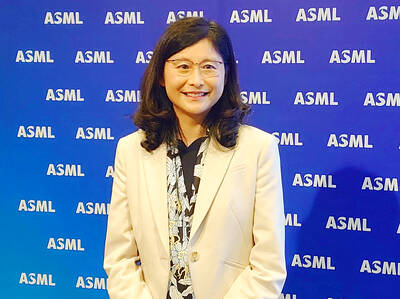
Netherlands-based semiconductor equipment supplier ASML Holding NV yesterday said that it is planning to hire an additional 1,000 people in Taiwan this year in response to growing demand from clients. ASML had previously planned to recruit 600 people this year, but that the plan has been adjusted upward, ASML vice president and ASML Taiwan general manager Grace Wang (汪佳慧) told reporters. ASML has a workforce of more than 4,500 in Taiwan, accounting for about 10 percent of its global total, Wang said. This year’s recruitment campaign would focus on adding people in the customer support, manufacturing and supply chain domains to assist ASML
UNDER MICROSCOPE: Taiwan detained three people who allegedly conspired to buy servers in Taiwan and export them using fraudulent documentation, prosecutors said Nvidia Corp chief executive officer Jensen Huang (黃仁勳) on Saturday urged Super Micro Computer Inc to tighten up on compliance after Taiwan detained three people this week for allegedly making fraudulent declarations about artificial intelligence (AI) servers made by its US partner. The development marked the nation’s first crackdown on semiconductor smuggling, which grew after the US slapped restrictions on exports of high-end chips such as Nvidia AI accelerators to China. Nvidia is “rigorous” in explaining regulations to all of its partners, Huang told reporters after arriving in Taipei. “Ultimately Super Micro has to run their own company,” he said in response to

Nvidia Corp yesterday announced that CEO Jensen Huang (黃仁勳) would attend an employee meeting in Taipei tomorrow to celebrate the launch of the company’s Taiwan headquarters project. Huang would attend a gathering at the site of Nvidia’s planned headquarters in Beitou Shilin Technology Park (北投士林科技園區), the company said in a statement. After arriving in Taiwan on Saturday last week, Huang told reporters that he plans to meet with Quanta Computer Inc (廣達) chairman Barry Lam (林百里) and Taiwan Semiconductor Manufacturing Co (TSMC, 台積電) chairman C.C. Wei (魏哲家), and would attend the groundbreaking ceremony for Nvidia’s Taiwan headquarters tomorrow. Nvidia has not yet applied
Huawei Technologies Co (華為) said it has come up with a new pathway to shorten its gap with industry leader Taiwan Semiconductor Manufacturing Co (TSMC, 台積電), potentially achieving a breakthrough in making advanced semiconductors without cutting-edge equipment. Right now there is about a five-year gap between what TSMC is capable of and what Huawei, together with its manufacturing partner Semiconductor Manufacturing International Corp (中芯), can produce. Huawei is to start making 1.4-nanometer chips by 2031 with its own “LogicFolding” technology, Huawei semiconductor chief He Tingbo (何庭波) said in a rare public appearance during a chip conference yesterday, while TSMC has


 RSS
RSS