


Taiwan’s economy remained firmly in expansion mode last month, as robust demand for artificial intelligence (AI) applications continued to drive exports, investment and domestic consumption, the National Development Council (NDC) said yesterday.
The council’s business climate monitoring indicator held steady at 39 points, maintaining the “red light” signal for a fifth consecutive month, suggesting sustained economic strength and above-trend growth.
The reading underscores Taiwan’s deep integration into the global AI buildout, driven by heavy investment from global cloud service providers and semiconductor customers seeking advanced computing capacity, NDC Department of Economic Development Director Chen Mei-chu (陳美菊) said.
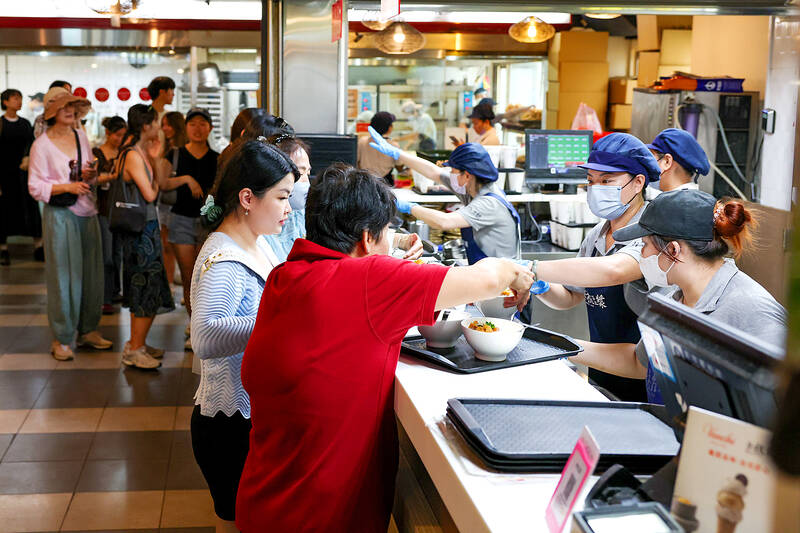
Photo: CNA
Easing Middle East geopolitical tensions also helped stabilize sentiment, she said.
Taiwan has emerged as one of the biggest beneficiaries of the AI boom, with local companies supplying advanced chips, servers and related hardware to major US technology companies.
The rapid shift in AI — from generative models to agentic AI and robotics — has further broadened demand across the supply chain, she said.
Revenue and capital expenditure among the world’s largest cloud service providers rose in the first quarter, reinforcing expectations that AI-driven investment would remain a key growth engine, Chen added.
The trend is feeding through to manufacturing output, corporate investment and equity markets, while also spilling over into domestic consumption.
Construction activity continued to expand, as technology firms raised production capacity, while upbeat earnings guidance from the tech sector helped lift local stock prices, Chen said.
The leading index, which signals economic conditions over the next six months, rose 0.58 percent month-on-month to 103.63, the council said.
Six of its seven components posted gains, including floor area of construction starts, the stock price index, imports of semiconductor equipment and employment in the industrial and services sectors, it said
The coincident index, which tracks current conditions, climbed 0.84 percent to 107.57, with improvements seen in wholesale, retail and restaurant sales, electricity consumption, industrial production, manufacturing sales, and imports of machinery and electrical equipment, it said.
Domestic demand remained resilient, Chen said.
While AI-related activity continued to support wholesale trade, while record-high equity markets and holiday spending boosted retail and restaurant sales, she said.
Geopolitical tensions in the Middle East remain a risk, but the economic impact has so far been limited, Chen said.
Unlike the Russia-Ukraine war, global oil supply has stayed relatively stable due to higher US output and weaker demand from China, helping cap energy prices.
Taiwan’s export structure has also shifted toward higher-value advanced manufacturing, cushioning the economy from external shocks and reinforcing its role in the global AI supply chain, Chen said.
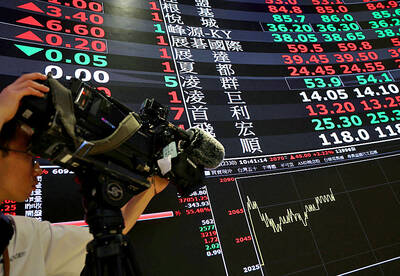
After several years flying high as Asia’s best Nvidia Corp proxy, Taiwan Semiconductor Manufacturing Co (TSMC, 台積電) is increasingly vying with other artificial intelligence (AI) stocks for investor attention. Stock traders are chasing a wider array of beneficiaries as mainstream usage of AI creates demand for hardware beyond the most-advanced chips TSMC makes for Nvidia. Subthemes from the deepening memory crunch to advances in robotics are also luring bids. At the same time, investment caps on single stocks are pushing funds to diversify, while retail investors long familiar with TSMC through its US depositary receipts are being offered a broader set of
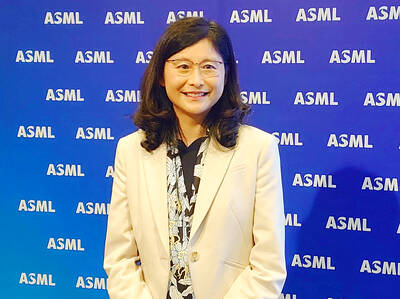
Netherlands-based semiconductor equipment supplier ASML Holding NV yesterday said that it is planning to hire an additional 1,000 people in Taiwan this year in response to growing demand from clients. ASML had previously planned to recruit 600 people this year, but that the plan has been adjusted upward, ASML vice president and ASML Taiwan general manager Grace Wang (汪佳慧) told reporters. ASML has a workforce of more than 4,500 in Taiwan, accounting for about 10 percent of its global total, Wang said. This year’s recruitment campaign would focus on adding people in the customer support, manufacturing and supply chain domains to assist ASML
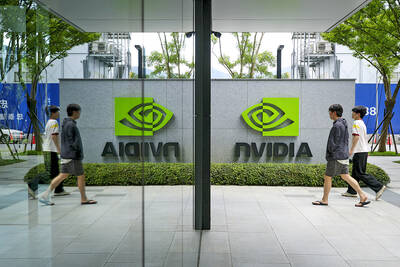
UNDER MICROSCOPE: Taiwan detained three people who allegedly conspired to buy servers in Taiwan and export them using fraudulent documentation, prosecutors said Nvidia Corp chief executive officer Jensen Huang (黃仁勳) on Saturday urged Super Micro Computer Inc to tighten up on compliance after Taiwan detained three people this week for allegedly making fraudulent declarations about artificial intelligence (AI) servers made by its US partner. The development marked the nation’s first crackdown on semiconductor smuggling, which grew after the US slapped restrictions on exports of high-end chips such as Nvidia AI accelerators to China. Nvidia is “rigorous” in explaining regulations to all of its partners, Huang told reporters after arriving in Taipei. “Ultimately Super Micro has to run their own company,” he said in response to

Nvidia Corp yesterday announced that CEO Jensen Huang (黃仁勳) would attend an employee meeting in Taipei tomorrow to celebrate the launch of the company’s Taiwan headquarters project. Huang would attend a gathering at the site of Nvidia’s planned headquarters in Beitou Shilin Technology Park (北投士林科技園區), the company said in a statement. After arriving in Taiwan on Saturday last week, Huang told reporters that he plans to meet with Quanta Computer Inc (廣達) chairman Barry Lam (林百里) and Taiwan Semiconductor Manufacturing Co (TSMC, 台積電) chairman C.C. Wei (魏哲家), and would attend the groundbreaking ceremony for Nvidia’s Taiwan headquarters tomorrow. Nvidia has not yet applied


 RSS
RSS