


US export controls on semiconductor chips were not a major topic of discussions with Chinese officials in Beijing, US Trade Representative Jamieson Greer said in an interview yesterday.
The comments suggest a breakthrough on selling Nvidia’s advanced H200 chips to China remains far away, despite Nvidia Corp chief executive officer Jensen Huang’s (黃仁勳) last-minute invitation to travel with US President Donald Trump to Beijing this week alongside other CEOs of tope US tech companies.
“This was not a major topic of discussion at the bilateral meeting. We did not talk about chip export controls at the meeting,” Greer said, adding that “15 to 17” US chief executive officers at Thursday’s meeting between Trump and Chinese President Xi Jinping (習近平) spoke about their companies’ issues.
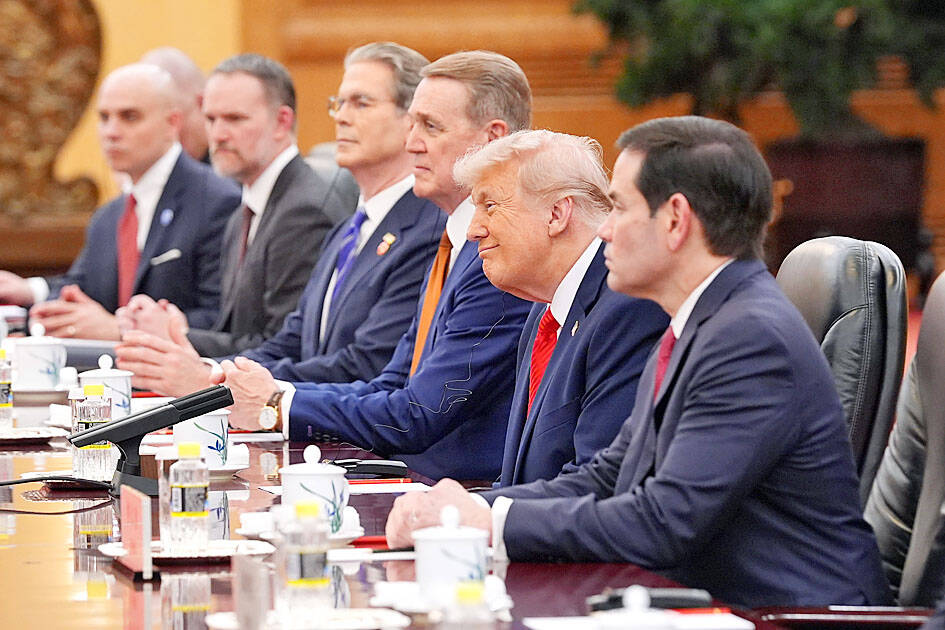
Photo: AP
The US had cleared about 10 Chinese companies to buy H200s, including Alibaba (阿里巴巴), Tencent (騰訊) and Bytedance (字節跳動), but not a single delivery has been made so far. The Trump administration approved H200 exports to China in December last year and added further conditions in January.
Allowing the H200 imports would be a “sovereign decision” for China, Greer said.
“They’re fluid, right? They change over time. It depends on what threats you see, what’s commercially available worldwide, what the Chinese can already do,” he said.
“And so you want to make sure you strike a balance between national security, protecting high tech, but also making sure that we’re benefiting from overseas markets. And so those are the kinds of things that went into the H200 decision as to whether the Chinese are going to buy or not,” he added.
While Chinese artificial intelligence (AI) firms such as DeepSeek (深度求索) increasingly tout their reliance on domestic chips, US chip curbs continue to choke Beijing’s push for self-sufficiency just when domestic fabs are struggling to scale up output.
Computing power shortages have forced many Chinese AI models to ration user access in the past few months, but Chinese policymakers are worried about deepening dependencies on US chips, which they view as a supply chain vulnerability.
US lawmakers and former officials have argued that selling advanced AI chips to China would allow them to catch up with the US in frontier AI and advance China’s military ambitions.
“They’re making their own determinations. They’re very committed to domestic production,” Greer said.
“They often see US high tech sometimes as a threat to them because if we’re ahead of the game like we are on AI chips, sometimes they feel that can stop their own growth,” he added.


Taiwanese firms have increased investment in the Philippines in recent years as Manila’s ties with Washington deepen and global supply chains continue to shift away from China, an expert at the Chung-Hua Institution for Economic Research (CIER, 中華經濟研究院) said yesterday. The Philippines had not been among Taiwanese investors’ top choices in Southeast Asia, CIER Taiwan ASEAN Studies Center director Kristy Hsu (徐遵慈) said at a seminar in Taipei. However, Taiwan’s investment in the country has grown significantly since the COVID-19 pandemic, reaching US $257 million last year, a high in recent years, she said. Although Taiwan’s total investment in the Philippines still lags
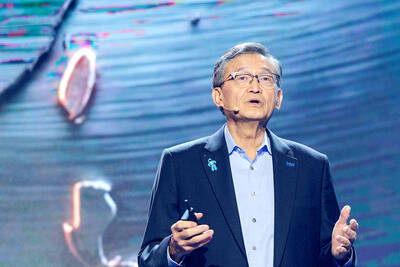
Intel Corp regards Taiwan Semiconductor Manufacturing Co (TSMC, 台積電) as a longstanding partner, as the US chipmaker would continue outsourcing production of advanced chips to TSMC, Intel chief executive officer Lip-Bu Tan (陳立武) said yesterday. “I don’t look at people as competitors. I look at the collaboration... Nvidia is also, you know, a good friend,” Tan told a news conference following his keynote speech at the Computex trade show in Taipei. “It’s a very trusted partnership for us... We are a big, top customer for them, and we’re going to continue doing that,” he said, referring to TSMC, the world’s largest foundry

Hon Hai Precision Industry Co (鴻海精密) yesterday said it would work with US chipmaker Intel Corp to jointly develop and deploy next-generation artificial intelligence (AI) infrastructure and intelligent computing platforms in a move to capture booming demand for AI computing systems. Hon Hai, also known as Foxconn Technology Group (富士康), said in a statement that the partnership would combine its global manufacturing scale, system integration expertise and AI data center deployment capabilities with Intel’s strengths in processor architecture, silicon technologies and software ecosystem. The companies said they plan to work on equipment used in AI data centers, including server racks powered by

Artificial intelligence (AI) agents would supplant smartphones as the center of people’s digital lives, fundamentally reshaping personal devices and driving a major computing upgrade cycle, Qualcomm Inc CEO Cristiano Amon said yesterday. In his keynote speech for this year’s Computex trade show in Taipei, Amon said that the rise of "agentic AI" — AI systems capable of reasoning, planning and carrying out tasks autonomously — would transform how people interact with technology across phones, PCs, vehicles and wearable devices. Describing the technology as the next major evolution in computing, Amon said that "2026 is the year of agents.” For decades, smartphones have sat


 RSS
RSS