


CPC Corp, Taiwan (CPC, 台灣中油) has begun planning crude oil and natural gas procurement for the fourth quarter amid continued tensions in the Middle East, chairman Fang Jeng-zen (方振仁) said yesterday.
The most critical period for Taiwan has passed, and the nation’s energy supply is expected to remain stable, Fang said at a meeting of the Legislative Yuan’s Economics Committee.
Taiwan has about 140 to 150 days of crude oil reserves and about 12 days of natural gas reserves, above the required safety level of 11 days, Minister of Economic Affairs Kung Ming-hsin (龔明鑫) told the committee.
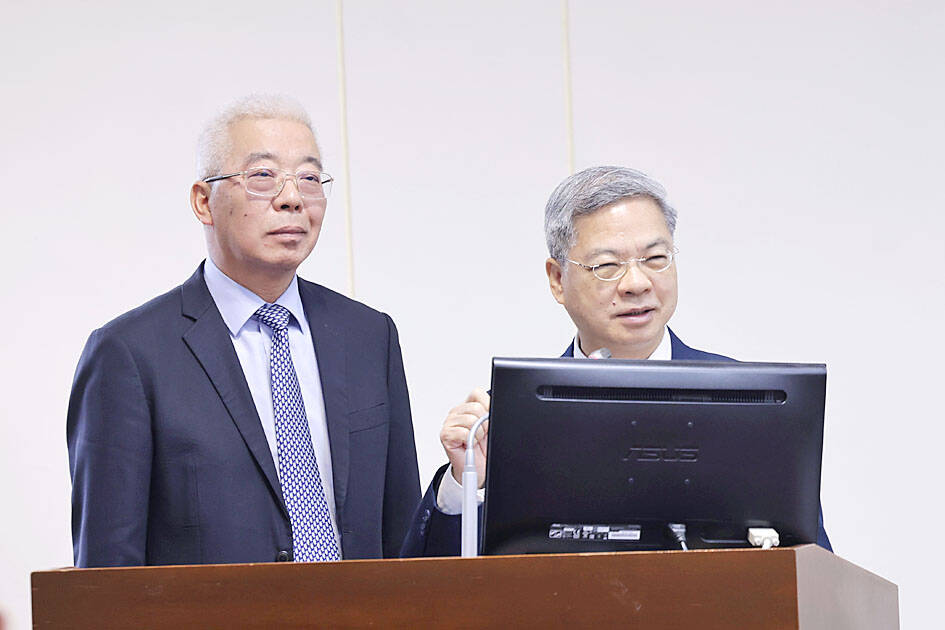
Photo: CNA
Procurement and scheduling for next month and July have largely been completed, with planning now focused on the fourth quarter, Kung said.
While the Strait of Hormuz has not fully reopened, major oil-producing countries, including Saudi Arabia and the United Arab Emirates, have found alternatives, such as transporting crude through pipelines to Red Sea ports or conducting ship-to-ship transfers outside the strait, Fang said.
Even so, crude oil exports from the Middle East have declined by about 40 percent compared with prewar levels, he said.
The impact on Taiwan remains relatively limited, as the nation’s main source of crude imports is the US, he added.
Tehran closed the Strait of Hormuz after the US and Israel attacked Iran on Feb. 28.
Some countries implemented fuel restrictions to mitigate oil supply shortages, but Taiwan has not seen any direct impacts, Fang said.
Meanwhile, shipments under CPC’s 25-year liquefied natural gas (LNG) supply agreement with Texas-based Cheniere Energy Inc, signed in February, are to begin next month.
LNG imports from the US account for about 10 percent of Taiwan’s total imports, and the government aims to raise the share to 25 percent by 2029 to reduce supply concentration risks and bolster supply stability, Kung said.
About 30 percent of Taiwan’s natural gas imports come from Qatar, he said.
As CPC has been absorbing rising costs for gasoline, diesel and natural gas to help stabilize consumer prices, it has come under heavy financial pressure, Kung said.
The Executive Yuan has proposed three measures to assist the company: special loans, subsidies and capital injections, he said.
The special loan program has already been completed, while subsidy plans are being compiled by the Directorate-General of Budget, Accounting and Statistics, he said.
The government is also planning a NT$350 billion (US$11.14 billion) capital injection into CPC over the next four years, with about NT$170 billion expected to be budgeted next year, Kung said.

Taiwanese firms have increased investment in the Philippines in recent years as Manila’s ties with Washington deepen and global supply chains continue to shift away from China, an expert at the Chung-Hua Institution for Economic Research (CIER, 中華經濟研究院) said yesterday. The Philippines had not been among Taiwanese investors’ top choices in Southeast Asia, CIER Taiwan ASEAN Studies Center director Kristy Hsu (徐遵慈) said at a seminar in Taipei. However, Taiwan’s investment in the country has grown significantly since the COVID-19 pandemic, reaching US $257 million last year, a high in recent years, she said. Although Taiwan’s total investment in the Philippines still lags

Intel Corp regards Taiwan Semiconductor Manufacturing Co (TSMC, 台積電) as a longstanding partner, as the US chipmaker would continue outsourcing production of advanced chips to TSMC, Intel chief executive officer Lip-Bu Tan (陳立武) said yesterday. “I don’t look at people as competitors. I look at the collaboration... Nvidia is also, you know, a good friend,” Tan told a news conference following his keynote speech at the Computex trade show in Taipei. “It’s a very trusted partnership for us... We are a big, top customer for them, and we’re going to continue doing that,” he said, referring to TSMC, the world’s largest foundry

Artificial intelligence (AI) agents would supplant smartphones as the center of people’s digital lives, fundamentally reshaping personal devices and driving a major computing upgrade cycle, Qualcomm Inc CEO Cristiano Amon said yesterday. In his keynote speech for this year’s Computex trade show in Taipei, Amon said that the rise of "agentic AI" — AI systems capable of reasoning, planning and carrying out tasks autonomously — would transform how people interact with technology across phones, PCs, vehicles and wearable devices. Describing the technology as the next major evolution in computing, Amon said that "2026 is the year of agents.” For decades, smartphones have sat

Hon Hai Precision Industry Co (鴻海精密) yesterday said it would work with US chipmaker Intel Corp to jointly develop and deploy next-generation artificial intelligence (AI) infrastructure and intelligent computing platforms in a move to capture booming demand for AI computing systems. Hon Hai, also known as Foxconn Technology Group (富士康), said in a statement that the partnership would combine its global manufacturing scale, system integration expertise and AI data center deployment capabilities with Intel’s strengths in processor architecture, silicon technologies and software ecosystem. The companies said they plan to work on equipment used in AI data centers, including server racks powered by


 RSS
RSS