


Developers bankrolled by two of the world’s biggest asset managers set their sights on building a massive datacenter hub in Northern Virginia. A battle over newspaper advertising threw their plans into disarray.
Compass Datacenters, backed by investment company Brookfield Asset Management, abandoned plans for an 320-plus hectare campus in Virginia’s Prince William County. Blackstone Inc’s QTS is fighting in court to salvage a similarly sized development on adjacent parcels.
Strident public opposition to a tech corridor roughly twice the size of New York’s Central Park culminated in court rulings voiding zoning approvals.
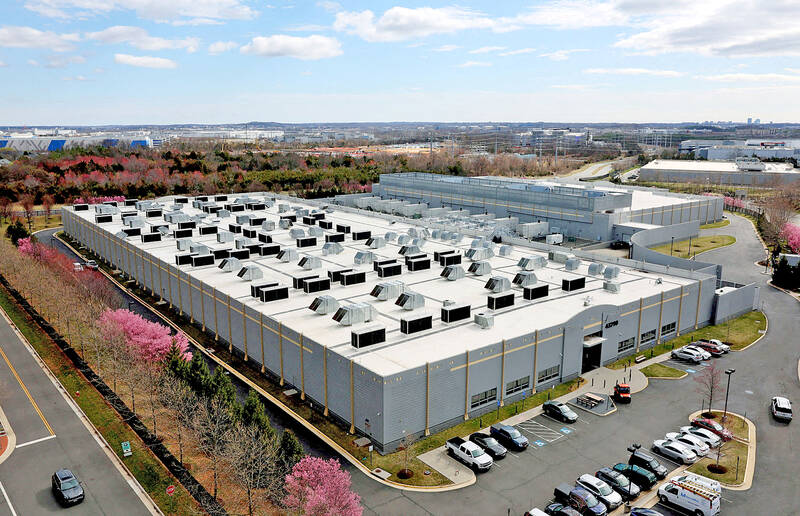
Photo: Reuters
A bureaucratic blunder was the final straw.
After a clerk did not respond promptly to an e-mail, the first two public notices for a key zoning meeting were published in the Washington Post three days apart, instead of the minimum of six that laws required, courts found.
The fight has created a rift among residents, cost county taxpayers US$1.7 million and set back the developers behind the “Digital Gateway” plan.
The saga, one chapter in data-center operators’ avarice to grab a bigger piece of the artificial intelligence boom, is a reminder that all the private equity cash in the world cannot buy the hearts and minds of towns and cities.
HISTORIC BATTLEFIELD
The Digital Gateway was an ambitious plan for a 850 hectare corridor that would house as many as 37 data-center buildings. The idea took shape when groups of property owners, their land criss-crossed by high-voltage lines, struck deals with QTS and Compass Datacenters.
The site, near Manassas National Battlefield, encroaches on Virginia’s “rural crescent” — an area protected from development. It galvanized preservationists and nearby residents worried about the impact on home values.
In 2023, county planners recommended denying QTS and Compass’s requests to convert an agricultural zone into datacenter sites. The developers had not provided enough detail on their applications, officials said.
But the county went ahead and scheduled a meeting for a key local panel, the Board of County Supervisors, to approve the projects.
The zoning meeting was timed just before the panel’s chair — a Digital Gateway advocate — was scheduled to step down. The
outgoing chair, Ann Wheeler, had been unseated by Deshundra Jefferson, a political outsider who ran for election against unchecked datacenter growth.
If the zoning decision were delayed until after the leadership shift, the Digital Gateway’s proponents risked failing to muster the votes.
Adding to the urgency, several landowners’ contracts with QTS were in danger of unraveling if zoning decisions were not reached that December, said people familiar with the land deals, who asked not to be identified discussing confidential agreements.
The hearing dragged on for more than 27 hours. Landowners, local residents, union members and conservationists lined up to speak overnight and into the morning. Speakers provided clashing views before a panel of policymakers who grew more exhausted by the hour.
The plan ultimately passed by a 4-3 vote, with one official abstaining, and the backlash was swift.
COUNTERATTACK
Local residents and a battlefield conservationist group sued to overturn the zoning approvals, as did a homeowners association. Lawsuits alleged the county did not provide proper notice of the zoning meeting, rendering the outcome moot.
The court proceedings put the spotlight on the bureaucratic snarl, in which a clerk to the board did not reply to the Washington Post after newspaper staff asked her to confirm when the zoning advertisements should be published. The deadline to respond passed, the publication dates changed, and the first two of three advertisements were spaced only three days apart.
That fell short of what state and local codes required at that time, the Virginia court of appeals determined, upholding a lower court’s decision. Rules required notices published weekly over two successive weeks, and no fewer than six days between the first and second ads.
The clerk and a representative for the county declined to comment.
The courts ruled that the public was not actually able to review what the county was intending to adopt until five days before the hearing, and that did not satisfy disclosure rules.
Last month, Prince William County decided it would be too costly to continue fighting the legal challenges. Compass Datacenters also walked away.
QTS is now the lone developer in the fight as the case heads to the Virginia Supreme Court. Its decision would not only decide the fate of Digital Gateway, it could determine how forthcoming developers must be about their designs when they seek approval to build in Northern Virginia.
Lawyers for QTS said that the appeals court was wrong to let a set of plaintiffs — who were aware of the hearing — void zoning decisions “based on technical notice defects that caused them no harm.”
In their petition to the state Supreme Court, the lawyers said: “If all the substantial effort and investment is to be erased in a pen stroke, it should only be with this court’s approval.”

Netherlands-based semiconductor equipment supplier ASML Holding NV yesterday said that it is planning to hire an additional 1,000 people in Taiwan this year in response to growing demand from clients. ASML had previously planned to recruit 600 people this year, but that the plan has been adjusted upward, ASML vice president and ASML Taiwan general manager Grace Wang (汪佳慧) told reporters. ASML has a workforce of more than 4,500 in Taiwan, accounting for about 10 percent of its global total, Wang said. This year’s recruitment campaign would focus on adding people in the customer support, manufacturing and supply chain domains to assist ASML

Starlux Airlines Co (星宇航空) today unveiled a long-haul network expansion plan at a shareholders’ meeting in Taipei, including direct flights to Barcelona, Spain, and Zurich, Switzerland, as well as a service connecting Taipei, Sydney and New Zealand. Starlux is to become the first Taiwanese carrier to offer non-stop services to the two European cities, while the inaugural oceanic route is expected to expand transit opportunities within the Australia-New Zealand market, Starlux said. Flight services to Chicago, Dallas, Washington and New York are under evaluation, the airline added. Prior to the shareholders’ meeting, the airline earlier this year announced that it would be

UNDER MICROSCOPE: Taiwan detained three people who allegedly conspired to buy servers in Taiwan and export them using fraudulent documentation, prosecutors said Nvidia Corp chief executive officer Jensen Huang (黃仁勳) on Saturday urged Super Micro Computer Inc to tighten up on compliance after Taiwan detained three people this week for allegedly making fraudulent declarations about artificial intelligence (AI) servers made by its US partner. The development marked the nation’s first crackdown on semiconductor smuggling, which grew after the US slapped restrictions on exports of high-end chips such as Nvidia AI accelerators to China. Nvidia is “rigorous” in explaining regulations to all of its partners, Huang told reporters after arriving in Taipei. “Ultimately Super Micro has to run their own company,” he said in response to

Nvidia Corp yesterday announced that CEO Jensen Huang (黃仁勳) would attend an employee meeting in Taipei tomorrow to celebrate the launch of the company’s Taiwan headquarters project. Huang would attend a gathering at the site of Nvidia’s planned headquarters in Beitou Shilin Technology Park (北投士林科技園區), the company said in a statement. After arriving in Taiwan on Saturday last week, Huang told reporters that he plans to meet with Quanta Computer Inc (廣達) chairman Barry Lam (林百里) and Taiwan Semiconductor Manufacturing Co (TSMC, 台積電) chairman C.C. Wei (魏哲家), and would attend the groundbreaking ceremony for Nvidia’s Taiwan headquarters tomorrow. Nvidia has not yet applied


 RSS
RSS