


Taiwan’s inflation remained relatively benign last month, despite higher fuel and food prices, with headline consumer inflation staying below the central bank’s 2 percent alert level for a 12th consecutive month, aided by government price stabilization measures, the Directorate-General of Budget, Accounting and Statistics (DGBAS) said yesterday.
The consumer price index (CPI) rose 1.74 percent from a year earlier last month, accelerating from 1.2 percent in March, mainly due to higher fuel and produce prices amid rising global oil costs linked to tensions in the Middle East and volatile weather conditions that disrupted agricultural supply.
Transportation and communication costs recorded the largest increase among major categories, rising 2.66 percent, as fuel prices surged 13.6 percent year-on-year — the sharpest increase in nearly four years, DGBAS official Tsao Chih-hung (曹志弘) said. Train fares and international airfares also increased.
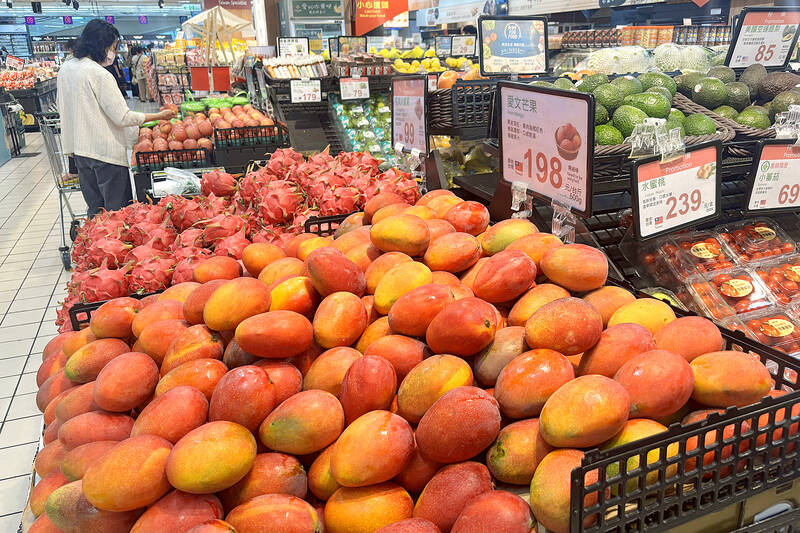
Photo: CNA
Government stabilization measures helped prevent rising energy costs from spilling over into broader consumer inflation, Tsao said.
Weather-related disruptions caused vegetable prices to rebound, while a fading high comparison base for fruit prices last year also pushed costs higher. Together, fruit and vegetable prices contributed about 0.25 percentage points to headline inflation, he said.
However, underlying inflation pressures remained stable, with core CPI, which excludes vegetables, fruit and energy, rising 1.91 percent year-on-year, little changed from 1.94 percent in March.
Inflation could edge slightly higher this month as airlines adjust fuel surcharges, but CPI growth is likely to remain below 2 percent if weather conditions stabilize and oil prices continue easing, Tsao said.
International oil prices retreated after signs emerged that Iran might end disruption of shipping through the Strait of Hormuz, easing concerns over a global supply shock.
Other price categories were broadly stable, suggesting domestic inflation pressures remained contained despite rising imported costs, Tsao said.
Miscellaneous goods prices rose 2.48 percent, driven by a 12.78 percent increase in gold and jewelry prices amid elevated bullion markets, as well as higher personal care service costs.
Recreation and education costs climbed 2.44 percent on higher prices for computer equipment, software and entertainment services, while healthcare costs rose 1.03 percent because of higher medical fees and hospital charges.
Meanwhile, the import price index last month surged 9.22 percent from a year earlier, the fastest increase in 40 months, driven by rising energy costs and firm demand for artificial intelligence-related electronic components amid tight global supply, Tsao said.
The sharp rise in import costs also fed into producer prices, with the producer price index climbing 8.54 percent year-on-year, led by gains in petroleum products, chemicals, electronics and semiconductor-related goods.
The pass-through to consumer inflation remained limited, as electronic products account for a relatively small share of the CPI basket and are not purchased frequently by households, Tsao said.
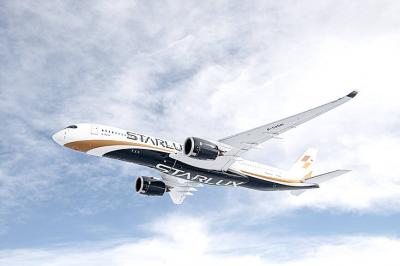
Starlux Airlines Co (星宇航空) today unveiled a long-haul network expansion plan at a shareholders’ meeting in Taipei, including direct flights to Barcelona, Spain, and Zurich, Switzerland, as well as a service connecting Taipei, Sydney and New Zealand. Starlux is to become the first Taiwanese carrier to offer non-stop services to the two European cities, while the inaugural oceanic route is expected to expand transit opportunities within the Australia-New Zealand market, Starlux said. Flight services to Chicago, Dallas, Washington and New York are under evaluation, the airline added. Prior to the shareholders’ meeting, the airline earlier this year announced that it would be

Netherlands-based semiconductor equipment supplier ASML Holding NV yesterday said that it is planning to hire an additional 1,000 people in Taiwan this year in response to growing demand from clients. ASML had previously planned to recruit 600 people this year, but that the plan has been adjusted upward, ASML vice president and ASML Taiwan general manager Grace Wang (汪佳慧) told reporters. ASML has a workforce of more than 4,500 in Taiwan, accounting for about 10 percent of its global total, Wang said. This year’s recruitment campaign would focus on adding people in the customer support, manufacturing and supply chain domains to assist ASML

UNDER MICROSCOPE: Taiwan detained three people who allegedly conspired to buy servers in Taiwan and export them using fraudulent documentation, prosecutors said Nvidia Corp chief executive officer Jensen Huang (黃仁勳) on Saturday urged Super Micro Computer Inc to tighten up on compliance after Taiwan detained three people this week for allegedly making fraudulent declarations about artificial intelligence (AI) servers made by its US partner. The development marked the nation’s first crackdown on semiconductor smuggling, which grew after the US slapped restrictions on exports of high-end chips such as Nvidia AI accelerators to China. Nvidia is “rigorous” in explaining regulations to all of its partners, Huang told reporters after arriving in Taipei. “Ultimately Super Micro has to run their own company,” he said in response to

Nvidia Corp yesterday announced that CEO Jensen Huang (黃仁勳) would attend an employee meeting in Taipei tomorrow to celebrate the launch of the company’s Taiwan headquarters project. Huang would attend a gathering at the site of Nvidia’s planned headquarters in Beitou Shilin Technology Park (北投士林科技園區), the company said in a statement. After arriving in Taiwan on Saturday last week, Huang told reporters that he plans to meet with Quanta Computer Inc (廣達) chairman Barry Lam (林百里) and Taiwan Semiconductor Manufacturing Co (TSMC, 台積電) chairman C.C. Wei (魏哲家), and would attend the groundbreaking ceremony for Nvidia’s Taiwan headquarters tomorrow. Nvidia has not yet applied


 RSS
RSS