


Hugo Hivernat’s restaurant was only open for a few days before he got dragged into New York’s cost of living row for pricing a half rotisserie chicken at US$40.
For some, the cost highlights how dining out has become prohibitively expensive in one of the world’s culinary capitals. However, Hivernat insists that steep overheads leave little room for profit.
“We are at the mercy of the affordability crisis,” he said at Gigi’s, a small, wooden-floored restaurant in a trendy Brooklyn neighborhood.
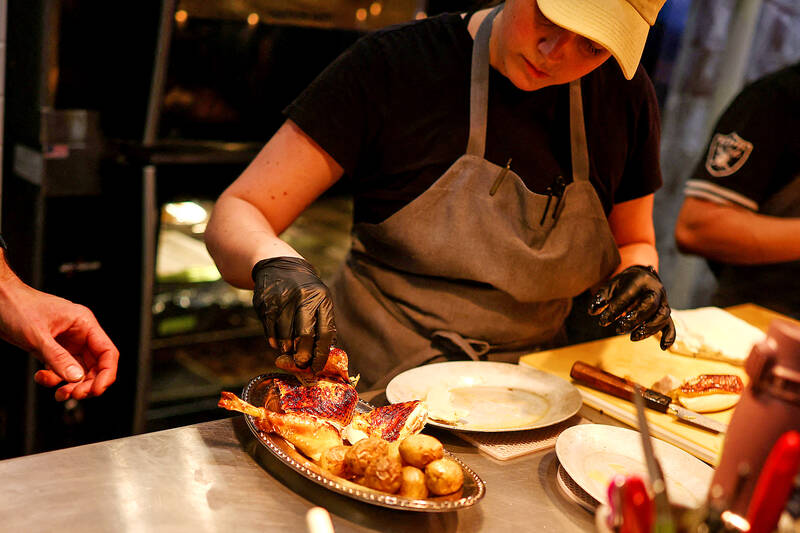
Photo: AFP
“Maybe people think we’re driving a Porsche in the Hamptons on the weekends with our US$40 chicken, but we’re like everyone here,” Hivernat said, referring to a wealthy beach resort in the New York area.
The cost of living is a worry across the US and is acutely felt in New York, where leftist Mayor Zohran Mamdani was elected largely on promises to counter the problem. Its restaurants are not immune to inflation, from operating costs to wholesale food prices.
Menu prices in the city rose by 43.6 percent in the decade up to 2023, compared with 42.8 percent nationally, a report released by the state’s fiscal watchdog in February showed.
“People have a very strong idea about how much things should cost in the restaurant industry, but they have absolutely no idea what the real cost is,” Hivernat said.
The 36-year-old, who co-ran the esteemed Fulgurances restaurant in Paris and New York before opening Gigi’s last month, said his pricing falls in line with industry standards. He said that 25 percent of the US$40 revenue is spent on raw ingredients — including quality chicken from upstate New York — and the rest goes toward rent, bills, salaries and other expenses. Anything left helps pay down the US$500,000 debt incurred from opening the restaurant, Hivernat added.
The chicken row gained traction after a local lawmaker alluded to the US$40 menu price in an exasperated Instagram post that received more than 9,000 likes.
It prompted one local food outlet to produce a “half chicken price index” ranking the dishes from below US$10 all the way to US$78 at a French restaurant in affluent Manhattan.
However, a stream of online commenters defended Gigi’s and pointed to the financial pressures for small businesses.
“Many restaurants aren’t even making money. They’re just getting by,” New York City Hospitality Alliance executive director Andrew Rigie said.
Rigie noted a confluence of factors including insurance premiums, slow economic recovery from the COVID-19 pandemic and higher food costs — the latter partly due to tariffs imposed by US President Donald Trump.
Menu prices would inevitably reflect those pressures, he said.
“It costs so much to run a small business in New York City that our beloved local restaurants are forced to charge these prices just so they can survive, not even thrive,” he said.
Underscoring the issue, almost half (46 percent) of more than 200 restaurants surveyed by the New York City Hospitality Alliance reported making fewer sales than expected in the final quarter of last year. Their chief concerns were labor costs, the price of goods and services, and a lack of customers.
At Gigi’s, head chef Thomas Knodell is glad the controversy over the US$40 half chicken has prompted a much-needed conversation about affordability.
“It’s blown up, because it’s a discussion about the cost of everything, the overall frustration that people have,” he said. “I get it, it is expensive. We agree with you, but this is the reality that we’re in now, unfortunately.”
Knodell, 35, believes that policy changes are needed — such as price caps on how much food wholesalers can charge — to stem the ever-growing costs at restaurants.
“It’s good that it’s a discussion, because, you know, that actually makes change,” he said.

SECOND-RATE: Models distilled from US products do not perform the same as the original and undo measures that ensure the systems are neutral, the US’ cable said The US Department of State has ordered a global push to bring attention to what it said are widespread efforts by Chinese companies, including artificial intelligence (AI) start-up DeepSeek (深度求索), to steal intellectual property from US AI labs, according to a diplomatic cable. The cable, dated Friday and sent to diplomatic and consular posts around the world, instructs diplomatic staff to speak to their foreign counterparts about “concerns over adversaries’ extraction and distillation of US AI models.” Distillation is the process of training smaller AI models using output from larger, more expensive ones to lower the costs of training a powerful new
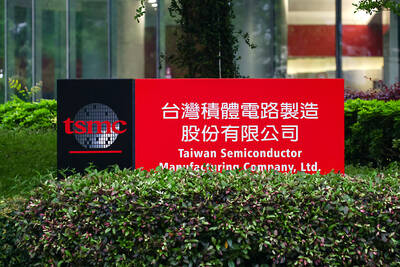
Shares of Taiwan Semiconductor Manufacturing Co (TSMC, 台積電) have repeatedly hit new highs, but an equity analyst said the stock’s valuation remains within a reasonable range and any pullback would likely be technical. The contract chipmaker’s historical price-to-earnings (P/E) ratio has ranged between 20 and 30, Cathay Futures Consultant Co (國泰證期) analyst Tsai Ming-han (蔡明翰) told Central News Agency. With market consensus projecting that TSMC would post earnings per share of about NT$100 (US$3.17) this year, supported by strong global demand for artificial intelligence (AI) applications, and the stock currently trading at a P/E ratio of below 25, Tsai said the valuation

The artificial intelligence (AI) boom has triggered a seismic reshuffling of global equity markets, with Taiwan and South Korea muscling past European nations one by one. With its stock market now valued at nearly US$4.3 trillion, Taiwan surpassed the UK, Europe’s biggest market, earlier this month, data compiled by Bloomberg showed. South Korea is about US$140 billion away from doing the same. The tech-heavy Asian markets have shot past Germany and France in the past seven months. The shift is largely down to massive gains in shares of three companies that provide essential hardware for AI: Taiwan Semiconductor Manufacturing Co (TSMC, 台積電),

The US Department of Commerce last week ordered multiple chip equipment companies to halt shipments of certain tools to China’s second-largest chipmaker, Hua Hong Semiconductor Ltd (華虹半導體), its latest action to slow the country’s development of advanced chips, two people familiar with the matter said. The department sent letters to at least a handful of companies informing them of restrictions on tools and other materials destined for two Hua Hong facilities US officials believe make China’s most sophisticated chips, the people said. Top US chip equipment companies Lam Research Corp, Applied Materials Inc and KLA Corp, each of which has significant


 RSS
RSS