


Delta Electronics Inc (台達電) on Thursday gave an optimistic forecast for this quarter and this year, driven by rising demand for its power and thermal management products amid artificial intelligence (AI) infrastructure deployments.
Gross margin this quarter is to expected to surpass the 35.51 percent registered for the second quarter last year, supported by a larger revenue contribution of its AI-related products, Delta Electronics chairman Ping Cheng (鄭平) said at an earnings conference in Taipei.
Products shipped to the world’s major cloud service providers for their data centers usually carry a higher margin than to other customers, boosting overall profitability, Cheng said.
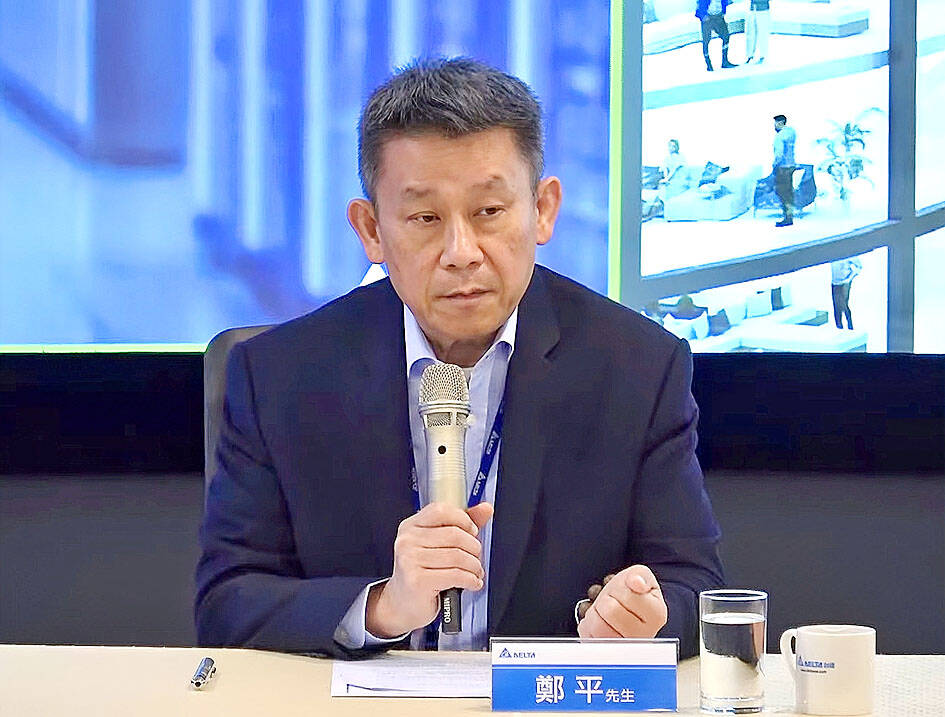
Photo: Fang Wei-chieh, Taipei Times
Revenue this quarter is expected to surpass the first quarter due to improved demand based on a normal seasonal pattern, driven by rising shipments of power products, Delta vice president Lanford Liu (劉亮甫) said.
The robust growth momentum for the company’s core products are fueled by heavy capital spending by the world’s major cloud service providers, who are forecasting a 60 percent annual jump to US$670 billion this year, Liu said.
For next-generation servers, Delta is focusing on upgrading power architectures by providing high-voltage direct current (HVDC) solutions, with its ±400-volt HVDC products expected to begin mass shipments this year due to faster adoption, he said.
Meanwhile, 800-volt HVDC architecture is being developed alongside Nvidia Corp’s next-generation AI platforms, with volume production slated for next year, Liu said.
The architecture is expected to be deployed in next-generation rack designs such as Nvidia’s Kyber power rack, he said.
In the thermal management business, liquid-to-air solutions generated more than US$1.6 billion in revenue last year and are expected to continue growing this year, he said.
Although the transition to liquid-to-liquid technologies has been slower than expected, ongoing data center upgrades are supporting steady improvements to liquid cooling, Liu said.
As AI server power architectures move toward modularization, Delta is also expanding into power racks and battery backup units, Cheng said.
To meet rapidly growing AI demand, Delta is expanding its global production footprint, strengthening research and development in Taiwan, while ramping up capacity in Thailand, he said.
The company is also building new facilities in the US, and optimizing operations in China and India for its power and infrastructure business, he said.
Net profit last quarter grew 19 percent quarter-on-quarter and 102 percent year-on-year to NT$20.55 billion (US$649 million), driven by continued strong demand.
Earnings per share increased to NT$7.91 from NT$6.67 in the previous quarter, and up from NT$3.94 a year earlier.
Gross margin increased to 37 percent from 34.6 percent in the previous quarter.
Power electronics products accounted for 54 percent of Delta’s total revenue of NT$159.4 billion last quarter, followed by infrastructure products at 32 percent, automation devices at 9 percent and mobility applications at 5 percent.
AI-related products are expected to contribute more than 20 percent of the company’s revenue this year, Delta said.
Capital expenditure this year is expected to grow by at least 10 percent from last year’s NT$46.1 billion to support the company’s AI and data center product lines, Cheng said.

SECOND-RATE: Models distilled from US products do not perform the same as the original and undo measures that ensure the systems are neutral, the US’ cable said The US Department of State has ordered a global push to bring attention to what it said are widespread efforts by Chinese companies, including artificial intelligence (AI) start-up DeepSeek (深度求索), to steal intellectual property from US AI labs, according to a diplomatic cable. The cable, dated Friday and sent to diplomatic and consular posts around the world, instructs diplomatic staff to speak to their foreign counterparts about “concerns over adversaries’ extraction and distillation of US AI models.” Distillation is the process of training smaller AI models using output from larger, more expensive ones to lower the costs of training a powerful new
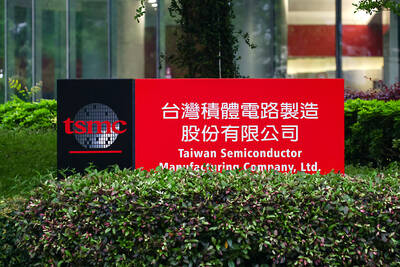
Shares of Taiwan Semiconductor Manufacturing Co (TSMC, 台積電) have repeatedly hit new highs, but an equity analyst said the stock’s valuation remains within a reasonable range and any pullback would likely be technical. The contract chipmaker’s historical price-to-earnings (P/E) ratio has ranged between 20 and 30, Cathay Futures Consultant Co (國泰證期) analyst Tsai Ming-han (蔡明翰) told Central News Agency. With market consensus projecting that TSMC would post earnings per share of about NT$100 (US$3.17) this year, supported by strong global demand for artificial intelligence (AI) applications, and the stock currently trading at a P/E ratio of below 25, Tsai said the valuation
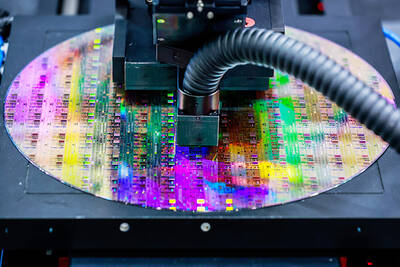
The artificial intelligence (AI) boom has triggered a seismic reshuffling of global equity markets, with Taiwan and South Korea muscling past European nations one by one. With its stock market now valued at nearly US$4.3 trillion, Taiwan surpassed the UK, Europe’s biggest market, earlier this month, data compiled by Bloomberg showed. South Korea is about US$140 billion away from doing the same. The tech-heavy Asian markets have shot past Germany and France in the past seven months. The shift is largely down to massive gains in shares of three companies that provide essential hardware for AI: Taiwan Semiconductor Manufacturing Co (TSMC, 台積電),
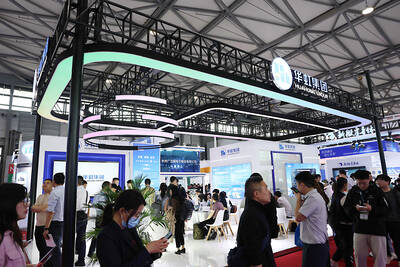
The US Department of Commerce last week ordered multiple chip equipment companies to halt shipments of certain tools to China’s second-largest chipmaker, Hua Hong Semiconductor Ltd (華虹半導體), its latest action to slow the country’s development of advanced chips, two people familiar with the matter said. The department sent letters to at least a handful of companies informing them of restrictions on tools and other materials destined for two Hua Hong facilities US officials believe make China’s most sophisticated chips, the people said. Top US chip equipment companies Lam Research Corp, Applied Materials Inc and KLA Corp, each of which has significant


 RSS
RSS