


Taiwan’s financial sector yesterday launched a joint initiative to develop a localized large language model (LLM), part of a broader push to build domestic artificial intelligence (AI) capabilities and reduce reliance on foreign technologies.
The first version, focused on banking knowledge, is set to be released by the end of this year, Financial Supervisory Commission Chairman Peng Jin-lung (彭金隆) said at the launch event in Taipei.
Subsequent phases would expand the model to cover insurance, securities and other financial services, he said.
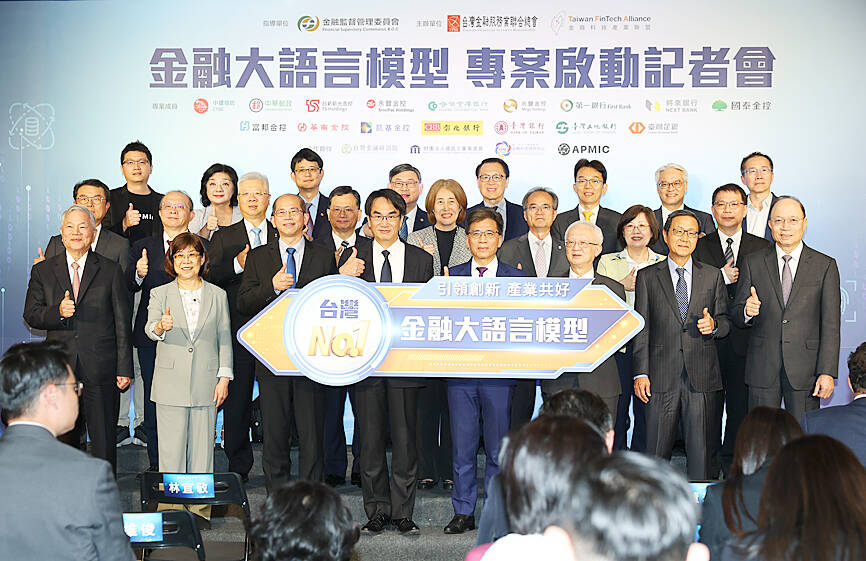
Photo: CNA
The project is expected to deliver three key benefits, including bolstering sovereign AI by embedding local regulations, supervisory practices and industry expertise into the system, Peng said.
It would also reduce reliance on foreign-developed models such as OpenAI’s ChatGPT, Google’s Gemini and Meta Platforms Inc’s Llama, he said.
Led by CTBC Financial Holding Co (中信金控), the initiative aims to upgrade the industry’s technological capabilities by pooling resources from participating institutions and avoiding duplicated investment. It could ultimately form a shared AI infrastructure for the local financial sector, Peng said.
In the long term, the platform is expected to support financial inclusion by extending services and knowledge to smaller financial institutions, companies, educational organizations and the general public, improving access to financial information and services, Peng said.
Overall, the project is expected to serve as a key milestone in AI adoption for the financial sector, he said, adding that banks and insurers are particularly well-suited for automation given their heavy reliance on language and text processing.
Peng added that financial services operate under complex local regulatory frameworks, meaning foreign AI models cannot be directly applied.
A localized financial LLM is therefore necessary to ensure compliance and accuracy, he said.
Peng added that the initiative has strong government backing, having discussed the project with the National Science and Technology Council (NSTC).
Officials from the council and the Ministry of Digital Affairs (MODA) attended the launch.
The project has been incorporated into the council’s national AI development program, while the MODA is providing sovereign AI datasets to support training and development.
Peng said the initiative is only the starting point. After the banking-focused model is released later this year, future versions would expand to incorporate knowledge from insurance, securities and other financial sectors.
Participating institutions include state-backed lenders such as Bank of Taiwan Co (臺灣銀行), Land Bank of Taiwan Co (臺灣土地銀行), Taiwan Business Bank Co (臺灣企銀) and Chang Hwa Commercial Bank Ltd (彰化商業銀行), as well as financial holding companies including Cathay Financial Holding (國泰金控), Fubon Financial Holding Co (富邦金控), TS Financial Holding Co (台新新光金控), KGI Financial Holding Co (凱基金控) and SinoPac Financial Holdings Co (永豐金控). Other participants include Chunghwa Post Co (中華郵政) and digital lender Next Commercial Bank Co (將來商業銀行).


Taiwanese firms have increased investment in the Philippines in recent years as Manila’s ties with Washington deepen and global supply chains continue to shift away from China, an expert at the Chung-Hua Institution for Economic Research (CIER, 中華經濟研究院) said yesterday. The Philippines had not been among Taiwanese investors’ top choices in Southeast Asia, CIER Taiwan ASEAN Studies Center director Kristy Hsu (徐遵慈) said at a seminar in Taipei. However, Taiwan’s investment in the country has grown significantly since the COVID-19 pandemic, reaching US $257 million last year, a high in recent years, she said. Although Taiwan’s total investment in the Philippines still lags

Intel Corp regards Taiwan Semiconductor Manufacturing Co (TSMC, 台積電) as a longstanding partner, as the US chipmaker would continue outsourcing production of advanced chips to TSMC, Intel chief executive officer Lip-Bu Tan (陳立武) said yesterday. “I don’t look at people as competitors. I look at the collaboration... Nvidia is also, you know, a good friend,” Tan told a news conference following his keynote speech at the Computex trade show in Taipei. “It’s a very trusted partnership for us... We are a big, top customer for them, and we’re going to continue doing that,” he said, referring to TSMC, the world’s largest foundry

Hon Hai Precision Industry Co (鴻海精密) yesterday said it would work with US chipmaker Intel Corp to jointly develop and deploy next-generation artificial intelligence (AI) infrastructure and intelligent computing platforms in a move to capture booming demand for AI computing systems. Hon Hai, also known as Foxconn Technology Group (富士康), said in a statement that the partnership would combine its global manufacturing scale, system integration expertise and AI data center deployment capabilities with Intel’s strengths in processor architecture, silicon technologies and software ecosystem. The companies said they plan to work on equipment used in AI data centers, including server racks powered by

Artificial intelligence (AI) agents would supplant smartphones as the center of people’s digital lives, fundamentally reshaping personal devices and driving a major computing upgrade cycle, Qualcomm Inc CEO Cristiano Amon said yesterday. In his keynote speech for this year’s Computex trade show in Taipei, Amon said that the rise of "agentic AI" — AI systems capable of reasoning, planning and carrying out tasks autonomously — would transform how people interact with technology across phones, PCs, vehicles and wearable devices. Describing the technology as the next major evolution in computing, Amon said that "2026 is the year of agents.” For decades, smartphones have sat


 RSS
RSS