


Electric vehicle (EV) sales have jumped in Southeast Asia as cost-conscious buyers have poured into dealerships looking to dodge the fuel price spikes driven by the Middle East war.
Asian nations have been particularly hard hit due to a sharp fall in the crude shipments they rely on — and have few alternatives to replace them.
Yet the energy crisis has been a windfall for Vietnam’s leading EV maker, Vinfast, as well as Chinese manufacturers.
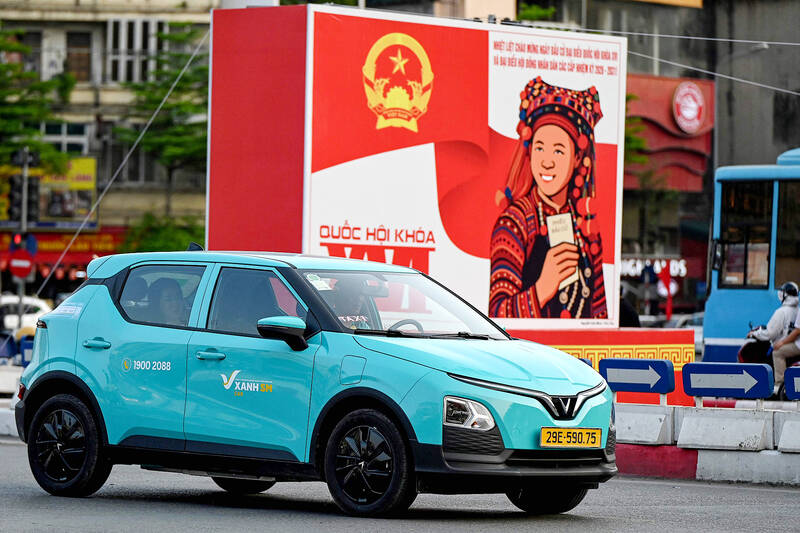
Photo: AFP
Vietnamese office worker Do Thi Lan explained the simple math of the cars’ appeal at a Vinfast showroom in Hanoi.
“We have to calculate our monthly expenses, as the money we spend on petroleum has been on the rise,” she said.
She said her family owns a car that runs on gasoline, but was considering buying an EV to save money.
Dao Thi Hue, also at the showroom, was looking to go electric too.
“Driving an EV is so much better than driving a petroleum vehicle, in terms of costs and also in terms of saving fuel, queuing to fill up,” the school teacher said.
Crude oil prices have soared by about 50 percent since the start of the Middle East war and again exceeded US$100 per barrel on Monday, driving up the cost at the pump.
Vinfast, listed on the NASDAQ, saw a 127 percent surge in annual sales in Vietnam last month, reaching 27,600 cars.
About 40 percent of cars sold in Vietnam last year were electric, but the trend has been accelerating.
“At this point in time, clients consider fuel costs a lot when making a decision on which cars to buy,” said Pham Minh Hai, deputy head of sales at a Vinfast showroom.
“In March we sold 300-400 cars,” he said, adding that the showroom normally sells between 200 and 250 cars a month.
Hai said that more than 50 percent of his customers changed from gasoline to electric cars last month, while the number of customers at the showroom was up by about 30 percent.
Opening hours had been extended to deal with the rush, he added.
Outside Vietnam, Chinese manufacturers specializing in EVs, particularly BYD, are booming.
At the Bangkok Auto Show earlier this month, BYD secured the most orders of any manufacturer, surpassing Japan-based Toyota for the first time.
“I drive a lot, nearly 100km a day ... with the current fuel situation and no idea how long it will last, it’s become a major factor pushing me to make the switch,” said Pleng Nawintham, a 36-year-old pharmacist from Thailand.
BYD was also seeing increased sales in the Philippines.
Mae Anne Clarisse Bacquiano, manager of a BYD showroom in the suburbs of Manila, said that foot traffic at the dealership was “at another level.”
“It was all because of the rise in fuel prices,” she said. “Earlier today, I had a customer, a doctor who was ranting to me about how he is being punished by gas prices... He was in a hurry to go full electric. There’d be a huge difference in expenses.”
She added that all of her stock for the month had already been reserved by buyers.
“I don’t expect the gas [prices] to go back down over the next couple of months,” said Arlone Abello, an entrepreneur who was browsing BYD models at the showroom.
As BYD sales decline in China due to fierce local competition, the manufacturer hopes to gain international momentum.
The company told analysts that it expects to exceed 1.5 million exported vehicles this year, well above the 1.3 million target announced in January.
Exports of Chinese EVs — for which Southeast Asia is a major market — doubled last month compared with the same month last year across all manufacturers, the CPCA industry body said.
Economic factors are at the forefront of the increased demand for greener vehicles.
“You have the individual consumer response to what they are seeing in terms of the price of petrol or diesel suddenly surge,” said Euan Graham, an electricity and data analyst at energy think tank Ember.
The installation of charging stations in the region is also growing rapidly.
Jakarta last week promised to take “more serious steps to accelerate the development of a national electric vehicle ecosystem” to combat its “high level of energy consumption.”
EVs are gaining momentum beyond Southeast Asia.
“There are signs that global demand has already picked up substantially,” Capital Economics said, adding that registrations of EVs in Japan, South Korea and New Zealand more than doubled last month, and rose by more than 50 percent in India and Australia.

Cairo’s new monorail slices across the city skyline, running above the familiar chaos of blaring horns and aging buses’ exhaust fumes that mark rush hour below. The US$4.5 billion monorail, opened this month, is among Egypt’s most prominent new transport projects, part of a debt-funded infrastructure drive criticized for sapping state finances while bringing limited benefits to most of the country’s 109 million people. “It feels like you’re in a different country,” said Ramy Sayed, a restaurant manager, aboard a driverless Innovia 300 train. “No noise, no traffic, we’re not used to this.” The eastern line runs 56km from the bustling middle-class
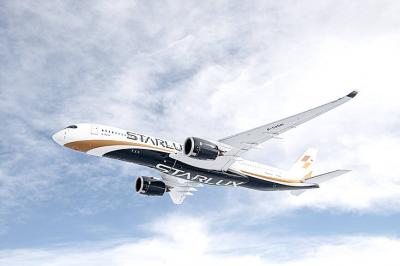
Starlux Airlines Co (星宇航空) today unveiled a long-haul network expansion plan at a shareholders’ meeting in Taipei, including direct flights to Barcelona, Spain, and Zurich, Switzerland, as well as a service connecting Taipei, Sydney and New Zealand. Starlux is to become the first Taiwanese carrier to offer non-stop services to the two European cities, while the inaugural oceanic route is expected to expand transit opportunities within the Australia-New Zealand market, Starlux said. Flight services to Chicago, Dallas, Washington and New York are under evaluation, the airline added. Prior to the shareholders’ meeting, the airline earlier this year announced that it would be

Taiwanese prosecutors suspect that three people successfully smuggled at least one shipment of Nvidia Corp artificial intelligence (AI) chips to China after first exporting them to Japan, people familiar with the matter said. The trio was detained last week by the Keelung District Prosecutors’ Office for allegedly falsifying documents related to exports of Super Micro Computer Inc servers containing advanced Nvidia chips, which the US has barred from sale to China without a license from Washington. The move marked Taiwan’s first public crackdown on AI chip diversion after years of pressure from the US to take a more active role in curtailing
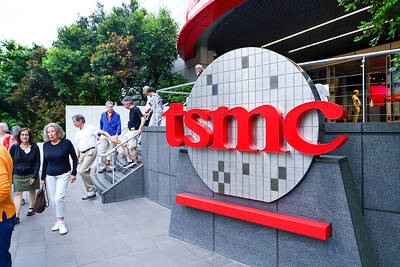
Taiwan Semiconductor Manufacturing Co (TSMC, 台積電) employee bonuses are likely to grow more than 30 percent this year, in line with the past few years as the company’s profits continue to set new records, an anonymous source cited TSMC chairman C.C. Wei (魏哲家) as saying yesterday. TSMC, the world’s largest contract chipmaker, is committed to taking care of its workers, the source said, citing Wei’s meeting with employees yesterday morning. Wei also expressed gratitude to employees for their contribution to the company’s improving bottom line, the source added. Since 2023, TSMC’s employee bonuses have grown at an annual rate of


 RSS
RSS