


Foxconn Industrial Internet Co (FII, 工業富聯), a subsidiary of Hon Hai Precision Industry Co (鴻海精密), yesterday said it expects strong growth this year, driven by booming demand for artificial intelligence (AI) and high-end interconnects.
FII, 84 percent owned by Hon Hai, was listed on the Shanghai Stock Exchange in June 2018 and focuses on smart manufacturing, AI-related applications and the industrial Internet.
Last year, FII’s net profit rose 52 percent year-on-year to 35.29 billion yuan (US$5.17 billion), which translated into earnings per share of 1.78 yuan, up 52.1 percent from 1.17 yuan a year earlier, FII chief financial officer Michael Shen (沈道邦) told an investors’ conference.
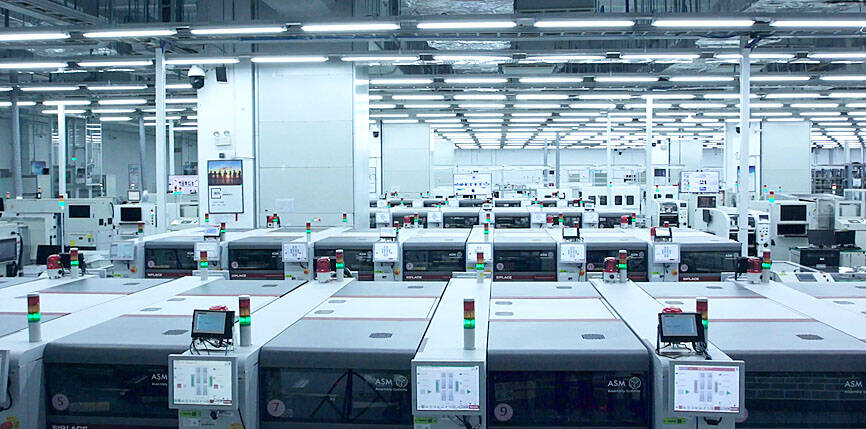
Photo courtesy of Hon Hai Precision Industry Co
Revenue last year increased 48.2 percent year-on-year to 902.89 billion yuan, reflecting the company’s ability to capitalize on the AI boom and improvements in its overall operations, Shen said.
FII became the biggest manufacturer in Shenzhen by revenue, surpassing Shenzhen-based Huawei Technologies Co (華為), BYD Co (比亞迪) and Tencent Holdings Ltd (騰訊控股) last year, companies’ data showed.
AI has become FII’s core growth driver since last year, with cloud computing revenue surging 88.7 percent year-on-year to account for 66.75 percent of total revenue, company chairman Brand Cheng (鄭弘孟) said.
Communications and mobile network equipment business accounted for the other 33 percent, Cheng said.
AI server revenue more than tripled from a year earlier, while shipments of switches above 800G surged more than 13-fold, he said.
Shipments of precision mechanical components, including server chassis, also posted double-digit annual growth, he added.
This year, shipments of AI servers and related rack products — including Nvidia Corp’s GB200, GB300 and next-generation Vera Rubin platforms — are expected to continue growing, FII rotating CEO Liu Zong-chang (劉宗長) said.
Vera Rubin platform-based servers are set to enter mass production in the third quarter, Liu said.
In terms of key technology deployment, liquid-cooled servers are expected to account for a larger share of FII’s total server capacity this year, driven by rapid adoption by major clients, FII said.
About 60 percent of key components per server rack are now developed in-house, which enhances value-added and raises entry barriers in server production, the company said.
Regarding its recent push into the copackaged optics (CPO) business, Liu said the company’s CPO switches have begun sampling shipments last quarter and are slated for mass production next quarter.
CPO switch shipments are expected to exceed 100,000 units this year and reach 200,000 units by 2030, FII said.
Excluding integrated circuit costs, gross margin for such products is expected to remain above a double-digit percentage, making CPO a key future profit driver, the company said.
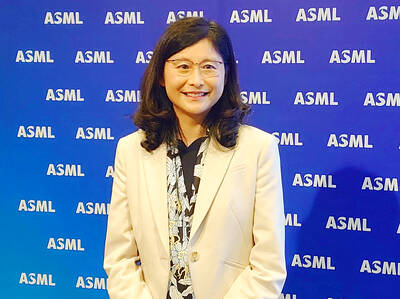
Netherlands-based semiconductor equipment supplier ASML Holding NV yesterday said that it is planning to hire an additional 1,000 people in Taiwan this year in response to growing demand from clients. ASML had previously planned to recruit 600 people this year, but that the plan has been adjusted upward, ASML vice president and ASML Taiwan general manager Grace Wang (汪佳慧) told reporters. ASML has a workforce of more than 4,500 in Taiwan, accounting for about 10 percent of its global total, Wang said. This year’s recruitment campaign would focus on adding people in the customer support, manufacturing and supply chain domains to assist ASML
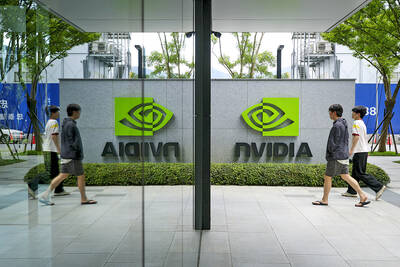
UNDER MICROSCOPE: Taiwan detained three people who allegedly conspired to buy servers in Taiwan and export them using fraudulent documentation, prosecutors said Nvidia Corp chief executive officer Jensen Huang (黃仁勳) on Saturday urged Super Micro Computer Inc to tighten up on compliance after Taiwan detained three people this week for allegedly making fraudulent declarations about artificial intelligence (AI) servers made by its US partner. The development marked the nation’s first crackdown on semiconductor smuggling, which grew after the US slapped restrictions on exports of high-end chips such as Nvidia AI accelerators to China. Nvidia is “rigorous” in explaining regulations to all of its partners, Huang told reporters after arriving in Taipei. “Ultimately Super Micro has to run their own company,” he said in response to

Nvidia Corp yesterday announced that CEO Jensen Huang (黃仁勳) would attend an employee meeting in Taipei tomorrow to celebrate the launch of the company’s Taiwan headquarters project. Huang would attend a gathering at the site of Nvidia’s planned headquarters in Beitou Shilin Technology Park (北投士林科技園區), the company said in a statement. After arriving in Taiwan on Saturday last week, Huang told reporters that he plans to meet with Quanta Computer Inc (廣達) chairman Barry Lam (林百里) and Taiwan Semiconductor Manufacturing Co (TSMC, 台積電) chairman C.C. Wei (魏哲家), and would attend the groundbreaking ceremony for Nvidia’s Taiwan headquarters tomorrow. Nvidia has not yet applied

Huawei Technologies Co (華為) said it has come up with a new pathway to shorten its gap with industry leader Taiwan Semiconductor Manufacturing Co (TSMC, 台積電), potentially achieving a breakthrough in making advanced semiconductors without cutting-edge equipment. Right now there is about a five-year gap between what TSMC is capable of and what Huawei, together with its manufacturing partner Semiconductor Manufacturing International Corp (中芯), can produce. Huawei is to start making 1.4-nanometer chips by 2031 with its own “LogicFolding” technology, Huawei semiconductor chief He Tingbo (何庭波) said in a rare public appearance during a chip conference yesterday, while TSMC has


 RSS
RSS