


Anthropic postponing the release of its new artificial intelligence (AI) model, Claude Mythos, said to be so skilled at coding it could be a wicked weapon for hackers, has encountered a mix of alarm and skepticism.
The company is among several contenders in a fierce AI race. Promoting the awe of Anthropic’s own technology boosts business and enhances its allure in the event it soon goes public, as is rumored.
“The world has no choice but to take the cyberthreat associated with Mythos seriously,” said David Sacks, an entrepreneur and investor who heads US President Donald Trump’s council of advisers on technology.
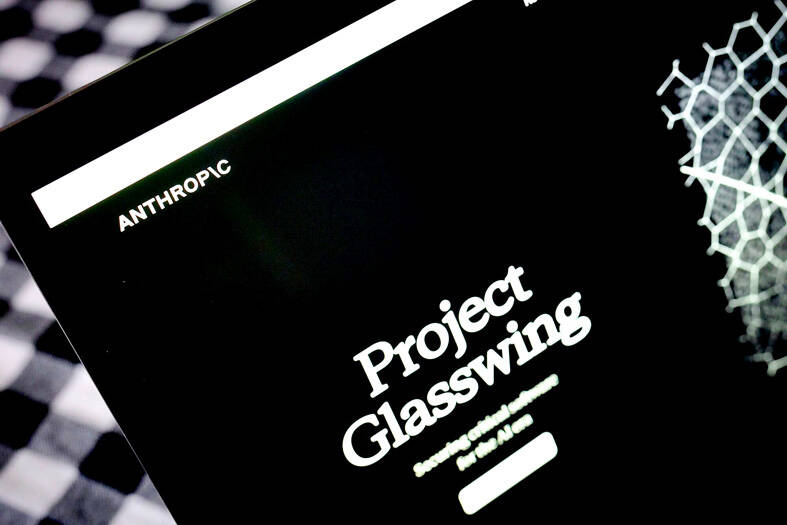
Photo: Bloomberg
“But it’s hard to ignore that Anthropic has a history of scare tactics,” Sacks said.
Mythos has sparked fears of hackers commanding armies of AI agents able to break through computer defenses with ease.
At this week’s HumanX AI conference in San Francisco, Alex Stamos of start-up Corridor, which addresses AI safety, acknowledged a real threat from agentic hackers.
Stamos quipped about what he referred to as Anthropic’s “marketing schtick.”
“They have these adorable cutesy cartoons about these products that are so incredibly dangerous that they won’t even let people use them,” Stamos said of the San Francisco-based start-up. “It’s like if the Manhattan Project announced the nuclear bomb within a cute little Calvin and Hobbes cartoon.”
The heads of the US’ biggest banks met this week with US Federal Reserve Chair Jerome Powell and US Secretary of the Treasury Scott Bessent to weigh the security implications of the yet-to-be released Claude Mythos, reports said on Friday.
“Mythos model points to something far more consequential than another leap in artificial intelligence,” Cato Networks cofounder and chief executive Shlomo Kramer said in a blog post.
“It signals a shift that could redefine the balance between attackers and defenders in cyberspace,” Kramer said.
A tightly restricted preview of Mythos was shared with partner organizations this week, under an initiative called Project Glasswing. They include Amazon.com Inc, Apple Inc, Microsoft Corp, Google, Cisco Systems Inc, CrowdStrike Inc and JPMorgan Chase & Co.
Mythos can autonomously scan vast amounts of code to find and chain together previously unknown security vulnerabilities in all kinds of software, from operating systems to Web browsers, Anthropic and partners said.
Crucially this can be done at a speed and scale no human could match, meaning it could be used to bring down banks, hospitals or national infrastructure within hours, the said.
“What once required elite specialists can now be performed by software agents,” Kramer said.
“The immediate consequences will be a surge in vulnerability discovery, a true tsunami” of exploiting known and unknown vulnerabilities, he added.
At HumanX, the apparent consensus was that it makes sense that AI agents already adept at coding would excel at finding weaknesses in software.
“We’re not in an era where human beings can write code when we have superhuman [AI models] that are then going to find bugs in it,” Stamos said. “It’s just not possible.”
He said the coming dynamic would involve humans supervising AI agents to protect networks against hackers using that same technology to attack.
Stamos referred to it as “agent-to-agent war,” with humans on the sidelines giving advice.
Palo Alto Networks chief security intelligence officer Wendy Whitmore said she expects “some sort of catastrophic attack” this year connected to AI agent capabilities.
“The thing that keeps me up at night is that we’re staring down the barrel of a massive influx of new vulnerabilities that are going to be found by AI,” CrowdStrike senior vice president Adam Meyers said.
Meyers said he saw embedding a tiny AI model directly into malicious code infecting networks as a natural tactic to be explored by hackers.
“The ultimate weapon would be malware that has no preprogramming,” Meyers said. “It can do whatever you ask it to.”
SECOND-RATE: Models distilled from US products do not perform the same as the original and undo measures that ensure the systems are neutral, the US’ cable said The US Department of State has ordered a global push to bring attention to what it said are widespread efforts by Chinese companies, including artificial intelligence (AI) start-up DeepSeek (深度求索), to steal intellectual property from US AI labs, according to a diplomatic cable. The cable, dated Friday and sent to diplomatic and consular posts around the world, instructs diplomatic staff to speak to their foreign counterparts about “concerns over adversaries’ extraction and distillation of US AI models.” Distillation is the process of training smaller AI models using output from larger, more expensive ones to lower the costs of training a powerful new
Shares of Taiwan Semiconductor Manufacturing Co (TSMC, 台積電) have repeatedly hit new highs, but an equity analyst said the stock’s valuation remains within a reasonable range and any pullback would likely be technical. The contract chipmaker’s historical price-to-earnings (P/E) ratio has ranged between 20 and 30, Cathay Futures Consultant Co (國泰證期) analyst Tsai Ming-han (蔡明翰) told Central News Agency. With market consensus projecting that TSMC would post earnings per share of about NT$100 (US$3.17) this year, supported by strong global demand for artificial intelligence (AI) applications, and the stock currently trading at a P/E ratio of below 25, Tsai said the valuation
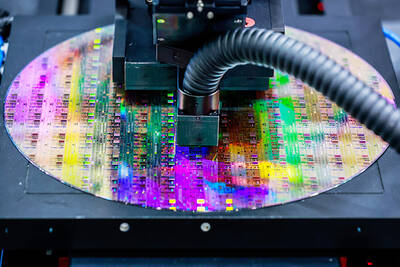
The artificial intelligence (AI) boom has triggered a seismic reshuffling of global equity markets, with Taiwan and South Korea muscling past European nations one by one. With its stock market now valued at nearly US$4.3 trillion, Taiwan surpassed the UK, Europe’s biggest market, earlier this month, data compiled by Bloomberg showed. South Korea is about US$140 billion away from doing the same. The tech-heavy Asian markets have shot past Germany and France in the past seven months. The shift is largely down to massive gains in shares of three companies that provide essential hardware for AI: Taiwan Semiconductor Manufacturing Co (TSMC, 台積電),

The US Department of Commerce last week ordered multiple chip equipment companies to halt shipments of certain tools to China’s second-largest chipmaker, Hua Hong Semiconductor Ltd (華虹半導體), its latest action to slow the country’s development of advanced chips, two people familiar with the matter said. The department sent letters to at least a handful of companies informing them of restrictions on tools and other materials destined for two Hua Hong facilities US officials believe make China’s most sophisticated chips, the people said. Top US chip equipment companies Lam Research Corp, Applied Materials Inc and KLA Corp, each of which has significant


 RSS
RSS