


Taiwanese stocks surged sharply yesterday after the US and Iran agreed to a two-week ceasefire that injected a burst of optimism into markets.
The benchmark TAIEX climbed 1,531.56 points, or 4.61 percent, to close at 34,761.38, marking the second-largest single-day point gain on record, while the New Taiwan dollar rose NT$0.182 to end at NT$31.785 against the US dollar.
The turnover on the local main board increased to NT$856.26 billion (US$26.94 billion) from NT$584.69 billion on Tuesday, reflecting broad participation from investors.
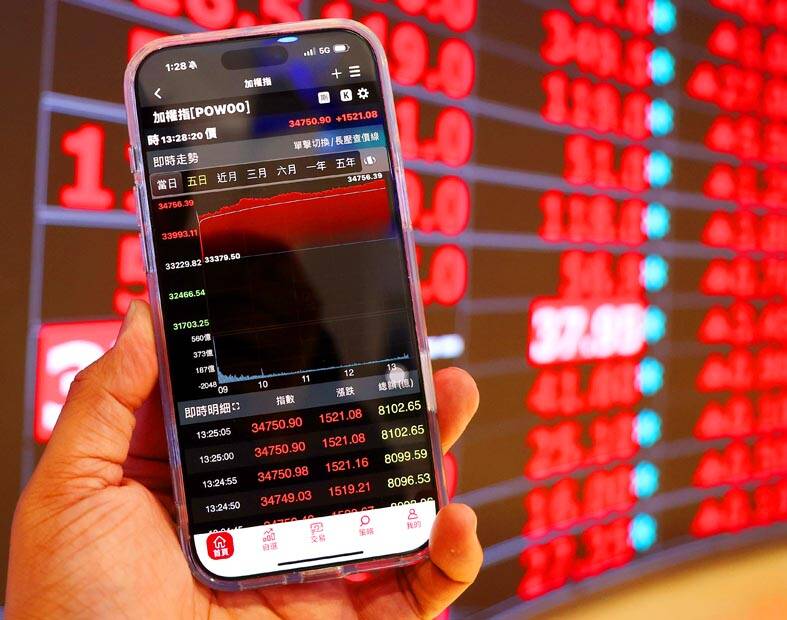
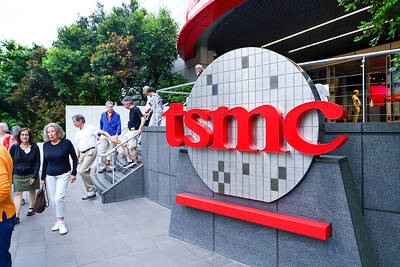
Photo: CNA
The rally was fueled by easing geopolitical tensions after US President Donald Trump announced a two-week suspension of planned attacks on Iran under a conditional ceasefire.
The ceasefire hinges on Tehran reopening the Strait of Hormuz, a strategic chokepoint for global oil shipments. Iran agreed to temporarily reopen the strait, sending Brent crude futures tumbling as much as 15 percent to below US$100 per barrel and easing some inflationary pressures in global markets.
“Markets generally treat the two-week window as positive,” Taishin Securities Investment Advisory Co (台新投顧) vice president Tony Huang (黃文清) said.
Even if tensions persist beyond the two weeks, the situation is unlikely to escalate into a prolonged conflict, giving investors a chance to return to risk assets, he said.
Institutional investors led the buying frenzy, signaling a reversal in market sentiment after a period of pessimism.
Foreign institutional investors, who had been rapidly exiting the local market last month, increased their holdings in Taiwanese shares by a net NT$117.77 billion yesterday, Taiwan Stock Exchange data showed.
Investment trusts added a net of NT$4.28 billion, while proprietary traders overbought by NT$35.87 billion, the exchange’s data showed.
Technology and electronics sectors were at the forefront of the rally. Taiwan Semiconductor Manufacturing Co (TSMC, 台積電), the world’s largest contract chipmaker, gained nearly 5 percent to close at NT$1,950.
MediaTek Inc (聯發科), a leading smartphone chip designer, jumped 7 percent to NT$1,580, while Hon Hai Precision Industry Co (鴻海), a major electronics assembler, rose by about 5 percent to NT$201.50. Delta Electronics Inc (台達電), a power supply and electronic components manufacturer, hit the 10 percent daily trading limit at NT$1,665, marking a new all-time high.
Analysts said the surge reflects a combination of geopolitical relief and renewed investor confidence in Taiwan’s technology-heavy market.
“The easing of geopolitical risks prompted investors to rejoin equities after a period of volatility, with technology stocks benefiting from a revived global risk appetite,” Huang said.
Market participants are expected to refocus on fundamentals, as TSMC and other tech firms are scheduled to report earnings from next week.
TSMC and other major technology companies in January issued optimistic revenue forecasts, citing strong demand from artificial intelligence applications, while the Directorate-General of Budget, Accounting and Statistics in February projected GDP growth of 7.71 percent for this year, supported by robust export performance.
The combination of easing external risks and strong domestic economic indicators has helped restore investor confidence, suggesting that Taiwan’s equity market could maintain its upward momentum in the near term, particularly in technology and electronics sectors, analysts said.
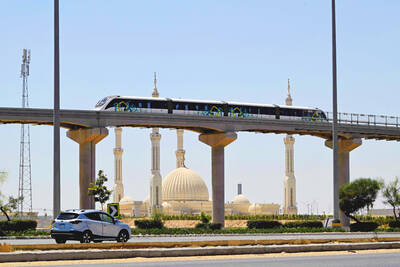
Cairo’s new monorail slices across the city skyline, running above the familiar chaos of blaring horns and aging buses’ exhaust fumes that mark rush hour below. The US$4.5 billion monorail, opened this month, is among Egypt’s most prominent new transport projects, part of a debt-funded infrastructure drive criticized for sapping state finances while bringing limited benefits to most of the country’s 109 million people. “It feels like you’re in a different country,” said Ramy Sayed, a restaurant manager, aboard a driverless Innovia 300 train. “No noise, no traffic, we’re not used to this.” The eastern line runs 56km from the bustling middle-class
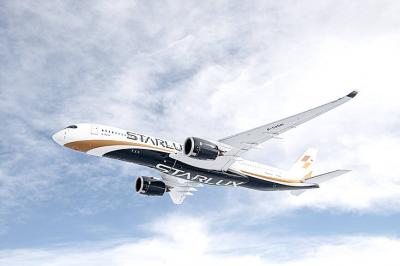
Starlux Airlines Co (星宇航空) today unveiled a long-haul network expansion plan at a shareholders’ meeting in Taipei, including direct flights to Barcelona, Spain, and Zurich, Switzerland, as well as a service connecting Taipei, Sydney and New Zealand. Starlux is to become the first Taiwanese carrier to offer non-stop services to the two European cities, while the inaugural oceanic route is expected to expand transit opportunities within the Australia-New Zealand market, Starlux said. Flight services to Chicago, Dallas, Washington and New York are under evaluation, the airline added. Prior to the shareholders’ meeting, the airline earlier this year announced that it would be
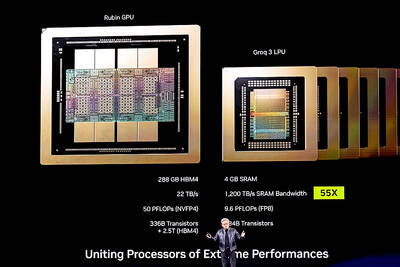
Taiwanese prosecutors suspect that three people successfully smuggled at least one shipment of Nvidia Corp artificial intelligence (AI) chips to China after first exporting them to Japan, people familiar with the matter said. The trio was detained last week by the Keelung District Prosecutors’ Office for allegedly falsifying documents related to exports of Super Micro Computer Inc servers containing advanced Nvidia chips, which the US has barred from sale to China without a license from Washington. The move marked Taiwan’s first public crackdown on AI chip diversion after years of pressure from the US to take a more active role in curtailing
Taiwan Semiconductor Manufacturing Co (TSMC, 台積電) employee bonuses are likely to grow more than 30 percent this year, in line with the past few years as the company’s profits continue to set new records, an anonymous source cited TSMC chairman C.C. Wei (魏哲家) as saying yesterday. TSMC, the world’s largest contract chipmaker, is committed to taking care of its workers, the source said, citing Wei’s meeting with employees yesterday morning. Wei also expressed gratitude to employees for their contribution to the company’s improving bottom line, the source added. Since 2023, TSMC’s employee bonuses have grown at an annual rate of


 RSS
RSS