


The war in the Middle East will lead to higher inflation and slower global growth, International Monetary Fund managing director Kristalina Georgieva told Reuters on Monday, ahead of a forecast for the world economy planned by the global lender for next week.
The war has triggered the worst-ever disruption in global energy supply, with millions of barrels of oil production shuttered due to Iran’s effective blockage of the Strait of Hormuz, crucial for shipping one-fifth of the world’s oil and gas. Even if the conflict is swiftly resolved, the IMF is set to reduce its forecast for economic growth and bump up its outlook for inflation, Georgieva said.
The war is expected to dominate discussions among finance officials from around the world at next week’s spring meetings of the IMF and World Bank in Washington. The Fund is expected to release a range of scenarios in its upcoming World Economic Outlook due on April 14. It signaled a possible downgrade in a March 30 blog post, citing the asymmetric shock of the war and tighter financial conditions.
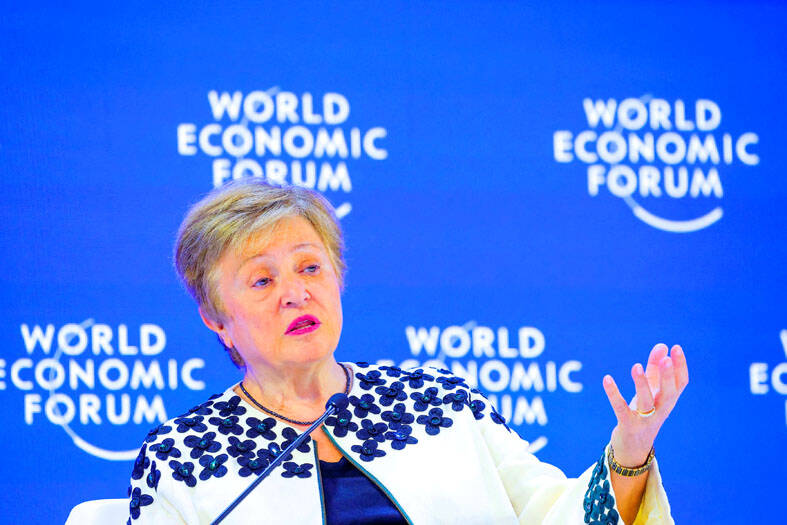
Photo: Denis Balibouse, Reuters
Without the war, Georgieva said the IMF had expected a small upgrade in its projection for global growth of 3.3 percent this year and 3.2 percent next year as economies continue to recover from the COVID-19 pandemic.
"Instead, all roads now lead to higher prices and slower growth," said Georgieva, who will preview the spring meetings in a speech on Thursday.
"We are in a world of elevated uncertainty," the IMF chief said, citing geopolitical tensions, technological advancements, climate shocks and demographic shifts. "All of this means that after we recover from this shock, we need to keep our eyes open for the next one."
The war has shrunk global oil supply by 13 percent, Georgieva said, with the impact rippling through oil and gas shipments and into related supply chains such as helium and fertilizers.
Even a rapid end to hostilities and a fairly rapid recovery will result in a "relatively small" downward revision of the growth forecast and an upward revision of its inflation forecast, she said. If the war is protracted, the effect on inflation and growth will be greater.
Poor, vulnerable countries with no energy reserves will be hardest hit, Georgieva added, noting that many countries had little to no fiscal space to help their populations weather the price increases caused by the war, which in turn also increased the prospects of social unrest.
Georgieva said some countries had already asked for funding help, but did not name them. She said the IMF could augment some existing lending programs to meet countries’ needs. Eighty-five percent of the IMF’s members are energy importers.
The impact has been asymmetric, hitting energy-importing countries hardest, but even energy exporters such as Qatar are feeling the effect from Iranian strikes against their production facilities.
Qatar expects it will take three to five years to restore 17 percent of its natural gas production because of the damage, Georgieva said, while the International Energy Agency has reported 72 energy facilities have been damaged in the war, one-third of which have suffered significant damage.
"Even if the war is to stop today, there would be a lingering negative impact to the rest of the world," she said.
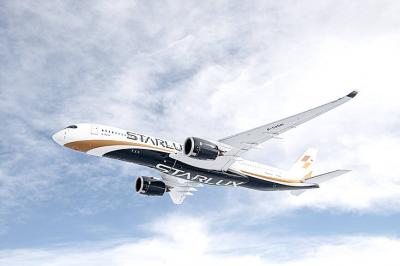
Starlux Airlines Co (星宇航空) today unveiled a long-haul network expansion plan at a shareholders’ meeting in Taipei, including direct flights to Barcelona, Spain, and Zurich, Switzerland, as well as a service connecting Taipei, Sydney and New Zealand. Starlux is to become the first Taiwanese carrier to offer non-stop services to the two European cities, while the inaugural oceanic route is expected to expand transit opportunities within the Australia-New Zealand market, Starlux said. Flight services to Chicago, Dallas, Washington and New York are under evaluation, the airline added. Prior to the shareholders’ meeting, the airline earlier this year announced that it would be

Netherlands-based semiconductor equipment supplier ASML Holding NV yesterday said that it is planning to hire an additional 1,000 people in Taiwan this year in response to growing demand from clients. ASML had previously planned to recruit 600 people this year, but that the plan has been adjusted upward, ASML vice president and ASML Taiwan general manager Grace Wang (汪佳慧) told reporters. ASML has a workforce of more than 4,500 in Taiwan, accounting for about 10 percent of its global total, Wang said. This year’s recruitment campaign would focus on adding people in the customer support, manufacturing and supply chain domains to assist ASML

UNDER MICROSCOPE: Taiwan detained three people who allegedly conspired to buy servers in Taiwan and export them using fraudulent documentation, prosecutors said Nvidia Corp chief executive officer Jensen Huang (黃仁勳) on Saturday urged Super Micro Computer Inc to tighten up on compliance after Taiwan detained three people this week for allegedly making fraudulent declarations about artificial intelligence (AI) servers made by its US partner. The development marked the nation’s first crackdown on semiconductor smuggling, which grew after the US slapped restrictions on exports of high-end chips such as Nvidia AI accelerators to China. Nvidia is “rigorous” in explaining regulations to all of its partners, Huang told reporters after arriving in Taipei. “Ultimately Super Micro has to run their own company,” he said in response to

Nvidia Corp yesterday announced that CEO Jensen Huang (黃仁勳) would attend an employee meeting in Taipei tomorrow to celebrate the launch of the company’s Taiwan headquarters project. Huang would attend a gathering at the site of Nvidia’s planned headquarters in Beitou Shilin Technology Park (北投士林科技園區), the company said in a statement. After arriving in Taiwan on Saturday last week, Huang told reporters that he plans to meet with Quanta Computer Inc (廣達) chairman Barry Lam (林百里) and Taiwan Semiconductor Manufacturing Co (TSMC, 台積電) chairman C.C. Wei (魏哲家), and would attend the groundbreaking ceremony for Nvidia’s Taiwan headquarters tomorrow. Nvidia has not yet applied


 RSS
RSS