


Good news for people who regret the Gmail address they came up with when they registered for an account: Google is now letting users change it.
Google started quietly rolling out the change late last year in India and said this week in a blog post that it is now available for all Google Account users in the US. There were no details on when it would be available to users in other countries.
Google chief executive officer Sundar Pichai suggested the update will be welcomed by people who want to keep their accounts but have outgrown the awkward, embarrassing or nonsensical Gmail handles they created after the service launched 22 years ago.
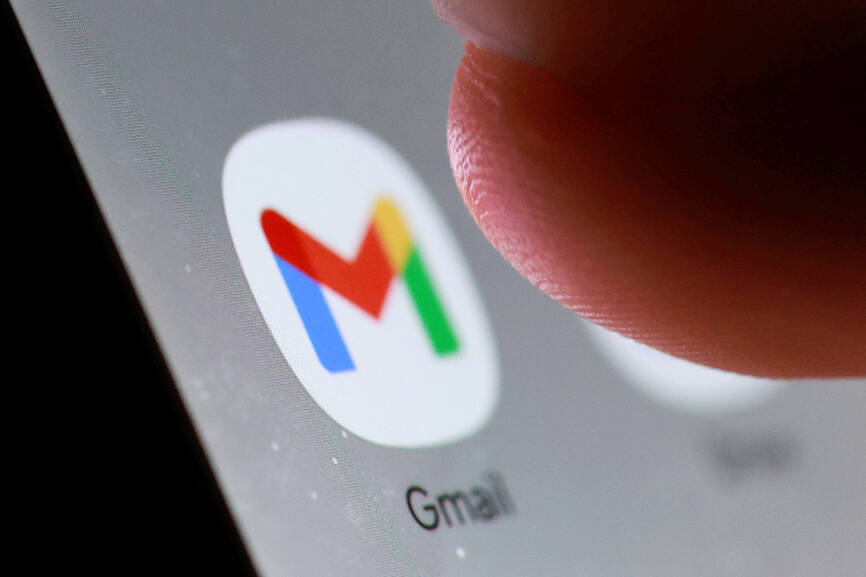
Photo: Reuters
“2004 was a good year, but your Gmail address does not need to be stuck in it,” Pichai wrote in a post on X, adding that the policy change means users could “say goodbye to v0t3f0rp3dr02004@gmail.com or mrbrightside416@gmail.com (or whatever you were into at the time).”
The company also updated a help page to reflect the new policy. Here is a quick run-through:
a simple process
The procedure is fairly easy to follow. First, go to your Google Account page. From the Google homepage in your computer browser or the Google mobile app, click the account icon in the top right corner, and then click or tap “Manage your Google Account,” then “Personal info,” then “E-mail.”
You should be able to click “Change Google Account e-mail.” If you do not see it, you might not have the option yet. Google says it is “gradually rolling out to all users.”
Now you will have to enter your new address, so make sure you have an idea for what you want. Then click to confirm that you want to make the change. Google says addresses cannot be identical to any existing address or one that was “used by someone in the past and then deleted.”
Second thoughts
But what if you miss your old Gmail address? Do not worry, you will still be able to access it because Google is effectively creating a second Gmail address.
The old address will remain as an alternate and messages sent to either the old or new addresses will appear in your Gmail inbox. To find out which address an e-mail was sent to, check the “to” field.
You can switch back to the old address by changing the settings in your Google account.
If you do not like the new Gmail address you have created, unfortunately you are out of luck — at least for the next year. Google will not let you create another Gmail address for your account until 12 months have passed. And you can only do so three times in total.
Potential issues
Gmail addresses are also used to sign in to other Google services like YouTube, Google Docs, as well as third-party websites and apps. However, the company warns that some non-Google apps and services might not recognize you with the new Gmail address, so it provided some troubleshooting tips on a help page.
Google also says Chromebook users might encounter problems, though many issues will go away after a few hours. It advises users to check a troubleshooting page, but warned that if the problems persist, “you may need to change back to your previous Google Account e-mail,” although the new address can still be used to send and receive messages.

Cairo’s new monorail slices across the city skyline, running above the familiar chaos of blaring horns and aging buses’ exhaust fumes that mark rush hour below. The US$4.5 billion monorail, opened this month, is among Egypt’s most prominent new transport projects, part of a debt-funded infrastructure drive criticized for sapping state finances while bringing limited benefits to most of the country’s 109 million people. “It feels like you’re in a different country,” said Ramy Sayed, a restaurant manager, aboard a driverless Innovia 300 train. “No noise, no traffic, we’re not used to this.” The eastern line runs 56km from the bustling middle-class

Taiwanese firms have increased investment in the Philippines in recent years as Manila’s ties with Washington deepen and global supply chains continue to shift away from China, an expert at the Chung-Hua Institution for Economic Research (CIER, 中華經濟研究院) said yesterday. The Philippines had not been among Taiwanese investors’ top choices in Southeast Asia, CIER Taiwan ASEAN Studies Center director Kristy Hsu (徐遵慈) said at a seminar in Taipei. However, Taiwan’s investment in the country has grown significantly since the COVID-19 pandemic, reaching US $257 million last year, a high in recent years, she said. Although Taiwan’s total investment in the Philippines still lags
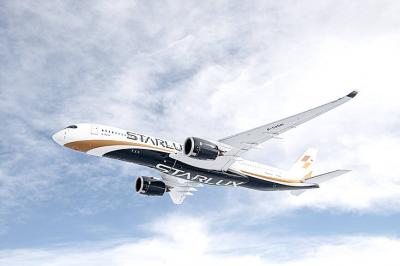
Starlux Airlines Co (星宇航空) today unveiled a long-haul network expansion plan at a shareholders’ meeting in Taipei, including direct flights to Barcelona, Spain, and Zurich, Switzerland, as well as a service connecting Taipei, Sydney and New Zealand. Starlux is to become the first Taiwanese carrier to offer non-stop services to the two European cities, while the inaugural oceanic route is expected to expand transit opportunities within the Australia-New Zealand market, Starlux said. Flight services to Chicago, Dallas, Washington and New York are under evaluation, the airline added. Prior to the shareholders’ meeting, the airline earlier this year announced that it would be

Intel Corp regards Taiwan Semiconductor Manufacturing Co (TSMC, 台積電) as a longstanding partner, as the US chipmaker would continue outsourcing production of advanced chips to TSMC, Intel chief executive officer Lip-Bu Tan (陳立武) said yesterday. “I don’t look at people as competitors. I look at the collaboration... Nvidia is also, you know, a good friend,” Tan told a news conference following his keynote speech at the Computex trade show in Taipei. “It’s a very trusted partnership for us... We are a big, top customer for them, and we’re going to continue doing that,” he said, referring to TSMC, the world’s largest foundry


 RSS
RSS