


Chunghwa Precision Test Technology Co (CHPT, 中華精測), a chip testing and wafer probing services provider, yesterday reported record-high quarterly revenue for last quarter totaling NT$1.36 billion (US$42.5 million), setting the scene for the company to report gradual growth each quarter this year driven by the artificial intelligence (AI) boom.
Revenue last quarter expanded 5.43 percent quarter-on-quarter from NT$1.29 billion in the fourth quarter last year and grew 18.26 percent year-on-year from NT$1.15 billion, bucking the downtrend in the traditional slow season.
Strong demand for high-seed load boards used in final testing for chips used in high-performance-computing (HPC) devices fueled revenue growth last month, setting an all-time high, CHPT said in a statement yesterday.
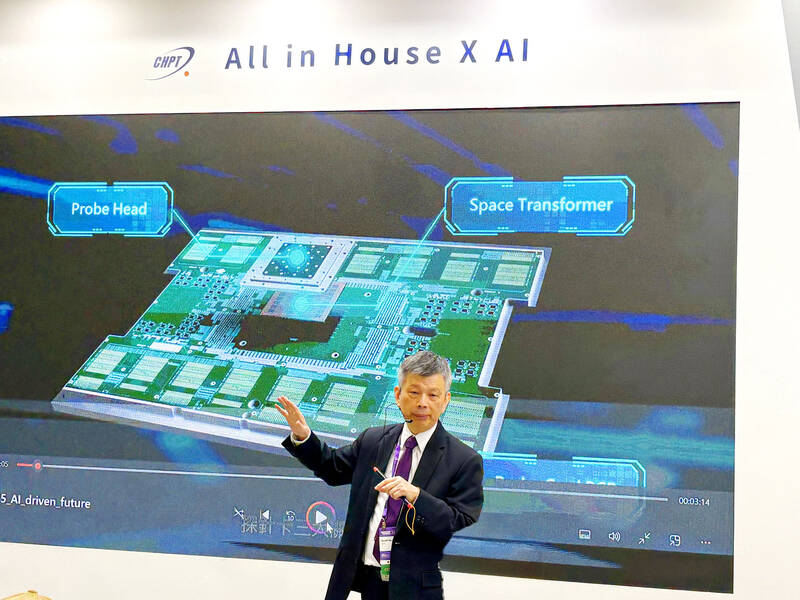
Photo: Lisa Wang, Taipei Times
Non-recurring engineering income from offering engineering verification services for application processors also helped propel revenue growth last month, it said.
By segment, HPC was the largest revenue contributor last year, making up 37 percent, followed by application processors’ 25 percent.
“As AI hardware is penetrating edge devices rather than only being adopted in cloud-based computing centers, demand for high-speed load boards increases rapidly,” CHPT said.
The growth was also driven by a shift in AI hardware from a content creator to a physical AI machine capable of perceiving, understanding and interacting with the physical world, CHPT said.
To cope with explosive demand from AI semiconductor customers, the company last month said it planned to invest NT$3.588 billion on building a new factory in Taoyuan’s Pingzhen District (平鎮).
The new factory, Fab 3, is expected to start operations in the second half of 2028, focusing on providing higher-price and advanced probe cards, as well as probe printed circuit boards for wafer testing and substrates for vertical probe cards.
The capacity expansion aims to meet increasing demand for high-end microelectro-mechanical systems, probe cards and substrates, further strengthening its capability to provide all-in-house services, the company said.
Before that, CHPT said it has adopted a strategic move by leasing a manufacturing facility to expand production capacity in the short term to adapt to strong and urgent demand from customers.
Separately, CHPT yesterday said it would seek an appeal against the first-instance judgement by Taiwan’s Intellectual and Commercial Court on a patent infringement lawsuit filed by Italy’s Technoprobe SPA.
An interlocutory judgement by the court determined that a semi-finished probe produced in one of CHPT’s experiments at the time the evidence was preserved falls within the scope of the patent in dispute. Technoprobe requested NT$31.65 million in damages.
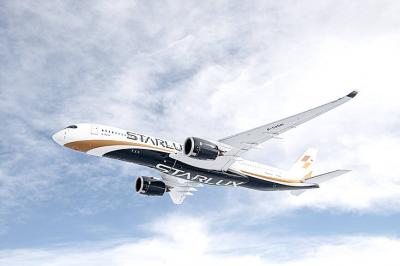
Starlux Airlines Co (星宇航空) today unveiled a long-haul network expansion plan at a shareholders’ meeting in Taipei, including direct flights to Barcelona, Spain, and Zurich, Switzerland, as well as a service connecting Taipei, Sydney and New Zealand. Starlux is to become the first Taiwanese carrier to offer non-stop services to the two European cities, while the inaugural oceanic route is expected to expand transit opportunities within the Australia-New Zealand market, Starlux said. Flight services to Chicago, Dallas, Washington and New York are under evaluation, the airline added. Prior to the shareholders’ meeting, the airline earlier this year announced that it would be

Netherlands-based semiconductor equipment supplier ASML Holding NV yesterday said that it is planning to hire an additional 1,000 people in Taiwan this year in response to growing demand from clients. ASML had previously planned to recruit 600 people this year, but that the plan has been adjusted upward, ASML vice president and ASML Taiwan general manager Grace Wang (汪佳慧) told reporters. ASML has a workforce of more than 4,500 in Taiwan, accounting for about 10 percent of its global total, Wang said. This year’s recruitment campaign would focus on adding people in the customer support, manufacturing and supply chain domains to assist ASML

UNDER MICROSCOPE: Taiwan detained three people who allegedly conspired to buy servers in Taiwan and export them using fraudulent documentation, prosecutors said Nvidia Corp chief executive officer Jensen Huang (黃仁勳) on Saturday urged Super Micro Computer Inc to tighten up on compliance after Taiwan detained three people this week for allegedly making fraudulent declarations about artificial intelligence (AI) servers made by its US partner. The development marked the nation’s first crackdown on semiconductor smuggling, which grew after the US slapped restrictions on exports of high-end chips such as Nvidia AI accelerators to China. Nvidia is “rigorous” in explaining regulations to all of its partners, Huang told reporters after arriving in Taipei. “Ultimately Super Micro has to run their own company,” he said in response to

Nvidia Corp yesterday announced that CEO Jensen Huang (黃仁勳) would attend an employee meeting in Taipei tomorrow to celebrate the launch of the company’s Taiwan headquarters project. Huang would attend a gathering at the site of Nvidia’s planned headquarters in Beitou Shilin Technology Park (北投士林科技園區), the company said in a statement. After arriving in Taiwan on Saturday last week, Huang told reporters that he plans to meet with Quanta Computer Inc (廣達) chairman Barry Lam (林百里) and Taiwan Semiconductor Manufacturing Co (TSMC, 台積電) chairman C.C. Wei (魏哲家), and would attend the groundbreaking ceremony for Nvidia’s Taiwan headquarters tomorrow. Nvidia has not yet applied


 RSS
RSS