


Taiwan’s manufacturing purchasing managers’ index (PMI) last month expanded for the sixth straight month, despite the Middle East conflict, the Chung-Hua Institution for Economic Research (CIER, 中華經濟研究院) said yesterday.
The gauge came in at 55.4, down 3.1 points from February, but still above the 50 mark, the Taipei-based think tank said.
A reading above 50 indicates expansion, while a figure below that threshold signals contraction.
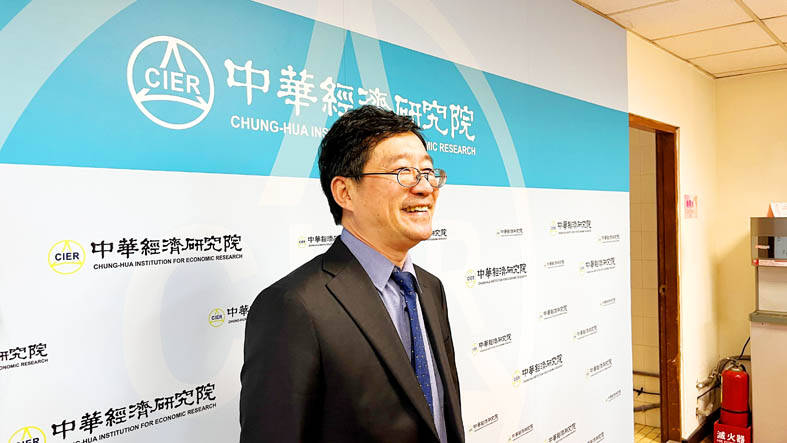
Photo: Liao Chia-ning, Taipei Times
CIER president Lien Hsien-ming (連賢明) attributed the 3.1-point decline to the intensifying Middle East conflict, which has driven up global commodity prices and disrupted supply chains.
The impact has been particularly pronounced in chemical-related industries, where rising oil prices have rapidly filtered through production chains.
“Price increases have spread from crude oil and naphtha downstream to key petrochemical products,” Lien said, adding that prices for basic chemicals such as ethylene, plastics and solvents have surged sharply.
Some suppliers have even suspended quotations or issued force majeure notices.
Upstream producers have also begun selectively allocating supply by raising prices, imposing quotas and delaying shipments, which reflects tightening market conditions and the shift in bargaining power toward sellers, Lien said.
As a result, the basic materials sector swung from contraction to expansion, jumping 15.3 points to 60.5, the fastest pace of growth since May 2022, CIER data showed.
However, the outlook for the chemical industry deteriorated sharply, with its six-month outlook plunging about 20 points, as companies turned more cautious about future demand should hostilities ease, the institute said.
The survey also showed geopolitical tensions disrupting maritime shipping capacity. The supplier delivery time index climbed to 66.3, the fastest increase since May 2022, indicating lengthening delivery times.
Meanwhile, the raw materials price index surged to 86, the highest level in nearly two years.
Despite these pressures, demand tied to artificial intelligence and semiconductor supply chains remained robust, helping support overall manufacturing activity, Lien said.
Technology companies have experienced relatively limited disruption compared with industries more exposed to petrochemical inputs, he added.
Still, business sentiment for the coming months cooled slightly. The six-month outlook index slipped to 61, suggesting that while manufacturers still expect expansion, confidence has weakened amid global uncertainty.
Taiwan’s energy pricing adjustment mechanism has helped cushion the broader economy from rising energy costs, Lien said.
“If the geopolitical conflict proves brief, the overall economic impact should remain manageable,” he said.
The institute expects the conflict to settle quickly, citing geopolitical considerations — including the upcoming US midterm elections — that could encourage a swift resolution.
Separately, Taiwan’s non-manufacturing sector continued to grow steadily, with the non-manufacturing index rising 0.9 points to 54.3 last month — its 13th consecutive month of expansion, the institute said.
While service-sector activity remained stable, businesses are closely monitoring geopolitical developments and commodity price movements for signs of further disruption, Lien said.
After several years flying high as Asia’s best Nvidia Corp proxy, Taiwan Semiconductor Manufacturing Co (TSMC, 台積電) is increasingly vying with other artificial intelligence (AI) stocks for investor attention. Stock traders are chasing a wider array of beneficiaries as mainstream usage of AI creates demand for hardware beyond the most-advanced chips TSMC makes for Nvidia. Subthemes from the deepening memory crunch to advances in robotics are also luring bids. At the same time, investment caps on single stocks are pushing funds to diversify, while retail investors long familiar with TSMC through its US depositary receipts are being offered a broader set of

UNDER MICROSCOPE: Taiwan detained three people who allegedly conspired to buy servers in Taiwan and export them using fraudulent documentation, prosecutors said Nvidia Corp chief executive officer Jensen Huang (黃仁勳) on Saturday urged Super Micro Computer Inc to tighten up on compliance after Taiwan detained three people this week for allegedly making fraudulent declarations about artificial intelligence (AI) servers made by its US partner. The development marked the nation’s first crackdown on semiconductor smuggling, which grew after the US slapped restrictions on exports of high-end chips such as Nvidia AI accelerators to China. Nvidia is “rigorous” in explaining regulations to all of its partners, Huang told reporters after arriving in Taipei. “Ultimately Super Micro has to run their own company,” he said in response to
TECH RELIANCE: Growth is increasingly reflecting an unequal K-shaped distribution, where technology sectors outperform and other industries struggle, an expert said Standard Chartered Bank has significantly raised its forecast for Taiwan’s economic growth to 9.5 percent this year, up from 7.6 percent previously, citing surging artificial intelligence (AI) demand driving exports, semiconductor production and investment. The upgrade reflects a sustained AI supercycle that continues to fuel demand for advanced chips and technology infrastructure, which form the backbone of Taiwan’s exports, the bank said in a report this week. “We raise our 2026 growth forecast to reflect a much stronger-than-expected first-quarter GDP figure,” Standard Chartered senior economist for greater China and Asia Tommy Wu (胡東安) said in the report. Driven largely by a 35.3 percent

Netherlands-based semiconductor equipment supplier ASML Holding NV yesterday said that it is planning to hire an additional 1,000 people in Taiwan this year in response to growing demand from clients. ASML had previously planned to recruit 600 people this year, but that the plan has been adjusted upward, ASML vice president and ASML Taiwan general manager Grace Wang (汪佳慧) told reporters. ASML has a workforce of more than 4,500 in Taiwan, accounting for about 10 percent of its global total, Wang said. This year’s recruitment campaign would focus on adding people in the customer support, manufacturing and supply chain domains to assist ASML


 RSS
RSS