


The dominance of China’s open-source artificial intelligence (AI) is creating a "self-reinforcing competitive advantage," allowing it to challenge US rivals despite restricted access to advanced AI chips, a US congressional advisory body said yesterday.
Driven by their cheaper cost, Chinese large language models from firms including Alibaba Group Holding Ltd (阿里巴巴), Moonshot AI Technology Co (月之暗面) and MiniMax Group Inc (稀宇科技) now dominate worldwide usage rankings on platforms like HuggingFace and OpenRouter.
Beijing’s push to deploy AI throughout a wide range of sectors to upgrade its manufacturing base, factories, logistics networks and robotics is generating real-world data that feeds back into model improvement, the report said.
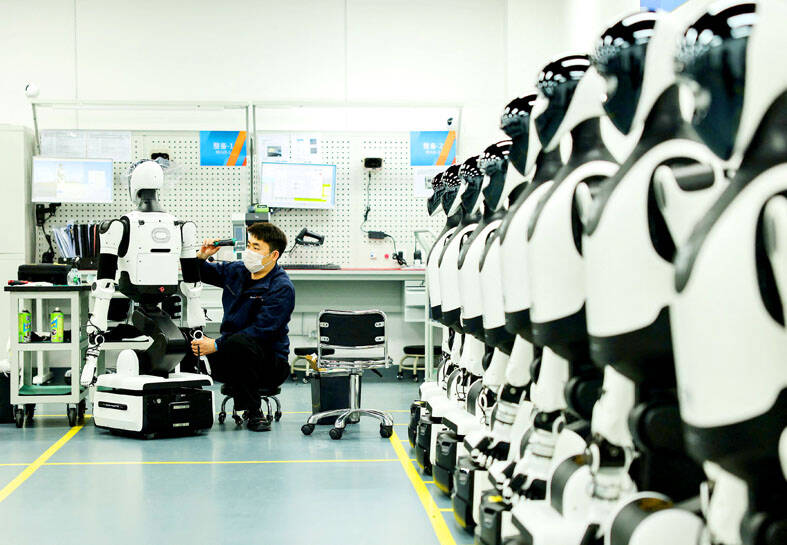
Photo: Maxim Shemetov, Reuters
"This open ecosystem enables China to innovate close to the frontier despite significant compute constraints," the US-China Economic and Security Review Commission (USCC) wrote in a report.
"Chinese labs have narrowed performance gaps with top Western large language models," it added.
US lawmakers have imposed successive rounds of export restrictions on China since 2022, banning them from acquiring the most advanced AI chips, though Washington approved exports of Nvidia Corp’s second-most advanced chip in December last year.
US companies including ChatGPT developer OpenAI and Anthropic PBC, creator of Claude, as well as traditional tech giants have invested billions of dollars to remain at the forefront of the new technology.
But their position could be under threat.
"Open model proliferation creates alternative pathways to AI leadership," the report said.
Some estimates suggest that around 80 percent of US AI start-ups now use Chinese open-source AI models.
DeepSeek’s (深度求索) groundbreaking R1 model launched last year quickly overtook ChatGPT as the most downloaded model on the US App Store. And Alibaba’s Qwen family of models has surpassed Meta Platforms Inc’s Llama in global cumulative downloads, according to HuggingFace.
As AI’s frontiers shift from large language models toward agentic AI and physical, or embodied, AI, China may be better positioned to capitalize on its mass data collection efforts to boost development of humanoid robots, autonomous driving software or even dual-purpose technologies, the report said.
"There’s a bit of a deployment gap in the embodied AI space between the US and China. That’s something that over time compounds itself ... We’re starting to see that compounding now," USCC vice chairman Michael Kuiken told Reuters in an interview.
The commission is also watching how China uses AI in sectors like biotech, quantum computing and advanced materials, he added.
Beijing has designated embodied AI as a core future strategic industry, and many leading Chinese humanoid robotics firms plan public listings this year.
Despite warnings from some Western research organisations of the potential security risks of an over-reliance on Chinese open-source AI models and their political bias toward Chinese government positions, many companies are adopting them anyway.

Cairo’s new monorail slices across the city skyline, running above the familiar chaos of blaring horns and aging buses’ exhaust fumes that mark rush hour below. The US$4.5 billion monorail, opened this month, is among Egypt’s most prominent new transport projects, part of a debt-funded infrastructure drive criticized for sapping state finances while bringing limited benefits to most of the country’s 109 million people. “It feels like you’re in a different country,” said Ramy Sayed, a restaurant manager, aboard a driverless Innovia 300 train. “No noise, no traffic, we’re not used to this.” The eastern line runs 56km from the bustling middle-class

Starlux Airlines Co (星宇航空) today unveiled a long-haul network expansion plan at a shareholders’ meeting in Taipei, including direct flights to Barcelona, Spain, and Zurich, Switzerland, as well as a service connecting Taipei, Sydney and New Zealand. Starlux is to become the first Taiwanese carrier to offer non-stop services to the two European cities, while the inaugural oceanic route is expected to expand transit opportunities within the Australia-New Zealand market, Starlux said. Flight services to Chicago, Dallas, Washington and New York are under evaluation, the airline added. Prior to the shareholders’ meeting, the airline earlier this year announced that it would be

Taiwanese firms have increased investment in the Philippines in recent years as Manila’s ties with Washington deepen and global supply chains continue to shift away from China, an expert at the Chung-Hua Institution for Economic Research (CIER, 中華經濟研究院) said yesterday. The Philippines had not been among Taiwanese investors’ top choices in Southeast Asia, CIER Taiwan ASEAN Studies Center director Kristy Hsu (徐遵慈) said at a seminar in Taipei. However, Taiwan’s investment in the country has grown significantly since the COVID-19 pandemic, reaching US $257 million last year, a high in recent years, she said. Although Taiwan’s total investment in the Philippines still lags

Taiwanese prosecutors suspect that three people successfully smuggled at least one shipment of Nvidia Corp artificial intelligence (AI) chips to China after first exporting them to Japan, people familiar with the matter said. The trio was detained last week by the Keelung District Prosecutors’ Office for allegedly falsifying documents related to exports of Super Micro Computer Inc servers containing advanced Nvidia chips, which the US has barred from sale to China without a license from Washington. The move marked Taiwan’s first public crackdown on AI chip diversion after years of pressure from the US to take a more active role in curtailing


 RSS
RSS