


Three people associated with artificial intelligence (AI) server maker Super Micro Computer Inc, including its cofounder, were charged with helping smuggle at least US$2.5 billion of US AI technology via Taiwan to China in contravention of export laws, the US Department of Justice said yesterday.
US prosecutors did not name Super Micro in the complaint, referring only to a "US manufacturer." San Jose, California-based Super Micro said that federal prosecutors informed it of the indictment yesterday.
The company itself was not named as a defendant in the case, it said, adding that it had cooperated with investigators.
Photo: Ann Wang, Reuters
The department said that it had charged Liaw Yih-shyan (廖益賢), Chang Ruei-tsang (張瑞滄), and Sun Ting-wei (孫廷瑋) in an indictment unsealed in federal court in Manhattan yesterday, on allegations of a complex scheme to send US-made servers through Taiwan to other countries in Southeast Asia, where they were swapped into unmarked boxes and sent onward to China.
The US has had export restrictions on China for advanced AI chips since 2022.
Liaw cofounded Super Micro in 1993, and joined its board of directors in 2023. Chang was a sales manager in the Taiwan office of Super Micro, while Sun was a contractor.
US officials allege the three took extensive measures to conceal their activity from the US-based makers of the servers and US export control officials, even using hair dryers to remove labels and serial numbers from the real machines and placing them on dummy machines left behind after the real machines had been shipped to China.
Super Micro said it placed Liaw and Chang on leave and terminated its ties with Sun, who was a contractor, after being made aware of the charges yesterday.
The company's shares fell 8 percent in after-hours trading following the news.
US officials did not name which chips were involved in the alleged scheme, but Nvidia Corp dominates the market for AI chips and its offerings command some of the highest prices.
In a statement, Nvidia, which sells chips to Super Micro and other server makers, said that "strict compliance" with export laws is a top priority.
"We continue to work closely with our customers and the government on compliance programs as export regulations have expanded," an Nvidia spokesperson said. "Unlawful diversion of controlled US computers to China is a losing proposition across the board — NVIDIA does not provide any service or support for such systems, and the enforcement mechanisms are rigorous and effective."
Nvidia did not immediately respond to a question about whether the company was aware of the alleged smuggling activity.
Reuters in 2024 reported that China acquired banned Nvidia chips from Super Micro servers, among others.
Prosecutors said the alleged coconspirators took servers that were assembled in the US and shipped them to facilities in Taiwan, both locations where Super Micro has facilities.
From there, the servers were sent to other countries in Southeast Asia, where they were put in unmarked boxes before being sent to China, prosecutors said.
The coconspirators worked to deceive the US manufacturer's compliance teams by staging thousands of "dummy" servers — non-working replicas of the actual computers — for inspection, when the real servers had been shipped to China, prosecutors said.
Surveillance video footage showed workers using hair dryers to remove labels from the real servers and putting them on dummy servers, the department said.
"The defendants’ scheme became more brazen over time and resulted in massive quantities of servers with controlled US artificial intelligence technology being sent to China," the department said in a statement.
More than US$500 million worth of servers were diverted to China between April and mid-May last year, it added.
Liaw, a US citizen, and Sun, a Taiwanese citizen, were yesterday arrested, while Chang, a Taiwanese citizen, remains a fugitive, the department said.
Liaw, in particular, was well-known in Silicon Valley, where Super Micro builds computers using chips from some of the region's biggest firms such as Nvidia, Intel Corp and Advanced Micro Devices Inc.
He actively welcomed customers to the company's headquarters, attended a groundbreaking ceremony for one of Micron Technology's new factories and met with Micron CEO Sanjay Mehrotra, posts on his LinkedIn profile showed.
On Monday, Nvidia CEO Jensen Huang (黃仁勳) walked the floor of Nvidia's massive developer conference meeting and met executives from key partners such as Samsung Electronics Co and SK Hynix Inc. When Huang stopped at Super Micro's booth to shake hands with Super Micro cofounder and CEO Charles Liang (梁見後), Liaw was standing nearby, a photograph posted by Super Micro on X showed.
Liaw did not respond to an e-mailed request for comment at his Super Micro address or a call at a phone number listed for him.
"The conduct by these individuals alleged in the indictment is a contravention of the company's policies and compliance controls, including efforts to circumvent applicable export control laws and regulations," Super Micro said.

DAMAGE REPORT: Global central banks are assessing war-driven inflation risks as the law of unintended consequences careens around the world, spiking oil prices Central banks from Washington to London and from Jakarta to Taipei are about to make their first assessments of economic damage after more than two weeks of conflict between the US and Iran. Decisions this week encompassing every member of the G7 and eight of the world’s 10 most-traded currency jurisdictions are likely to confirm to investors that the specter of a new inflation shock is already worrying enough to prompt heightened caution. The US Federal Reserve is widely expected to do exactly what everyone anticipated weeks ahead of its March 17-18 policy gathering: hold rates steady. The narrative surrounding that
Taiwan Semiconductor Manufacturing Co’s (TSMC, 台積電) share of the global foundry market rose to almost 70 percent last year amid booming demand for artificial intelligence (AI), market information advisory firm TrendForce Corp (集邦科技) said on Thursday. The contract chipmaker posted US$122.54 billion in revenue, up 36.1 percent from a year earlier, accounting for 69.9 percent of the global market, TrendForce said. Its share was up from 64.4 percent in 2024, it said. TSMC’s closest rival, Samsung Electronics, was a distant second, posting US$12.63 billion in sales, down 3.9 percent from a year earlier, for a 7.2 percent share of the global market. In the
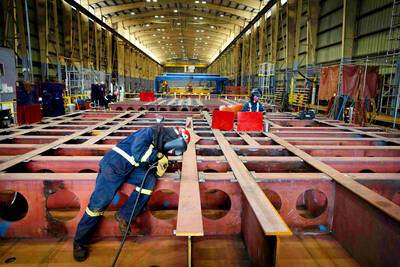
At a massive shipyard in North Vancouver, Canadian workers grind metal beams for a powerful new icebreaker crucial to cementing the country’s presence in the increasingly contested arctic. Icebreakers are specialized, expensive vessels able to navigate in the frozen far north. And “this is the crown jewel,” said Eddie Schehr, vice president of production at the Seaspan shipyard. For Canadian Prime Minister Mark Carney, who heads to Norway next Friday to observe arctic defense drills involving troops from 14 NATO states, Canada’s extreme north has emerged as a strategic priority. “Canada is and forever will be an Arctic nation,” he said ahead of

Chinese entrepreneur Frank Gao used to spend long hours running his social media accounts but now outsources the chore to artificial intelligence (AI) agent tool OpenClaw, which is taking China by storm despite official warnings over cybersecurity. OpenClaw, created in November by an Austrian coder, differs from bots such as ChatGPT because it can execute real-life tasks such as sending e-mails, organizing files or even booking flight tickets. “Since January, I’ve spent hours on the lobster every day,” Gao said in an interview, referring to OpenClaw’s red crustacean mascot. “We’re family.” After downloading OpenClaw, users connect it to artificial intelligence models of their


 RSS
RSS