


Micron Technology Inc warned that it would need to spend heavily on production to meet burgeoning demand, overshadowing an upbeat forecast from the largest US maker of computer memory chips.
Capital spending would exceed US$25 billion this fiscal year, which runs through August, the company said as part of its quarterly report on Wednesday. Analysts had estimated US$22.4 billion.
Micron added that next year’s expenditures would increase more than US$10 billion from the prior year.
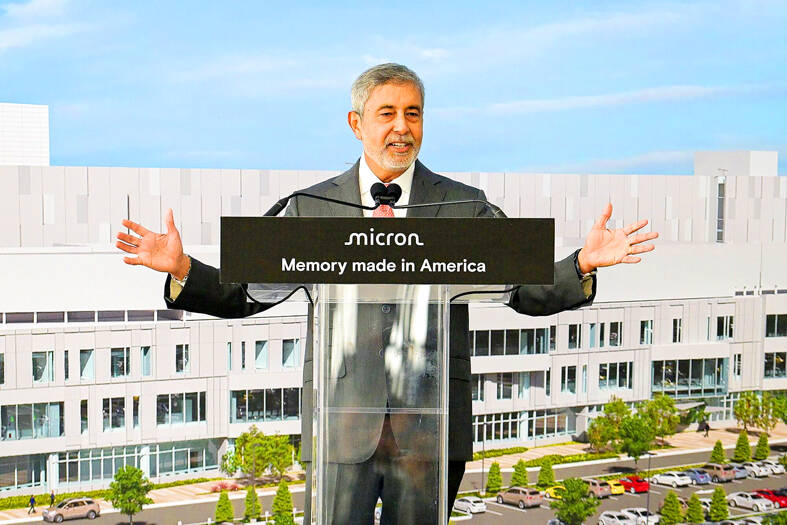
Photo: Bloomberg
“We project our fiscal 2027 capex to step up meaningfully,” chief executive officer Sanjay Mehrotra said during a conference call.
The heavy spending reflects the cost of keeping up with an insatiable appetite for Micron’s memory chips, especially high-bandwidth components used in artificial intelligence (AI) computing.
Fiscal third-quarter revenue would be approximately US$33.5 billion, the Idaho-based company said.
Analysts estimated US$23.7 billion on average for the period. Excluding some items, profit would be about US$19.15 a share, compared with a projection of US$11.29.
Memory prices have been soaring because of shortages fueled by AI computing demand. High-bandwidth memory is critical to the data transfer needed for training and running AI models. That has led memory makers to allocate more production to these higher-margin orders, hurting supply of other types of memory and causing price spikes.
Micron shares had risen 62 percent this year heading into the report, making it the best-performing stock on the closely watched Philadelphia Stock Exchange Semiconductor Index.
For the fiscal second quarter, which ended on Feb. 26, sales nearly tripled to US$23.9 billion. Earnings climbed to US$12.20 per share. Analysts had estimated US$19.7 billion in revenue and US$9 per share in profit on average.
The company has benefited from an unprecedented data center build-out. Their market is dominated by just three providers — Micron, Samsung Electronics Co and SK Hynix Inc — and demand is expected to stay strong for years to come.
Memory shortages have been good for Micron and its peers, but hard on the broader technology industry and consumers. Supply constraints have raised prices and lowered the number of smartphones and computers slated to ship this year.
HP Inc last month said that the company has seen memory prices roughly double this quarter from the previous period.
The global shortage is likely to persist for another four to five years because of endemic constraints in semiconductor production, SK Group chairman Chey Tae-won said this week.
In the AI market, Micron is working to ramp up production of new high-bandwidth memory, or HBM4. A big question is how much Nvidia Corp would rely on Micron for that component.
Any decision by Nvidia to limit its use of Micron for the new Vera Rubin line — and instead favor rival products — would be a significant blow.
Nvidia is the dominant maker of AI accelerators, the main processors used to power AI. Memory components from Micron and its competitors assist those chips in holding and managing data.
Last month, Micron shares surged after chief financial officer Mark Murphy assured investors that the company is producing HBM4 in high volumes.

Netherlands-based semiconductor equipment supplier ASML Holding NV yesterday said that it is planning to hire an additional 1,000 people in Taiwan this year in response to growing demand from clients. ASML had previously planned to recruit 600 people this year, but that the plan has been adjusted upward, ASML vice president and ASML Taiwan general manager Grace Wang (汪佳慧) told reporters. ASML has a workforce of more than 4,500 in Taiwan, accounting for about 10 percent of its global total, Wang said. This year’s recruitment campaign would focus on adding people in the customer support, manufacturing and supply chain domains to assist ASML

UNDER MICROSCOPE: Taiwan detained three people who allegedly conspired to buy servers in Taiwan and export them using fraudulent documentation, prosecutors said Nvidia Corp chief executive officer Jensen Huang (黃仁勳) on Saturday urged Super Micro Computer Inc to tighten up on compliance after Taiwan detained three people this week for allegedly making fraudulent declarations about artificial intelligence (AI) servers made by its US partner. The development marked the nation’s first crackdown on semiconductor smuggling, which grew after the US slapped restrictions on exports of high-end chips such as Nvidia AI accelerators to China. Nvidia is “rigorous” in explaining regulations to all of its partners, Huang told reporters after arriving in Taipei. “Ultimately Super Micro has to run their own company,” he said in response to

Nvidia Corp yesterday announced that CEO Jensen Huang (黃仁勳) would attend an employee meeting in Taipei tomorrow to celebrate the launch of the company’s Taiwan headquarters project. Huang would attend a gathering at the site of Nvidia’s planned headquarters in Beitou Shilin Technology Park (北投士林科技園區), the company said in a statement. After arriving in Taiwan on Saturday last week, Huang told reporters that he plans to meet with Quanta Computer Inc (廣達) chairman Barry Lam (林百里) and Taiwan Semiconductor Manufacturing Co (TSMC, 台積電) chairman C.C. Wei (魏哲家), and would attend the groundbreaking ceremony for Nvidia’s Taiwan headquarters tomorrow. Nvidia has not yet applied

Huawei Technologies Co (華為) said it has come up with a new pathway to shorten its gap with industry leader Taiwan Semiconductor Manufacturing Co (TSMC, 台積電), potentially achieving a breakthrough in making advanced semiconductors without cutting-edge equipment. Right now there is about a five-year gap between what TSMC is capable of and what Huawei, together with its manufacturing partner Semiconductor Manufacturing International Corp (中芯), can produce. Huawei is to start making 1.4-nanometer chips by 2031 with its own “LogicFolding” technology, Huawei semiconductor chief He Tingbo (何庭波) said in a rare public appearance during a chip conference yesterday, while TSMC has


 RSS
RSS