


Taiwan’s central bank yesterday kept key interest rates unchanged for the eighth consecutive quarter, sharply raised its GDP growth forecast and eased credit limits on second-home mortgages, signaling confidence in the economy while supporting self-occupying buyers amid a cooling property market.
The central bank said it would leave the discount rate, collateralized lending rate and short-term lending rate at 2 percent, 2.375 percent and 4.25 percent respectively.
It lifted its GDP growth projection for this year to 7.28 percent, up from a previous estimate of 3.67 percent, citing robust export demand fueled by emerging technology applications linked to artificial intelligence.
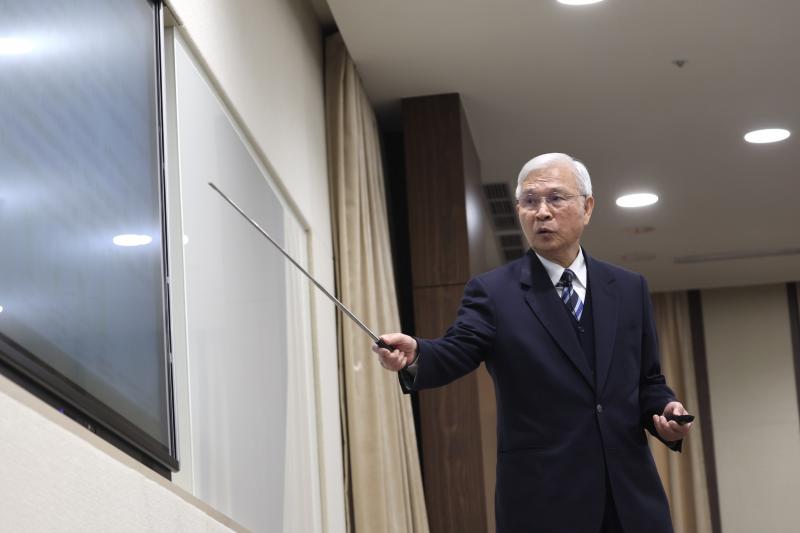
Photo: CNA
“We raised our GDP projection while acknowledging that ongoing Middle East conflicts could pose headwinds,” Governor Yang Chin-long (楊金龍) said. “If these risks persist, we will take them into account in the second-quarter outlook.”
Inflation expectations were revised slightly higher, with the consumer price index forecast at 1.8 percent, up from 1.63 percent, reflecting elevated global commodity prices, particularly crude oil, Yang said.
The central bank did not factor in Middle East tensions partly because the government has announced measures to stabilize prices.
“The government has taken steps to temper inflation pressures, and there is no need for rate hikes at this stage,” Yang said, adding that the outlook for the second quarter would consider potential risks if geopolitical conflicts persist and that policy actions would be taken if public expectations of price hikes intensify.
On housing, the central bank said it would moderately ease restrictions on second-home mortgages to accommodate genuine demand.
Effective from today, the loan-to-value ratio for second homes for individual buyers would rise to 60 percent from 50 percent.
Credit controls introduced in September 2024 have helped cool housing transactions, reduce lending concentration and rein in excessive price expectations, Yang said.
Data showed real estate lending concentration fell to 36 percent last month from a peak of 37.6 percent in June 2024, while growth in property-related loans slowed. Housing loans expanded 4.5 percent in the first two months of this year, down from a peak of 11.3 percent, and construction loan growth eased to 1.5 percent.
The easing should not be interpreted as a return to loose credit policies, Yang said.
“Expansive credit loosening is not appropriate as the market just entered the much-hoped-for soft landing,” he said.
Banks would continue submitting monthly reports on property lending, and the central bank would conduct inspections to monitor compliance and lending concentration, he added.
The governor stressed that a hard landing is not the central bank’s goal.
“We aim to avoid a property market slump like China’s, where stringent credit restrictions triggered years of steep price declines,” Yang said.

Cairo’s new monorail slices across the city skyline, running above the familiar chaos of blaring horns and aging buses’ exhaust fumes that mark rush hour below. The US$4.5 billion monorail, opened this month, is among Egypt’s most prominent new transport projects, part of a debt-funded infrastructure drive criticized for sapping state finances while bringing limited benefits to most of the country’s 109 million people. “It feels like you’re in a different country,” said Ramy Sayed, a restaurant manager, aboard a driverless Innovia 300 train. “No noise, no traffic, we’re not used to this.” The eastern line runs 56km from the bustling middle-class
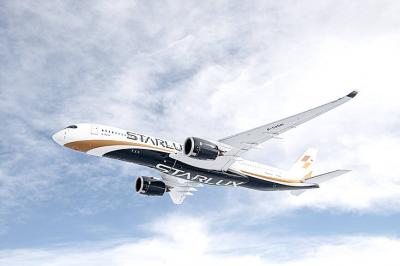
Starlux Airlines Co (星宇航空) today unveiled a long-haul network expansion plan at a shareholders’ meeting in Taipei, including direct flights to Barcelona, Spain, and Zurich, Switzerland, as well as a service connecting Taipei, Sydney and New Zealand. Starlux is to become the first Taiwanese carrier to offer non-stop services to the two European cities, while the inaugural oceanic route is expected to expand transit opportunities within the Australia-New Zealand market, Starlux said. Flight services to Chicago, Dallas, Washington and New York are under evaluation, the airline added. Prior to the shareholders’ meeting, the airline earlier this year announced that it would be

Taiwanese prosecutors suspect that three people successfully smuggled at least one shipment of Nvidia Corp artificial intelligence (AI) chips to China after first exporting them to Japan, people familiar with the matter said. The trio was detained last week by the Keelung District Prosecutors’ Office for allegedly falsifying documents related to exports of Super Micro Computer Inc servers containing advanced Nvidia chips, which the US has barred from sale to China without a license from Washington. The move marked Taiwan’s first public crackdown on AI chip diversion after years of pressure from the US to take a more active role in curtailing
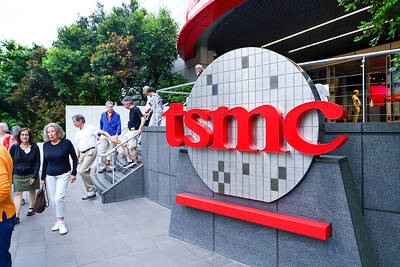
Taiwan Semiconductor Manufacturing Co (TSMC, 台積電) employee bonuses are likely to grow more than 30 percent this year, in line with the past few years as the company’s profits continue to set new records, an anonymous source cited TSMC chairman C.C. Wei (魏哲家) as saying yesterday. TSMC, the world’s largest contract chipmaker, is committed to taking care of its workers, the source said, citing Wei’s meeting with employees yesterday morning. Wei also expressed gratitude to employees for their contribution to the company’s improving bottom line, the source added. Since 2023, TSMC’s employee bonuses have grown at an annual rate of


 RSS
RSS