


Nvidia Corp chief executive officer Jensen Huang said the company is spinning up manufacturing of the H200 artificial intelligence (AI) accelerators for customers in China, a sign of progress in the chipmaker’s effort to re-enter the market.
At a news conference on Tuesday, Huang said Nvidia had been licensed for “many customers in China” for H200 sales and is in the process of “restarting our manufacturing.”
That outlook is different than it was a couple of weeks ago, he said.
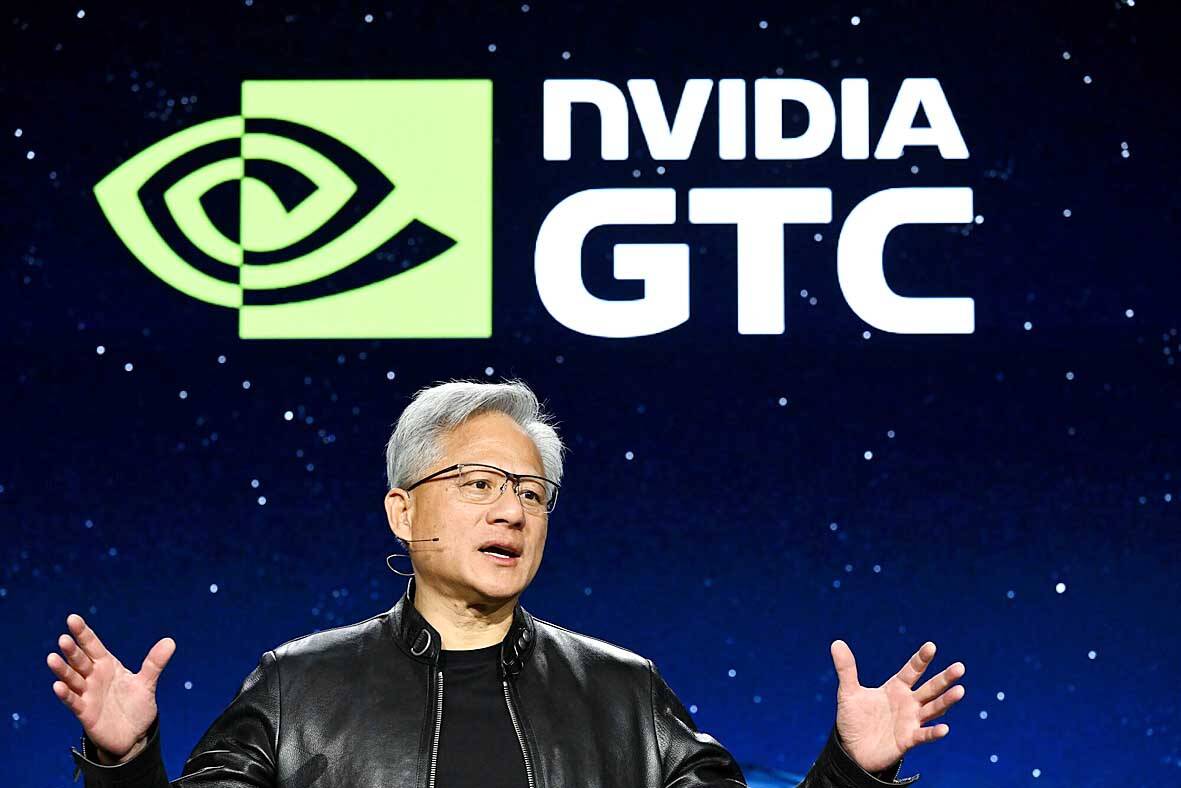
Photo: Bloomberg
“Our supply chain is getting fired up,” Huang said during the event, part of the company’s annual GPU Technology Conference in San Jose, California. The company unveiled a flurry of new products at the expo on Monday and gave investors a financial update on Tuesday morning.
Nvidia has been working to reestablish sales of its AI processors in China, a market that was virtually closed to such products by US export restrictions. US President Donald Trump’s administration has begun allowing Nvidia and rival Advanced Micro Devices Inc to sell less-powerful versions of their chips in the country, but licenses from the US government are required.
Though the H200 is less advanced than Nvidia’s current AI accelerators — used to train and run AI models — it is still more powerful than what is available locally in China. Nvidia’s top-of-the-range chips, the Blackwell and forthcoming Vera Rubin series, remain banned for sale in China.
Nvidia got Trump’s nod to sell H200s to Chinese customers in December last year, but the company has yet to tally any revenue from such sales. Rulemakers in Washington have also imposed hurdles that slowed formal approvals and make a return to unfettered sales unlikely.
H200 shipments to China are subject to a US inspection and a 25 percent duty. Officials are also considering capping H200 sales to 75,000 chips per Chinese customer, with total shipments reaching up to 1 million processors.
Nvidia is also preparing a version of Groq Inc’s AI chip that can be sold to the Chinese market, which was reported earlier on Tuesday, citing two sources familiar with the matter.
The company plans to tap Groq chips for inference, where AI systems answer questions, write code or carry out tasks for users.
While Nvidia dominates the market for training AI systems, it faces much more competition in the inference market. Several major Chinese firms, including AI heavyweights such as Baidu Inc (百度), already produce their own inference chips.
The chips being readied for China are not downgraded versions or made specifically for the Chinese market, one of the sources said. However, the new variant can be adapted to work with other systems, the source said, adding that the Groq chip is expected to be available in May.
Nvidia did not immediately respond to a request for comment.
Additional reporting by Reuters

Cairo’s new monorail slices across the city skyline, running above the familiar chaos of blaring horns and aging buses’ exhaust fumes that mark rush hour below. The US$4.5 billion monorail, opened this month, is among Egypt’s most prominent new transport projects, part of a debt-funded infrastructure drive criticized for sapping state finances while bringing limited benefits to most of the country’s 109 million people. “It feels like you’re in a different country,” said Ramy Sayed, a restaurant manager, aboard a driverless Innovia 300 train. “No noise, no traffic, we’re not used to this.” The eastern line runs 56km from the bustling middle-class
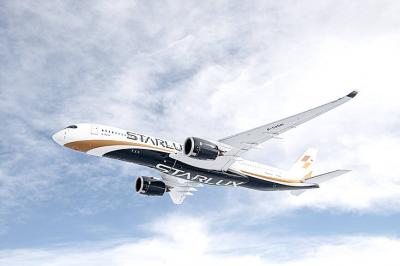
Starlux Airlines Co (星宇航空) today unveiled a long-haul network expansion plan at a shareholders’ meeting in Taipei, including direct flights to Barcelona, Spain, and Zurich, Switzerland, as well as a service connecting Taipei, Sydney and New Zealand. Starlux is to become the first Taiwanese carrier to offer non-stop services to the two European cities, while the inaugural oceanic route is expected to expand transit opportunities within the Australia-New Zealand market, Starlux said. Flight services to Chicago, Dallas, Washington and New York are under evaluation, the airline added. Prior to the shareholders’ meeting, the airline earlier this year announced that it would be
Taiwanese prosecutors suspect that three people successfully smuggled at least one shipment of Nvidia Corp artificial intelligence (AI) chips to China after first exporting them to Japan, people familiar with the matter said. The trio was detained last week by the Keelung District Prosecutors’ Office for allegedly falsifying documents related to exports of Super Micro Computer Inc servers containing advanced Nvidia chips, which the US has barred from sale to China without a license from Washington. The move marked Taiwan’s first public crackdown on AI chip diversion after years of pressure from the US to take a more active role in curtailing
Taiwan Semiconductor Manufacturing Co (TSMC, 台積電) employee bonuses are likely to grow more than 30 percent this year, in line with the past few years as the company’s profits continue to set new records, an anonymous source cited TSMC chairman C.C. Wei (魏哲家) as saying yesterday. TSMC, the world’s largest contract chipmaker, is committed to taking care of its workers, the source said, citing Wei’s meeting with employees yesterday morning. Wei also expressed gratitude to employees for their contribution to the company’s improving bottom line, the source added. Since 2023, TSMC’s employee bonuses have grown at an annual rate of


 RSS
RSS