


The economic fallout from the war in the Middle East is spreading outside the region.
Persian Gulf ports have turned into military targets. The vital Strait of Hormuz is effectively closed, sending fuel costs and shipping rates soaring. Vessels cannot reach a container hub that handles more volume than Rotterdam between four continents. Air cargo halted for a week would need time to work through backlogs as local carriers look to resume flights soon.
For companies exposed to the region, the risks are shortages of crucial components, higher costs and thinner profit margins. If that trickles down to stores, it is another potential squeeze on consumers at a time many are already struggling with day-to-day expenses.
Photo: AFP
Across financial markets, stocks, bonds and havens such as the US dollar are reflecting those inflation concerns as well as the threats to households and businesses. Those are especially acute for countries still dealing with the legacy of COVID 19 pandemic-era budget deficits, labor-market scars and subpar growth.
“The world economy has been remarkably resilient, shock after shock,” IMF managing director Kristalina Georgieva said on Friday in Bangkok. “But this resilience is being tested yet again, and many countries step into more uncertainty with depleted buffers.”
Central bankers need to be more attentive, and fiscal authorities must be “very careful” in deploying stimulus given existing debt loads in many countries, she said.
“Every shock that comes on top of the previous one, the world faces it in a more difficult position,” Georgieva said.
Beyond the old infrastructure of goods trade, bombs are dropping on the underpinnings of the digital economy: data centers. Drone strikes damaged three facilities operated by Amazon.com Inc in the United Arab Emirates and Bahrain.
For now, many economists say the overall impact on global GDP is likely to be modest and uneven, but that calculation would shift the longer the conflict drags on. Adding to the uncertainty in global trade is the lack of a clear roadmap for Washington’s tariff policy.
The biggest global economic headwinds come from energy markets, with about one-fifth of global oil and liquefied natural gas supplies passing through Hormuz, according to a Bloomberg Economics analysis. Asian countries such as China, India, South Korea and Japan are top buyers of Gulf oil.
By region, the fallout would be uneven. Asia, the euro area and the UK are more exposed than the US, Capital Economics chief economist Neil Shearing said, while officials from the European Central Bank indicated they are staying vigilant in case of any inflationary flareups.
The global economy’s worries extend past oil, natural gas, jet fuel and gasoline. Bloomberg Economics estimates that about 7 percent of global fertilizer exports, close to 6 percent of precious metals, 5.3 percent of aluminum and aluminum products, and 4.4 percent of cement and other non-metallic minerals were shipped out of Persian Gulf ports “and are at risk of disruption.”
“This is a significant event — not just in the Middle East, but for supply chains and for the world,” Danish shipping company D/S Norden A/S chief executive officer Jan Rindbo said.
“The longer this conflict continues, the greater the concern about what it means for the world,” Rindbo said. “We’re seeing people take a step back. It may be that they’re not buying quite as many raw materials as they otherwise would, as they wait to see how the situation develops.”
Shipping through the region would soon come with a higher premium, and air cargo rates could double or triple on flights transiting the Middle East hubs in the short run. Tourism and business travel have suffered, and much would depend on the resumption of flights and the return of capacity.
Container lines are adjusting, too, although they are less flexible to quick moves and more susceptible to attacks. Global shipping giants MSC Mediterranean Shipping Co, A.P. Moller-Maersk A/S and several others have suspended bookings for routes linking Asia to the Middle East, and services connecting that region with Europe.
“Certainly this is a challenging situation,” DHL Group CEO Tobias Meyer said, referring to the regional restrictions on air freight operations. “That will create some bottlenecks in the days and weeks to come, and similar on the ocean side — we’ll need to find new rotations for vessels.”
DHL is deploying its fleet of trucks “to move cargo to airports that are open,” he said.

Nanya Technology Corp (南亞科技) yesterday said the DRAM supply crunch could extend through 2028, as the artificial intelligence (AI) boom has led the world’s major memory makers to dramatically reduce production of standard DRAM and allocate a significant portion of their capacity for high-bandwidth memory (HBM) chips. The most severe supply constraints would stretch to the first half of next year due to “very limited” increases in new DRAM capacity worldwide, Nanya Technology president Lee Pei-ing (李培瑛) told a news briefing. The company plans to increase monthly 12-inch wafer capacity to 20,000 in the first half of 2028 after a

Taiwan has enough crude oil reserves for more than 100 days and sufficient natural gas reserves for more than 11 days, both above the regulatory safety requirement, Minister of Economic Affairs Kung Ming-hsin (龔明鑫) said yesterday, adding that the government would prioritize domestic price stability as conflicts in the Middle East continue. Overall, energy supply for this month is secure, and the government is continuing efforts to ensure sufficient supply for next month, Kung told reporters after meeting with representatives from business groups at the ministry in Taipei. The ministry has been holding daily cross-ministry meetings at the Executive Yuan to ensure
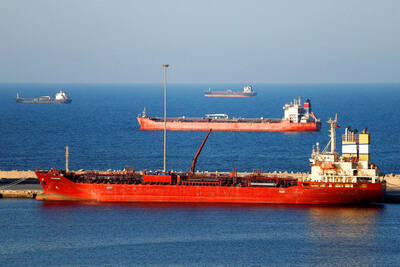
HORMUZ ISSUE: The US president said he expected crude prices to drop at the end of the war, which he called a ‘minor excursion’ that could continue ‘for a little while’ The United Arab Emirates (UAE) and Kuwait started reducing oil production, as the near-closure of the crucial Strait of Hormuz ripples through energy markets and affects global supply. Abu Dhabi National Oil Co (ADNOC) is “managing offshore production levels to address storage requirements,” the company said in a statement, without giving details. Kuwait Petroleum Corp said it was lowering production at its oil fields and refineries after “Iranian threats against safe passage of ships through the Strait of Hormuz.” The war in the Middle East has all but closed Hormuz, the narrow waterway linking the Persian Gulf to the open seas,
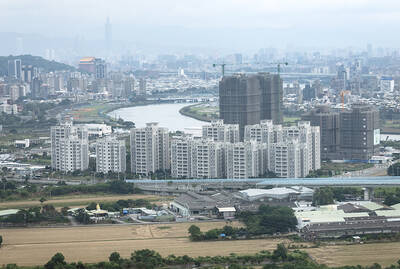
Property transactions in the nation’s six special municipalities plunged last month, as a lengthy Lunar New Year holiday combined with ongoing credit tightening dampened housing market activity, data compiled by local land administration offices released on Monday showed. The six cities recorded a total of 10,480 property transfers last month, down 42.5 percent from January and marking the second-lowest monthly level on record, the data showed. “The sharp drop largely reflected seasonal factors and tighter credit conditions,” Evertrust Rehouse Co (永慶房屋) deputy research manager Chen Chin-ping (陳金萍) said. The nine-day Lunar New Year holiday fell in February this year, reducing


 RSS
RSS