

The Donghe cooking oil factory in Chiayi County’s Puzih City has been in operation for nearly a century and has started to undergo renovations this year. The old-style bamboo-framed building is rather squat and low, and its owner originally intended to demolish it, but following discussions between local historians and the factory owner, the decision was made to preserve some of the building materials, allowing a modern factory to coexist with the old building.
The Donghe oil factory was established 94 years ago in the 10th year of the Japanese Taisho period (1921) by its first-generation owner Huang Piao, who was followed by the second generation — the brothers Huang Yen and Huang Yeh, and now the third-generation owner Huang Kuo-ming is in charge. The factory is famous for its oils that are made by hand and cold pressed at 40 degrees centigrade. Its products include camellia, sesame and peanut oils. Many early kinds of oil-making equipment are to be found in the factory.
Huang says that Donghe is one of a handful of oil factories that still burns firewood as its fuel. Although this involves high production costs, while burning firewood takes a long time, Huang says, “This method has been passed down from my grandfather’s time to this day, and it gives the oil a woody fragrance, so I can’t quit doing it this way.”
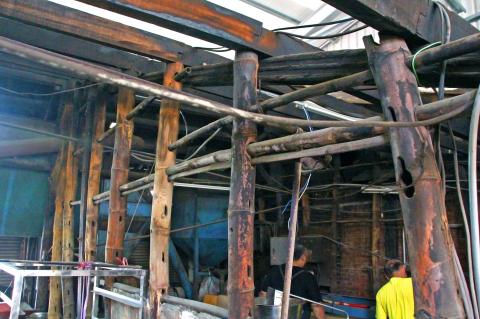
Photo: Lin I-chang, Liberty Times
照片:自由時報記者林宜樟
Nisshin Hospital Preservation Society board member Chen Chun-che says that cooking oil production was regulated under Japanese rule and the Donghe Oil Company was the only factory in what was then Toseki District to obtain an oil-making license. The techniques employed by many oil firms in the Chiayi region were inherited from Donghe. Chen says there are hardly any oil factories left that are housed in bamboo-framed buildings, so it is extremely important to preserve it. With regard to the factory’s existing bamboo columns, cypress beams, old storeroom and a section of crumbling wall, Chen and Huang are searching for other cases of preserving old factories. They are also discussing the issue with cultural figures, so that when this century-old oil factory gets a new lease on life, it will also be significant in terms of cultural preservation.
(Liberty Times, translated by Julian Clegg)
嘉義縣朴子市東和製油工廠已有近百年歷史,今年開始整修。古早的竹管厝又矮又低,原本打算拆除,但經地方文史人士與店家討論,將保留部分建材,讓現代化工廠與老建物共存。
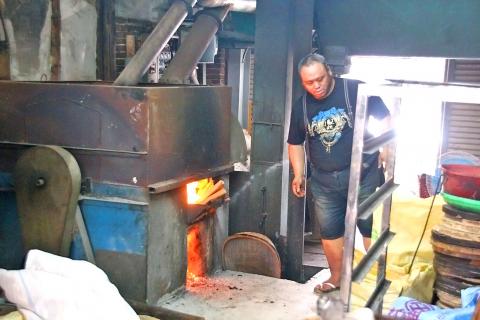
Photo: Lin I-chang, Liberty Times
照片:自由時報記者林宜樟
東和製油工廠成立於日治大正十年(一九二一年),迄今有九十四年,第一代經營者為黃標,第二代是黃炎與黃業兄弟,目前由第三代黃國明負責。東和以手工四十度冷壓榨油聞名,生產苦茶油、芝麻油及花生油等,廠內保有許多早期製油器具。
黃國明說,東和是少數還以燃燒柴火炒料製油的油行。雖然成本高,燒柴火又耗時,「但從阿公傳承至今,油裡飄出的木材香,我不能放棄。」
日新醫院保存協會理事陳俊哲說,日治時期製油有管控,東和油脂株式會社是當時東石郡唯一領有製油執照的工廠,嘉義地區許多油行的技術都是從此傳承。以竹管厝搭建的製油工廠幾乎已經絕跡,「留下來非常重要」。廠內目前保存的竹管柱、檜木梁、老倉庫及一處斷裂牆面,陳俊哲與黃國明正找尋其他老工廠保存案例及文化人士洽談,讓百年老油行重生後,能兼具文化保存意義。
(自由時報記者林宜樟)
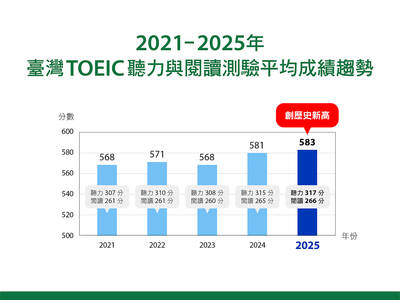
A: According to statistics of the 990-point TOEIC Listening and Reading Test, Taiwan’s score rose by 2 points to a new high of 583 points in 2025. B: It’s still far behind Asia’s “700-point Club” members: India, the Philippines and Malaysia, or the nearly 700-point South Korea. A: Why was the average for Taiwanese university students so much lower than high school seniors’ average of 655 points once again? B: Many universities attach little importance to language learning courses, and have even changed the basic “Freshman English” from compulsory to elective. Most students simply stop learning English after starting

A: In addition to the TOEIC Listening and Reading Test, some institutions also require staff to take the computer-based TOEIC Speaking and Writing Tests. B: I didn’t know that there are oral and written tests. What does the oral exam cover? A: The categories include: Read a text aloud, Describe a picture, Respond to questions, Respond to questions using information provided, and Express an opinion. The test takes about 20 minutes. B: And what about the writing exam? A: The categories include: Write a sentence based on a picture, Respond to a written request, and Write an opinion. The test lasts

Toxic chemicals from discarded electronic devices may be threatening endangered dolphins and porpoises in the South China Sea, according to a recent scientific study. Liquid crystal monomers (LCMs), chemicals widely used in smartphones, televisions and computer screens, were detected in several marine mammals. Scientists warned that these substances could pose risks to humans as well through contaminated seafood and water sources. The findings have raised concerns about the growing environmental harm caused by electronic waste worldwide. The chemicals were found in different parts of the animals’ bodies, including blubber, the liver, the kidneys, muscles and even brain tissue. After

1. 不該把一個生病的孩子獨自留在家裡。 ˇ It’s not advisable to leave a sick child all alone at home. χ It’s not advisable to leave an ill child all alone at home. 註︰ill 和 sick 都可用作補語形容詞,例如: 〔英語〕I have been ill/unwell for two weeks. 〔美語〕I have been sick for two weeks. 但作為修飾形容詞置於名詞之前時,英美都用 sick,不用 ill,如 a sick man /woman, a sick child 等。 2. 昨天整天都在下大雨。 ˇ Heavy rain fell all day long yesterday. ˇ There was heavy rain all day long yesterday. χ A great rain fell all day long yesterday. 註︰中文裡的「大」,不一定對應英語中的 big 或 great,試對照下列中英文: 大風:a strong / heavy wind、大雪:a heavy snow 3. 許多夜晚他餓著肚子去睡覺。 ˇ Many nights, he went to bed with an empty stomach. χ Many nights, he went to


 RSS
RSS