


Consumer confidence last month weakened slightly as the six factors that make up the consumer confidence index (CCI) all fell, a monthly survey released by National Central University (NCU) yesterday showed.
Last month’s CCI fell 0.58 points from a month earlier to 66.58, NCU said, citing the survey, which was conducted from Feb. 18 to 21.
The CCI measures sentiment over the following six months across six factors: consumer prices, the domestic economic climate, the stock market, durable goods purchases, employment prospects and family finances.
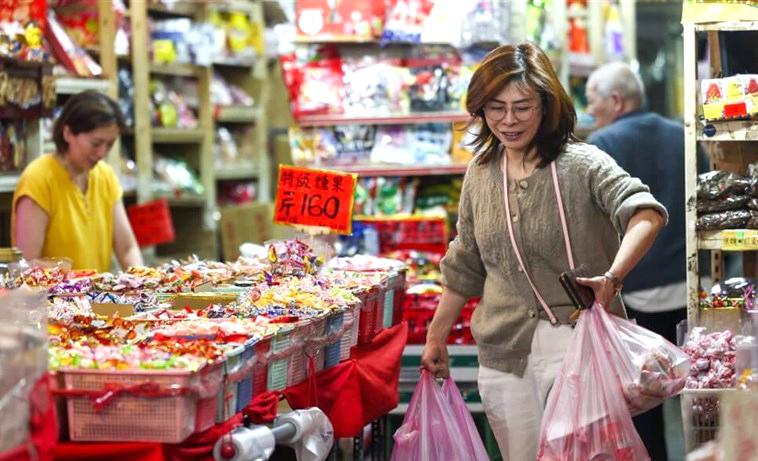
Photo: CNA
The subindex for durable goods purchases last month fell to 97.12, down 1.08 from a month earlier, the steepest decline among the six factors, while the subindex for the stock market also fell noticeably, by 1.06 to 28.46, the survey showed.
The subindices for the local economic climate, family finances, employment and consumer prices edged lower by 0.44, 0.39, 0.28 and 0.23, respectively, from January to 83.25, 80, 73.52 and 37.11 last month, the survey showed.
Subindex scores between 0 and 100 indicate pessimism, while those between 100 and 200 reflect optimism.
Last month’s CCI drop was minor, NCU Research Center for Taiwan Economic Development director Dachrahn Wu (吳大任) said, adding that he would characterize the CCI as being relatively unchanged.
Commenting on the individual factors of the CCI, Wu said that while the local stock market had posted robust gains prior to the survey, the stock subindex still moved lower, indicating that many investors were afraid of possible technical corrections.
However, many investors remained confident about market movements over the longer term and were willing to buy after a pullback, Wu said.
The Directorate-General of Budget, Accounting and Statistics last month raised its forecast for Taiwan's economic growth this year from 3.54 percent to 7.71 percent amid the artificial intelligence boom, supporting Wu's argument.
However, the US’ tariff policies have created global economic uncertainties, especially as a recent US Supreme Court ruling against Washington’s "reciprocal" tariffs prompted US President Donald Trump to use other legislation to impose duties, Wu said.
The Middle East conflict triggered by US and Israeli attacks on Iran has also pushed up international crude oil prices, Wu said, adding that he feared higher oil prices could spark inflationary pressures and hurt US consumption.
Under such circumstances and given the strong correlation between the economies of Taiwan and the US, the local economy could feel the pinch in the coming months, he said.
Also last month, the home-buying index compiled by NCU and Taiwan Realty fell 1.19 points month-on-month to 93.76.
The university's CCI survey collected 3,197 valid responses from Taiwanese consumers aged 20 or older. It had a confidence level of 95 percent and a margin of error of plus or minus 2 percentage points.
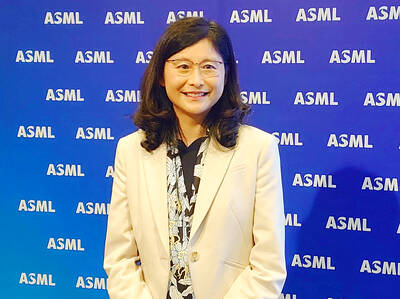
Netherlands-based semiconductor equipment supplier ASML Holding NV yesterday said that it is planning to hire an additional 1,000 people in Taiwan this year in response to growing demand from clients. ASML had previously planned to recruit 600 people this year, but that the plan has been adjusted upward, ASML vice president and ASML Taiwan general manager Grace Wang (汪佳慧) told reporters. ASML has a workforce of more than 4,500 in Taiwan, accounting for about 10 percent of its global total, Wang said. This year’s recruitment campaign would focus on adding people in the customer support, manufacturing and supply chain domains to assist ASML
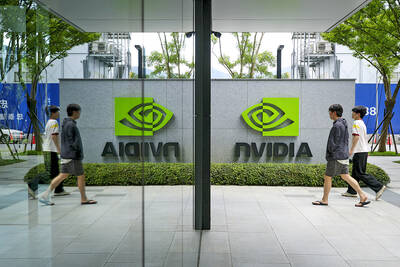
UNDER MICROSCOPE: Taiwan detained three people who allegedly conspired to buy servers in Taiwan and export them using fraudulent documentation, prosecutors said Nvidia Corp chief executive officer Jensen Huang (黃仁勳) on Saturday urged Super Micro Computer Inc to tighten up on compliance after Taiwan detained three people this week for allegedly making fraudulent declarations about artificial intelligence (AI) servers made by its US partner. The development marked the nation’s first crackdown on semiconductor smuggling, which grew after the US slapped restrictions on exports of high-end chips such as Nvidia AI accelerators to China. Nvidia is “rigorous” in explaining regulations to all of its partners, Huang told reporters after arriving in Taipei. “Ultimately Super Micro has to run their own company,” he said in response to
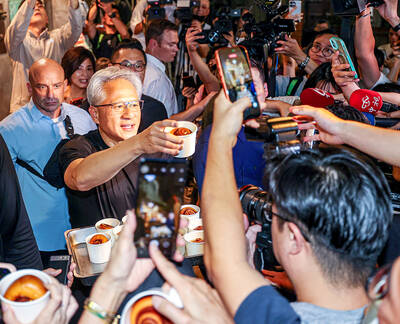
Nvidia Corp yesterday announced that CEO Jensen Huang (黃仁勳) would attend an employee meeting in Taipei tomorrow to celebrate the launch of the company’s Taiwan headquarters project. Huang would attend a gathering at the site of Nvidia’s planned headquarters in Beitou Shilin Technology Park (北投士林科技園區), the company said in a statement. After arriving in Taiwan on Saturday last week, Huang told reporters that he plans to meet with Quanta Computer Inc (廣達) chairman Barry Lam (林百里) and Taiwan Semiconductor Manufacturing Co (TSMC, 台積電) chairman C.C. Wei (魏哲家), and would attend the groundbreaking ceremony for Nvidia’s Taiwan headquarters tomorrow. Nvidia has not yet applied
Huawei Technologies Co (華為) said it has come up with a new pathway to shorten its gap with industry leader Taiwan Semiconductor Manufacturing Co (TSMC, 台積電), potentially achieving a breakthrough in making advanced semiconductors without cutting-edge equipment. Right now there is about a five-year gap between what TSMC is capable of and what Huawei, together with its manufacturing partner Semiconductor Manufacturing International Corp (中芯), can produce. Huawei is to start making 1.4-nanometer chips by 2031 with its own “LogicFolding” technology, Huawei semiconductor chief He Tingbo (何庭波) said in a rare public appearance during a chip conference yesterday, while TSMC has


 RSS
RSS