


Taiwan’s high-net-worth population is projected to reach 124,000 this year, with combined assets of NT$46.1 trillion (US$1.47 trillion), highlighting growing opportunities for private banking, a survey released yesterday by KPMG Taiwan and E.Sun Commercial Bank Ltd (玉山銀行) showed.
The large number of people holding more than NT$100 million in investable assets reflects rapid wealth accumulation amid strong equity markets and corporate earnings, the survey said.
“The rapid buildup of private wealth is reshaping demand for cross-border investing and institutionalized succession planning,” E.Sun Financial Holding Co (玉山金控) chairman Joseph Huang (黃男州) told a news conference in Taipei.
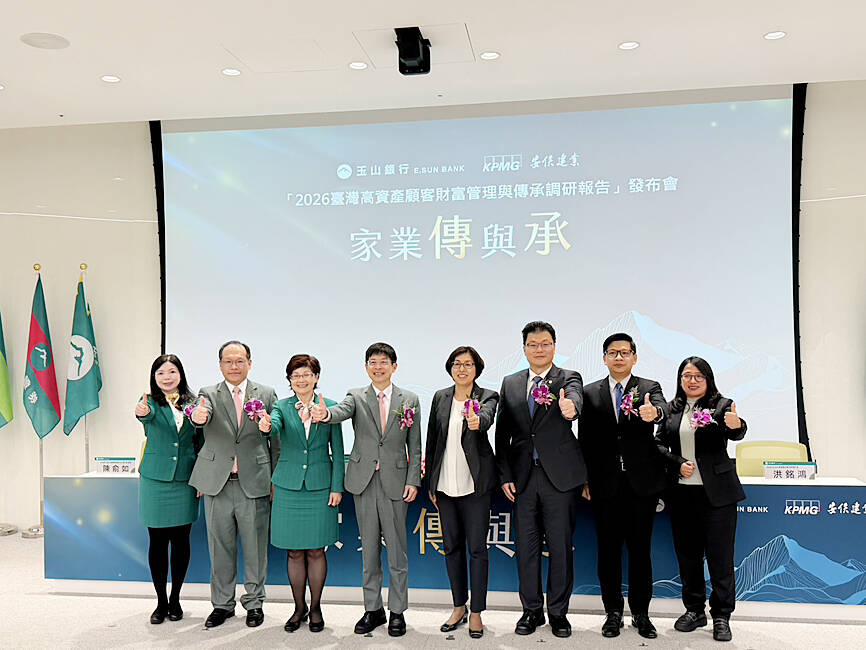
Photo: CNA
Amid geopolitical and economic uncertainty, more than 70 percent of wealthy Taiwanese have already allocated assets overseas, signaling a shift toward diversification and capital preservation, the companies said.
Offshore exposure across equities, fixed income and alternative assets has become a core allocation strategy.
However, global investing brings complexity, with more than half of respondents citing unfamiliarity with foreign legal and tax regimes as the biggest obstacle, the companies said.
This has boosted demand for integrated advisory services combining portfolio management with legal, tax and governance expertise, they said.
Affluent clients increasingly prioritize risk management and structural planning alongside returns, they said.
Succession planning is also evolving, the survey showed.
While discussions about inheritance were often postponed in the past, 85 percent of respondents said they have completed or initiated wealth transfer plans, it showed.
The shift reflects a move from “passive inheritance” to “active succession,” with founders taking a deliberate role in governance and long-term stewardship, the companies said.
Generational differences remain a challenge, as first-generation wealth creators express concern over the next generation’s readiness, citing communication gaps and diverging values, they said.
Demand now extends beyond traditional tools such as equity restructuring, insurance and trusts, the companies said.
Wealthy families are exploring formal governance frameworks, including family constitutions and advisory boards, to safeguard financial capital and cohesion, they said.
Meanwhile, interest in family offices is rising, with more than 60 percent of surveyed clients open to or planning adoption, they added.
Regulatory support is reinforcing the trend as the Financial Supervisory Commission (金管會) has included family offices in its push to develop Taiwan as an Asian asset management hub.
E.Sun Bank said it is expanding family office services with proactive advisory models and one-stop integration across its financial units, aiming to institutionalize governance and facilitate cross-generational wealth transfer.
After several years flying high as Asia’s best Nvidia Corp proxy, Taiwan Semiconductor Manufacturing Co (TSMC, 台積電) is increasingly vying with other artificial intelligence (AI) stocks for investor attention. Stock traders are chasing a wider array of beneficiaries as mainstream usage of AI creates demand for hardware beyond the most-advanced chips TSMC makes for Nvidia. Subthemes from the deepening memory crunch to advances in robotics are also luring bids. At the same time, investment caps on single stocks are pushing funds to diversify, while retail investors long familiar with TSMC through its US depositary receipts are being offered a broader set of

Netherlands-based semiconductor equipment supplier ASML Holding NV yesterday said that it is planning to hire an additional 1,000 people in Taiwan this year in response to growing demand from clients. ASML had previously planned to recruit 600 people this year, but that the plan has been adjusted upward, ASML vice president and ASML Taiwan general manager Grace Wang (汪佳慧) told reporters. ASML has a workforce of more than 4,500 in Taiwan, accounting for about 10 percent of its global total, Wang said. This year’s recruitment campaign would focus on adding people in the customer support, manufacturing and supply chain domains to assist ASML

UNDER MICROSCOPE: Taiwan detained three people who allegedly conspired to buy servers in Taiwan and export them using fraudulent documentation, prosecutors said Nvidia Corp chief executive officer Jensen Huang (黃仁勳) on Saturday urged Super Micro Computer Inc to tighten up on compliance after Taiwan detained three people this week for allegedly making fraudulent declarations about artificial intelligence (AI) servers made by its US partner. The development marked the nation’s first crackdown on semiconductor smuggling, which grew after the US slapped restrictions on exports of high-end chips such as Nvidia AI accelerators to China. Nvidia is “rigorous” in explaining regulations to all of its partners, Huang told reporters after arriving in Taipei. “Ultimately Super Micro has to run their own company,” he said in response to

Nvidia Corp yesterday announced that CEO Jensen Huang (黃仁勳) would attend an employee meeting in Taipei tomorrow to celebrate the launch of the company’s Taiwan headquarters project. Huang would attend a gathering at the site of Nvidia’s planned headquarters in Beitou Shilin Technology Park (北投士林科技園區), the company said in a statement. After arriving in Taiwan on Saturday last week, Huang told reporters that he plans to meet with Quanta Computer Inc (廣達) chairman Barry Lam (林百里) and Taiwan Semiconductor Manufacturing Co (TSMC, 台積電) chairman C.C. Wei (魏哲家), and would attend the groundbreaking ceremony for Nvidia’s Taiwan headquarters tomorrow. Nvidia has not yet applied


 RSS
RSS