


Shares in Taiwan yesterday closed lower, as market sentiment was hit by war in the Middle East after the US and Israel attacked Iran over the weekend, killing Iranian supreme leader Ayatollah Ali Khamenei.
The TAIEX ended down 319.40 points, or 0.9 percent, at 35,095.09, after foreign institutional investors sold a net NT$38.99 billion in shares on the market, Taiwan Stock Exchange’s data showed.
The New Taiwan dollar lost NT$0.180, or 0.57 percent, to close at NT$31.431 per US dollar, Taipei Forex Inc data showed.
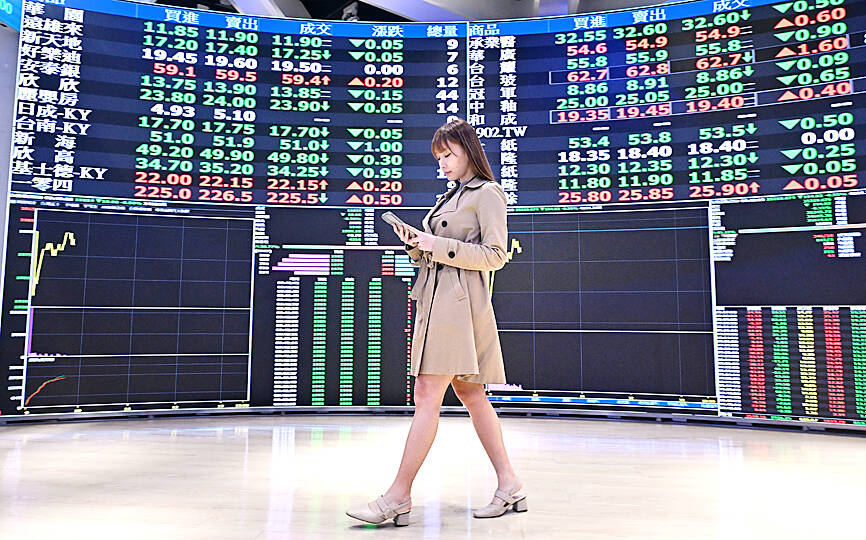
Photo: Fang Pin-chao, Taipei Times
Shares fell in most Asian markets, but they rose in Shanghai, where investors snapped up energy, gold and defense stocks. The Shanghai Composite Index ended up 0.5 percent at 4,182.59 points, the highest close since June 2015.
Oil prices surged as all eyes were on the Strait of Hormuz, through which about one-fifth of the world’s seaborne oil trade flows as well as 20 percent of its liquefied natural gas. Brent jumped about 10 percent to US$79.90 a barrel, though it had briefly topped US$82 at one stage, while US crude climbed 8.2 percent to US$72.64 per barrel. Safe-haven gold rose 2.6 percent to US$5,413 an ounce.
“The US and Israeli attacks and retaliatory strikes by Iran have pushed crude oil prices sharply higher, leading investors at home and abroad to trim their stock holdings amid concerns over the economic impact,” Concord Securities Co (康和證券) analyst Kerry Huang (黃志祺) said.
“In Taiwan, investors simply seized on the news to pocket recent gains, with tech stocks the major targets of the sell-off, although most shares recovered some of their early losses,” Huang said.
“It is hard to predict the floor for the TAIEX as long as the geopolitical unease continues. Uncertainty is the last thing the market wants to see,” he added.
Contract chipmaker Taiwan Semiconductor Manufacturing Co (台積電), which accounts for more than 40 percent of total market value, set the tone, falling 1 percent to close at NT$1,975 after hitting a low of NT$1,940.
Artificial intelligence (AI) server maker and iPhone assembler Hon Hai Precision Industry Co (鴻海精密) fell 1.65 percent to end at NT$239, while Quanta Computer Inc (廣達電腦), another AI server maker, rose 3.26 percent to close at NT$301 on its relatively low valuation.
By contrast, among non-tech stocks, Formosa Petrochemical Corp (台塑石化) benefited from higher oil prices, gaining 3.67 percent to end at NT$56.50.
In China, investors piled into energy companies after oil prices surged, sending the shares of oil giants China National Offshore Oil Co (中國海洋石油), PetroChina Co (中石油) and China Petroleum & Chemical Corp (中國石油化工) to rise by the 10 percent limit.
A prolonged spike in oil prices would risk reigniting inflationary pressures globally, while also acting as a tax on business and consumers that could dampen demand.
On Sunday, OPEC+ did agree a modest oil output boost of 206,000 barrels per day for next month, but a lot of that product still has to get out of the Middle East by tanker.
“At least in the short term, the disruption to global energy supply is substantial, [and] this clearly adds upside risks to the oil price,” Aberdeen Investments emerging markets economist Michael Langham said.
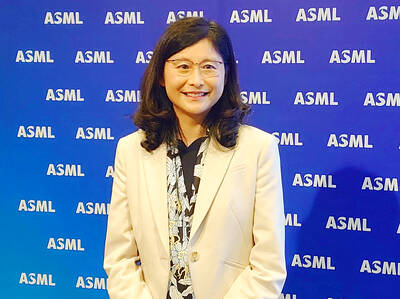
Netherlands-based semiconductor equipment supplier ASML Holding NV yesterday said that it is planning to hire an additional 1,000 people in Taiwan this year in response to growing demand from clients. ASML had previously planned to recruit 600 people this year, but that the plan has been adjusted upward, ASML vice president and ASML Taiwan general manager Grace Wang (汪佳慧) told reporters. ASML has a workforce of more than 4,500 in Taiwan, accounting for about 10 percent of its global total, Wang said. This year’s recruitment campaign would focus on adding people in the customer support, manufacturing and supply chain domains to assist ASML
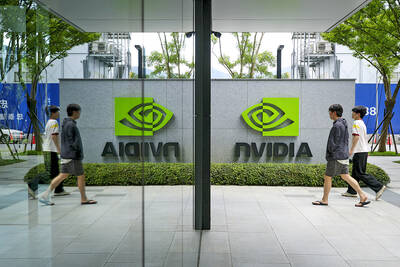
UNDER MICROSCOPE: Taiwan detained three people who allegedly conspired to buy servers in Taiwan and export them using fraudulent documentation, prosecutors said Nvidia Corp chief executive officer Jensen Huang (黃仁勳) on Saturday urged Super Micro Computer Inc to tighten up on compliance after Taiwan detained three people this week for allegedly making fraudulent declarations about artificial intelligence (AI) servers made by its US partner. The development marked the nation’s first crackdown on semiconductor smuggling, which grew after the US slapped restrictions on exports of high-end chips such as Nvidia AI accelerators to China. Nvidia is “rigorous” in explaining regulations to all of its partners, Huang told reporters after arriving in Taipei. “Ultimately Super Micro has to run their own company,” he said in response to

Nvidia Corp yesterday announced that CEO Jensen Huang (黃仁勳) would attend an employee meeting in Taipei tomorrow to celebrate the launch of the company’s Taiwan headquarters project. Huang would attend a gathering at the site of Nvidia’s planned headquarters in Beitou Shilin Technology Park (北投士林科技園區), the company said in a statement. After arriving in Taiwan on Saturday last week, Huang told reporters that he plans to meet with Quanta Computer Inc (廣達) chairman Barry Lam (林百里) and Taiwan Semiconductor Manufacturing Co (TSMC, 台積電) chairman C.C. Wei (魏哲家), and would attend the groundbreaking ceremony for Nvidia’s Taiwan headquarters tomorrow. Nvidia has not yet applied
Huawei Technologies Co (華為) said it has come up with a new pathway to shorten its gap with industry leader Taiwan Semiconductor Manufacturing Co (TSMC, 台積電), potentially achieving a breakthrough in making advanced semiconductors without cutting-edge equipment. Right now there is about a five-year gap between what TSMC is capable of and what Huawei, together with its manufacturing partner Semiconductor Manufacturing International Corp (中芯), can produce. Huawei is to start making 1.4-nanometer chips by 2031 with its own “LogicFolding” technology, Huawei semiconductor chief He Tingbo (何庭波) said in a rare public appearance during a chip conference yesterday, while TSMC has


 RSS
RSS