


Formula One is well anchored in the US with its American owners and three Grand Prix races, but the sport hopes to push its growing popularity further with the help of Netflix and Apple.
The Netflix documentary F1: Drive to Survive, which began its eighth season on Friday, has already taken motor sport’s top discipline into a new dimension.
The series provides a behind-the-scenes look at the sport’s drivers, managers and team owners.
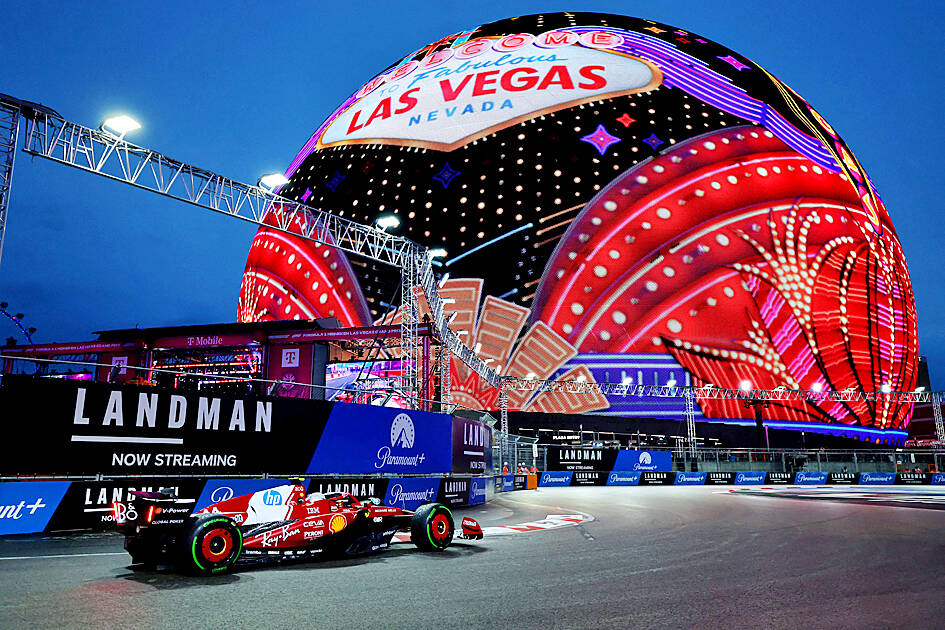
Photo: Reuters
While critics complain that the series magnifies tensions between drivers and managers for entertainment value, it has introduced a younger audience, particularly women, to F1.
The documentary series and the additional races in the US have been “seismic changes in terms of where we were as a sport,” said Liam Parker, head of communications for F1, which has been a subsidiary of US group Liberty Media since 2016.
Founded in 1991, Nasdaq-listed Liberty Media has spent the past decade pushing hard to boost F1’s audience in the US, where NASCAR and IndyCar dominate.
Drive to Survive co-executive producer Tom Rogers believes F1 has enormous potential in the US thanks to it now hosting three Grand Prix races — in Miami, Las Vegas and Austin, Texas.
Out of F1’s global audience of about 800 million viewers, only about 52 million are in the US, Parker said.
“We’re not really scratching the surface in the US in terms of what we can do given the size of that audience,” he said recently in Bahrain, where F1 held a series of preseason tests.
The sport is also still basking in the success of F1: The Movie starring Brad Pitt. In addition to box office success last year, the film garnered four Oscar nominations, including for best picture.
This year, five of the 24 Grand Prix races would be broadcast live at giant-screen IMAX theatres across the US.
This year also sees a switch in TV broadcasting rights from Disney’s ESPN to Apple TV.
The deal is worth a reported US$150 million per year to F1, US media reported.
“When we are talking about Apple in the US, we are talking about a new partner of Formula 1 that is believing in us with a great plan of being the protagonist of the growth in the US,” F1 chief executive officer Stefano Domenicali said.
However, F1 is setting its sights on more than just the US.
“I think we’re all anticipating probably a Latin American boost in Formula One interest... with Franco” Colapinto, the Argentinian driver for Alpine, Rogers said.
“And I think Latin America is an enormous market, especially for Netflix,” he added.
Mexican driver Sergio Perez with Cadillac and Brazilian Gabriel Bortoleto with Audi are also draws for Latin American viewers.

Netherlands-based semiconductor equipment supplier ASML Holding NV yesterday said that it is planning to hire an additional 1,000 people in Taiwan this year in response to growing demand from clients. ASML had previously planned to recruit 600 people this year, but that the plan has been adjusted upward, ASML vice president and ASML Taiwan general manager Grace Wang (汪佳慧) told reporters. ASML has a workforce of more than 4,500 in Taiwan, accounting for about 10 percent of its global total, Wang said. This year’s recruitment campaign would focus on adding people in the customer support, manufacturing and supply chain domains to assist ASML

UNDER MICROSCOPE: Taiwan detained three people who allegedly conspired to buy servers in Taiwan and export them using fraudulent documentation, prosecutors said Nvidia Corp chief executive officer Jensen Huang (黃仁勳) on Saturday urged Super Micro Computer Inc to tighten up on compliance after Taiwan detained three people this week for allegedly making fraudulent declarations about artificial intelligence (AI) servers made by its US partner. The development marked the nation’s first crackdown on semiconductor smuggling, which grew after the US slapped restrictions on exports of high-end chips such as Nvidia AI accelerators to China. Nvidia is “rigorous” in explaining regulations to all of its partners, Huang told reporters after arriving in Taipei. “Ultimately Super Micro has to run their own company,” he said in response to
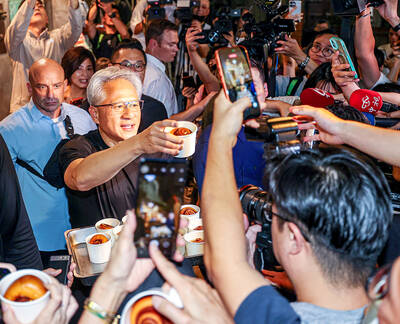
Nvidia Corp yesterday announced that CEO Jensen Huang (黃仁勳) would attend an employee meeting in Taipei tomorrow to celebrate the launch of the company’s Taiwan headquarters project. Huang would attend a gathering at the site of Nvidia’s planned headquarters in Beitou Shilin Technology Park (北投士林科技園區), the company said in a statement. After arriving in Taiwan on Saturday last week, Huang told reporters that he plans to meet with Quanta Computer Inc (廣達) chairman Barry Lam (林百里) and Taiwan Semiconductor Manufacturing Co (TSMC, 台積電) chairman C.C. Wei (魏哲家), and would attend the groundbreaking ceremony for Nvidia’s Taiwan headquarters tomorrow. Nvidia has not yet applied

Huawei Technologies Co (華為) said it has come up with a new pathway to shorten its gap with industry leader Taiwan Semiconductor Manufacturing Co (TSMC, 台積電), potentially achieving a breakthrough in making advanced semiconductors without cutting-edge equipment. Right now there is about a five-year gap between what TSMC is capable of and what Huawei, together with its manufacturing partner Semiconductor Manufacturing International Corp (中芯), can produce. Huawei is to start making 1.4-nanometer chips by 2031 with its own “LogicFolding” technology, Huawei semiconductor chief He Tingbo (何庭波) said in a rare public appearance during a chip conference yesterday, while TSMC has


 RSS
RSS