


Artificial intelligence (AI) may significantly displace workers and disrupt consumption-driven economies like the US in the near future, according to Alap Shah, co-author of a Citrini Research report that fueled a scare-trade selloff, and who is now calling for an AI tax to cushion job losses.
Governments should consider taxing incremental or windfall gains from AI, Shah, chief investment officer at Lotus Technology Management, said in a Bloomberg TV interview. Without it, rising unemployment will hit consumption, with the US likely among the most affected. Shah sketched out a scenario where 5 percent of white-collar workers could be cut within 18 months.
“We generally have a set of shorts out against businesses that we think are going to be disrupted by AI,” he said yesterday in Asia. “On the other side of that, we own a lot of semiconductors that we think are going to benefit.”
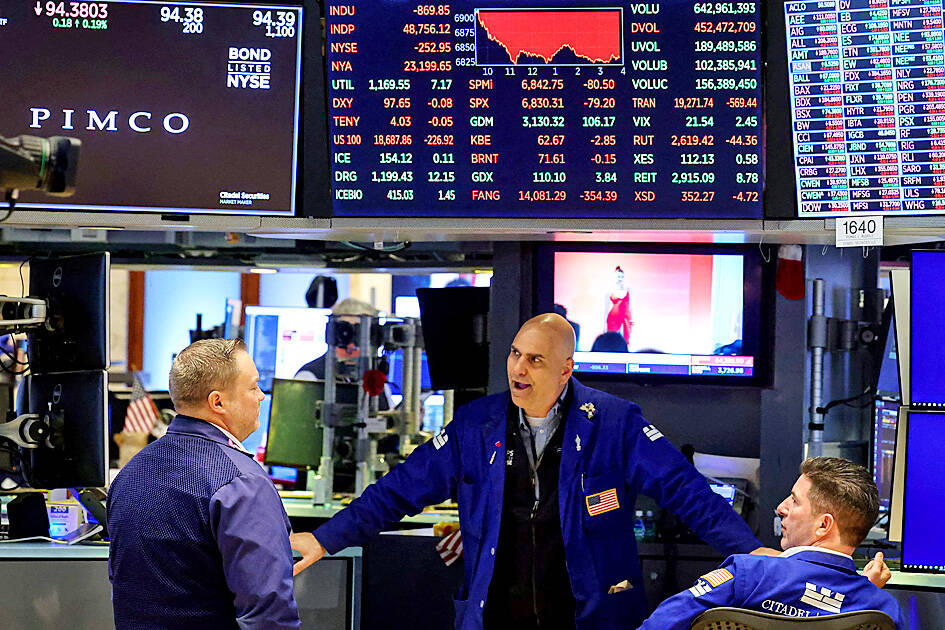
Photo: Reuters
Technology shares have slid in recent weeks on fears AI could upend business models, with the weekend report from Citrini Research adding to concerns about widespread disruption and job losses. The paper imagines a 2028 world in which rapid advances in machine intelligence turbocharge productivity but render large swaths of human labor obsolete, sparking job losses, collapsing consumer spending and dragging down stock indexes like the S&P 500.
Among the outcomes discussed, the displacement of white-collar workers creates a negative feedback loop where firms cut jobs to bolster margins, reinvest savings in AI, which enables further cuts. This weakens demand in sectors built on intermediation such as finance, insurance and software. Consumer-facing platforms that rely on discretionary spending — including food delivery services such as DoorDash and Uber Eats — are seen most at risk.
The report contributed to a global selloff in software stocks, with a related exchange-traded fund tumbling 4.8 percent and extending its decline from a peak in September last year to around 35 percent on concerns AI could cannibalize earnings.
In contrast, Asia’s bellwether chipmakers rallied to record highs yesterday. Taiwan Semiconductor Manufacturing Co (台積電), Samsung Electronics Co and SK Hynix Inc each gained more than 2.5 percent.
Shah said he’s surprised by the market reaction. “I thought there was going to be a small reaction — it was definitely larger than we expected,” he said.
Over the next five years, he said white-collar jobs in the US will be a key gauge of AI’s effects, with the impact likely to show up fastest there given its dynamic labor market. White-collar workers account for 50 percent of employment and drive roughly 75 percent of discretionary consumer spending, according to the Citrini paper.
“It’s much easier to fire folks than it is in other parts of the world,” he added.
Drawing a lesson from China, Shah said automation there has “rolled through the economy in a big way.” Companies aren’t creating jobs at the pace needed as the average firm can do far more with fewer workers — and increasingly choose not to hire. That weakens consumer demand and weighs on the economy, a scenario he sees as possible for the US over the next two years.
In the near term, Shah expects further market swings, including in software companies, as traders assess the long-term impact from AI. “We are entering a really highly volatile time in the markets,” he said.
Citrini has been publishing macro and thematic stock research since 2023. The platform has built a devoted following, with more than 119,000 subscribers. Its research spans topics from modern warfare and humanoid robots to GLP-1 drugs and broader macro trends.

Cairo’s new monorail slices across the city skyline, running above the familiar chaos of blaring horns and aging buses’ exhaust fumes that mark rush hour below. The US$4.5 billion monorail, opened this month, is among Egypt’s most prominent new transport projects, part of a debt-funded infrastructure drive criticized for sapping state finances while bringing limited benefits to most of the country’s 109 million people. “It feels like you’re in a different country,” said Ramy Sayed, a restaurant manager, aboard a driverless Innovia 300 train. “No noise, no traffic, we’re not used to this.” The eastern line runs 56km from the bustling middle-class

Taiwanese firms have increased investment in the Philippines in recent years as Manila’s ties with Washington deepen and global supply chains continue to shift away from China, an expert at the Chung-Hua Institution for Economic Research (CIER, 中華經濟研究院) said yesterday. The Philippines had not been among Taiwanese investors’ top choices in Southeast Asia, CIER Taiwan ASEAN Studies Center director Kristy Hsu (徐遵慈) said at a seminar in Taipei. However, Taiwan’s investment in the country has grown significantly since the COVID-19 pandemic, reaching US $257 million last year, a high in recent years, she said. Although Taiwan’s total investment in the Philippines still lags

Intel Corp regards Taiwan Semiconductor Manufacturing Co (TSMC, 台積電) as a longstanding partner, as the US chipmaker would continue outsourcing production of advanced chips to TSMC, Intel chief executive officer Lip-Bu Tan (陳立武) said yesterday. “I don’t look at people as competitors. I look at the collaboration... Nvidia is also, you know, a good friend,” Tan told a news conference following his keynote speech at the Computex trade show in Taipei. “It’s a very trusted partnership for us... We are a big, top customer for them, and we’re going to continue doing that,” he said, referring to TSMC, the world’s largest foundry

Artificial intelligence (AI) agents would supplant smartphones as the center of people’s digital lives, fundamentally reshaping personal devices and driving a major computing upgrade cycle, Qualcomm Inc CEO Cristiano Amon said yesterday. In his keynote speech for this year’s Computex trade show in Taipei, Amon said that the rise of "agentic AI" — AI systems capable of reasoning, planning and carrying out tasks autonomously — would transform how people interact with technology across phones, PCs, vehicles and wearable devices. Describing the technology as the next major evolution in computing, Amon said that "2026 is the year of agents.” For decades, smartphones have sat


 RSS
RSS