


E.Sun Financial Holding Co (玉山金控) yesterday said it closed last year with record-high earnings and outlined an ambitious expansion blueprint for this year, with deeper integration of its new businesses intended to reinforce growth across its banking, securities and asset management franchises.
At its earnings briefing in Taipei, the conglomerate struck a confident tone as strategy chief Charles Tan (譚宏) made his debut appearance, outlining a post-acquisition road map following the addition of asset management and life insurance operations.
The Taipei-based financial group recorded net income of NT$34.29 billion (US$1.09 billion) last year, up 31.2 percent from 2024, and total revenue of NT$91.77 billion. Earnings per share were NT$2.12.
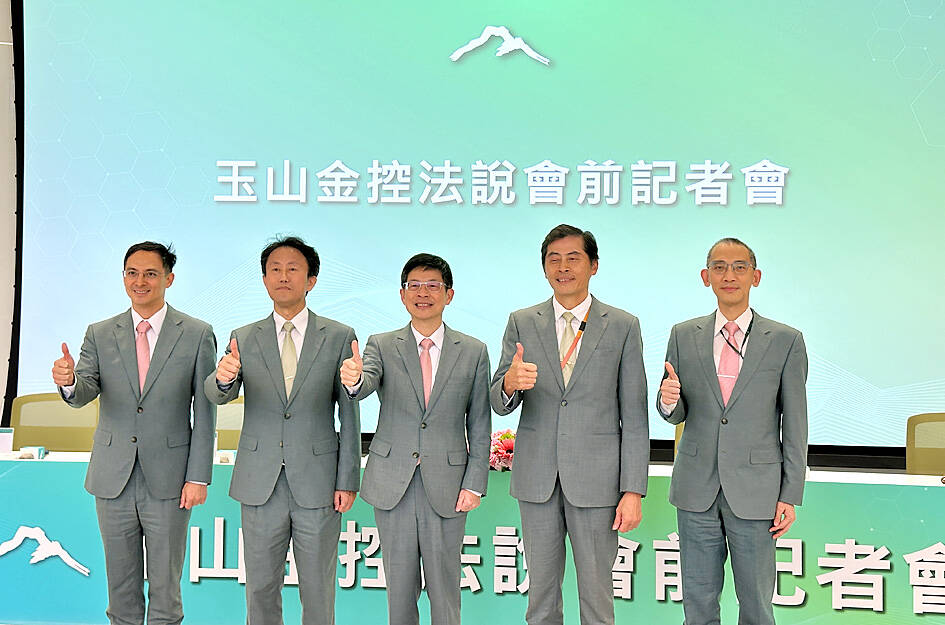
Photo: Kelson Wang, Taipei Times
Tan, who joined the group in November last year, said total assets are set to surpass NT$6 trillion, meaning E.Sun is among the top five financial holding firms in Taiwan.
However, scale alone is not the endgame, he said.
“E.Sun is not pursuing asset expansion for its own sake,” he said. “Our priority is to convert scale into long-term, sustainable value through integration, efficiency and a superior customer experience.”
The company is repositioning itself as an integrated financial services platform spanning banking, securities, asset management and insurance — a shift aimed at diversifying revenue streams and deepening client relationships, he said.
E.Sun is serving more than 8 million retail banking customers and more than 1 million securities clients, while the life insurance arm adds more than 2.5 million policyholders, significantly expanding the group’s addressable customer base, Tan said.
Executives plan to integrate customer and product data across subsidiaries to build a more comprehensive financial ecosystem, he said, adding that the goal is to move from a product-centric approach to needs-based services by better understanding clients’ financial profiles, risk appetites and behavioral patterns.
Distribution capacity would also expand materially, he said.
The addition of about 8,000 life insurance agents is expected to complement bank branches and securities channels, enhancing offline reach and reinforcing customer engagement across subsidiaries, he said.
On the product side, the newly added asset management and insurance businesses are designed to fill gaps in long-term asset allocation and protection planning, enabling E.Sun to evolve from a product provider into a platform capable of supporting clients’ long-term wealth management needs, Tan said.
Technology would underpin the transformation as E.Sun intends to extend artificial intelligence applications across subsidiaries, deploying them in areas such as risk monitoring, personalized marketing, advisory services and process automation to enhance operational efficiency and regulatory responsiveness, he added.
E.Sun chairman Joseph Huang (黃男州) said the group is targeting 10 percent growth in credit card spending this year and aims to lift combined annual transaction volume from credit cards, debit cards and mobile payments to more than NT$1 trillion within three years, underscoring its push to deepen customer engagement and fee-based income.
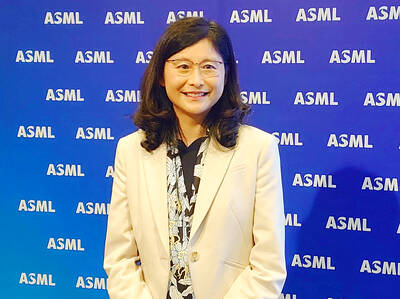
Netherlands-based semiconductor equipment supplier ASML Holding NV yesterday said that it is planning to hire an additional 1,000 people in Taiwan this year in response to growing demand from clients. ASML had previously planned to recruit 600 people this year, but that the plan has been adjusted upward, ASML vice president and ASML Taiwan general manager Grace Wang (汪佳慧) told reporters. ASML has a workforce of more than 4,500 in Taiwan, accounting for about 10 percent of its global total, Wang said. This year’s recruitment campaign would focus on adding people in the customer support, manufacturing and supply chain domains to assist ASML

UNDER MICROSCOPE: Taiwan detained three people who allegedly conspired to buy servers in Taiwan and export them using fraudulent documentation, prosecutors said Nvidia Corp chief executive officer Jensen Huang (黃仁勳) on Saturday urged Super Micro Computer Inc to tighten up on compliance after Taiwan detained three people this week for allegedly making fraudulent declarations about artificial intelligence (AI) servers made by its US partner. The development marked the nation’s first crackdown on semiconductor smuggling, which grew after the US slapped restrictions on exports of high-end chips such as Nvidia AI accelerators to China. Nvidia is “rigorous” in explaining regulations to all of its partners, Huang told reporters after arriving in Taipei. “Ultimately Super Micro has to run their own company,” he said in response to

Nvidia Corp yesterday announced that CEO Jensen Huang (黃仁勳) would attend an employee meeting in Taipei tomorrow to celebrate the launch of the company’s Taiwan headquarters project. Huang would attend a gathering at the site of Nvidia’s planned headquarters in Beitou Shilin Technology Park (北投士林科技園區), the company said in a statement. After arriving in Taiwan on Saturday last week, Huang told reporters that he plans to meet with Quanta Computer Inc (廣達) chairman Barry Lam (林百里) and Taiwan Semiconductor Manufacturing Co (TSMC, 台積電) chairman C.C. Wei (魏哲家), and would attend the groundbreaking ceremony for Nvidia’s Taiwan headquarters tomorrow. Nvidia has not yet applied
Huawei Technologies Co (華為) said it has come up with a new pathway to shorten its gap with industry leader Taiwan Semiconductor Manufacturing Co (TSMC, 台積電), potentially achieving a breakthrough in making advanced semiconductors without cutting-edge equipment. Right now there is about a five-year gap between what TSMC is capable of and what Huawei, together with its manufacturing partner Semiconductor Manufacturing International Corp (中芯), can produce. Huawei is to start making 1.4-nanometer chips by 2031 with its own “LogicFolding” technology, Huawei semiconductor chief He Tingbo (何庭波) said in a rare public appearance during a chip conference yesterday, while TSMC has


 RSS
RSS