


The US has paid about US$160 million of the nearly US$4 billion it owes the UN, the UN said on Thursday, and US President Donald Trump promised more money to the financially strapped world organization.
The Trump administration’s payment last week is earmarked for the UN’s regular operating budget, UN spokesperson Stephane Dujarric said.
The UN has said the US owes US$2.196 billion to its regular budget, including US$767 million for this year, as well as US$1.8 billion to a separate budget for the far-flung UN peacekeeping operations.
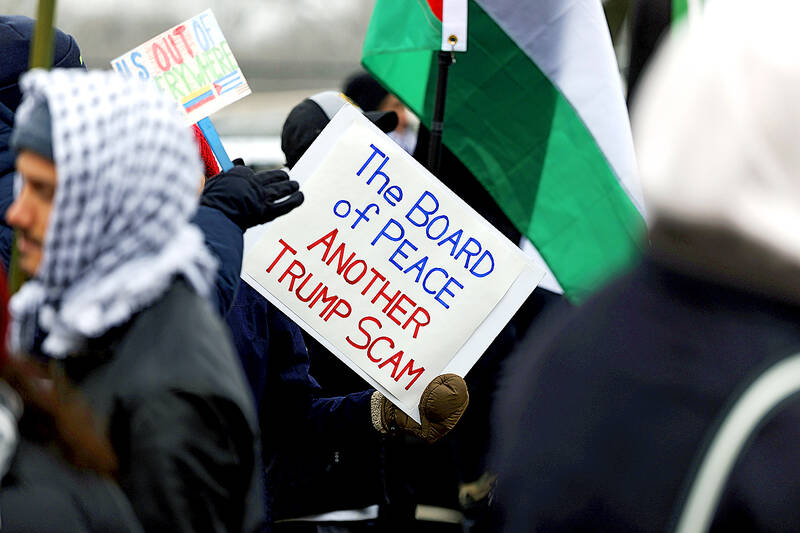
Photo: EPA
UN Secretary-General Antonio Guterres late last month warned that the world body faces “imminent financial collapse” unless its financial rules are overhauled or all 193 member nations pay their dues, a message clearly directed at the US.
He said in a letter to all member nations that cash for the regular budget could run out by July, which could dramatically affect UN operations.
UN officials have said 95 percent of the overdue payments to the UN’s regular budget are from the US.
The disclosure of the US payment came as Trump convened the first meeting of the Board of Peace, a new initiative initially meant to oversee the Gaza ceasefire, but whose wider ambitions under Trump many see as an attempt to rival the UN Security Council’s role in preventing and ending conflict around the world.
Trump has said the UN has not lived up to its potential and has withdrawn the US from UN organizations, including the WHO and the cultural agency UNESCO, while pulling funding from dozens of others.
At the Board of Peace meeting on Thursday in Washington, Trump was much more positive than he has been in the past about the future of the UN, which was established on the ashes of World War II.
He said his administration was going to be working “very closely” with the UN, adding: “Someday, I won’t be here — the United Nations will be.”
Trump said that the Board of Peace “is going to almost be looking over the United Nations,” strengthening it and making sure its facilities are good and it runs properly.
“They need help, and they need help moneywise,” the president said, never mentioning that the US’ failure to pay its dues is a key reason for the UN’s financial crisis.
“We’re going to help them moneywise, and we’re going to make sure the United Nations is viable,” Trump said. “And I think it’s going to eventually live up to its potential. That will be a big day.”
Dujarric last week said that Guterres has been in touch with US Ambassador to the UN Mike Waltz “for quite some time” and that the UN’s controller also has been in touch with US officials about the arrears.
The UN said 55 countries paid their annual dues for this year by the Feb. 8 due date.
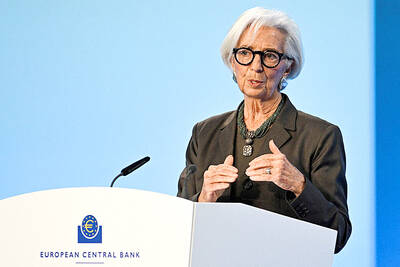
European Central Bank (ECB) President Christine Lagarde is expected to step down from her role before her eight-year term ends in October next year, the Financial Times reported. Lagarde wants to leave before the French presidential election in April next year, which would allow French President Emmanuel Macron and German Chancellor Friedrich Merz to find her replacement together, the report said, citing an unidentified person familiar with her thoughts on the matter. It is not clear yet when she might exit, the report said. “President Lagarde is totally focused on her mission and has not taken any decision regarding the end of
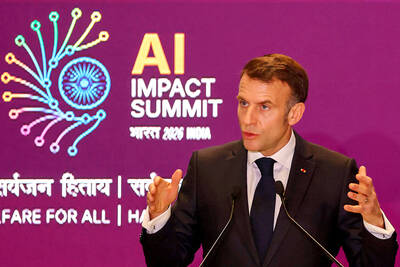
French President Emmanuel Macron told a global artificial intelligence (AI) summit in India yesterday he was determined to ensure safe oversight of the fast-evolving technology. The EU has led the way for global regulation with its Artificial Intelligence Act, which was adopted in 2024 and is coming into force in phases. “We are determined to continue to shape the rules of the game... with our allies such as India,” Macron said in New Delhi. “Europe is not blindly focused on regulation — Europe is a space for innovation and investment, but it is a safe space.” The AI Impact Summit is the fourth

Australian singer Kylie Minogue says “nothing compares” to performing live, but becoming an international wine magnate in under six years has been quite a thrill for the Spinning Around star. Minogue launched her first own-label wine in 2020 in partnership with celebrity drinks expert Paul Schaafsma, starting with a basic rose but quickly expanding to include sparkling, no-alcohol and premium rose offerings. The actress and singer has since wracked up sales of around 25 million bottles, with her carefully branded products pitched at low-to mid-range prices in dozens of countries. Britain, Australia and the United States are the biggest markets. “Nothing compares to performing

AUSPICIOUS TIMING: Ostensibly looking to spike the guns of domestic rivals, ByteDance launched the upgrade to coincide with the Lunar New Year China’s ByteDance Ltd (字節跳動) has rolled out its Doubao 2.0 model, an upgrade of the country’s most widely used artificial-intelligence (AI) app, the company announced on Saturday. ByteDance is one of several Chinese firms hoping to generate overseas and domestic buzz around its new AI models during the Lunar New Year holiday, which began yesterday, when hundreds of millions of Chinese partake in family gatherings in their hometowns. The company, like rival Alibaba Group Holding Ltd (阿里巴巴), was caught off-guard by DeepSeek’s (深度求索) meteoric rise to global fame during last year’s Spring Festival, when Silicon Valley and investors worldwide were


 RSS
RSS