

The US trade deficit widened sharply in December amid a surge in imports, and the goods shortfall last year was the highest on record, despite US President Donald Trump’s tariffs on foreign manufactured merchandise.
The second straight monthly deterioration in the trade deficit reported by the US Department of Commerce on Thursday suggested that trade made little or no contribution to GDP in the fourth quarter. However, most of the imports were capital goods, which should support business investment and keep expectations for strong economic growth intact.
Trump last year unleashed a barrage of tariffs against trading partners with the aim, among other things, to address trade imbalances and protect US industries, but the punitive duties have not yielded a manufacturing renaissance, with factory employment declining by 83,000 jobs last month compared with a year earlier.
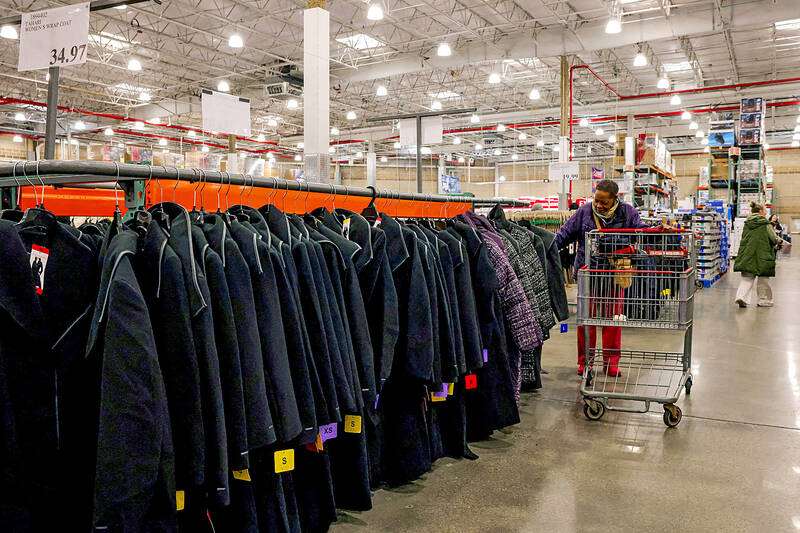
Photo: Reuters
“There just isn’t any evidence out there in the economic research literature to suggest that tariffs have materially impacted trade deficits historically when countries have implemented them,” Peterson Institute for International Economics senior fellow Chad Bown said.
The trade deficit last month ballooned 32.6 percent to a five-month high of US$70.3 billion, the US Bureau of Economic Analysis and Census Bureau said. Economists polled by Reuters forecast it would contract to US$55.5 billion.
The full-year trade deficit narrowed 0.2 percent to US$901.5 billion.
The goods trade gap widened 2.1 percent to an all-time high of US$1.24 trillion. Record goods trade deficits were reported with Taiwan, Mexico, Vietnam, Ireland, Thailand and India. The goods trade deficit with China shrank to US$202.1 billion from US$295.5 billion in 2024.
Imports increased 3.6 percent to US$357.6 billion in December. Goods imports surged 3.8 percent to US$280.2 billion, boosted by a US$7 billion increase in industrial supplies and materials, mostly non-monetary gold, copper and crude oil. Capital goods imports increased US$5.6 billion, lifted by computer accessories and telecommunications equipment. That rise is likely related to the construction of data centers to support artificial intelligence.
However, consumer goods imports fell, pulled down by pharmaceutical preparations. There have been large swings in imports of pharmaceutical preparations because of tariffs. Goods imports increased 4.3 percent to a record US$3.44 trillion last year. There were record imports from 46 countries last year, led by Mexico, Taiwan and Vietnam. Some goods from Taiwan and Vietnam have been exempted from tariffs. The rise in imports last year was almost across the board, led by capital goods, mostly computers, computer accessories and telecommunications equipment. Imports of motor vehicles, parts and engines fell.
Exports fell 1.7 percent to US$287.3 billion in December. Goods exports dropped 2.9 percent to US$180.8 billion, weighed down by an US$8.7 billion decline in industrial supplies and materials, mostly non-monetary gold. However, capital goods exports increased, boosted by semiconductors.
For the full year, exports of goods increased 5.7 percent to an all-time high of US$2.2 trillion, boosted by capital goods, industrial supplies and materials, other goods as well as consumer goods.
The goods trade deficit widened 18.8 percent to US$99.3 billion in December. Imports of services increased US$2.0 billion to US$77.4 billion amid gains in transport and travel services. Exports of services increased US$0.5 billion to US$106.5 billion.
The larger-than-expected trade deficit prompted the Atlanta Federal Reserve to cut its fourth-quarter GDP growth estimate to a 3.0 percent annualized rate from a 3.6 percent pace earlier.
“But strong imports should also imply strength in details like inventories or business investment,” Citigroup economist Veronica Clark said. “Surging computer imports in particular should correspond with stronger business equipment investment and could remain strong due to AI-related demand.”
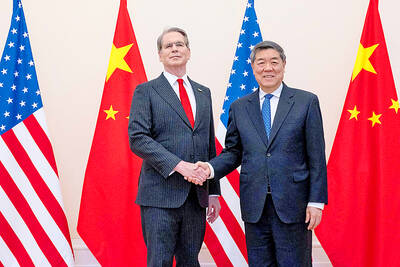
MINIMAL EXPECTATIONS: Analysts think that the two sides are likely to aim for ‘status quo’-level agreements, maintaining civility, without major trade breakthroughs US Secretary of the Treasury Scott Bessent and Chinese Vice Premier He Lifeng (何立峰) were set to meet yesterday to try to set up potential agreements on artificial intelligence (AI), tariffs and critical minerals for a summit in Washington this week between US President Donald Trump and Chinese President Xi Jinping (習近平). The meetings at JPMorgan Chase & Co’s headquarters in Manhattan, which included US Trade Representative Jamieson Greer, were due to start at about 10:30am on Sunday morning and were expected to run all day. Key topics would be the status of a US-China trade truce that is set to expire

MORE DATA CENTERS: Microsoft’s Taiwan-area general manager said the corporation is looking to add two more data centers in northern Taiwan over the next few years Microsoft Corp plans to double its data centers in Taiwan from two facilities to four, Microsoft Taiwan general manager Sean Pien (卞志祥) said yesterday. “Over the past two to three years, we have consistently seen demand outstrip supply, and we expect that situation to continue over the next two to three years,” Pien said on the sidelines of a news conference in Taipei. The data center sites would mainly be in northern Taiwan to meet customer demand and reduce the risk of operational disruptions caused by a single event, he said, without saying their exact locations. Microsoft enabled the first phase of

GlobalFoundries Inc yesterday said it plans to accelerate global capacity optimization and expansion to accommodate exponential growth in radio frequency (RF) and other chips driven by the artificial intelligence (AI) boom. Singapore will pay a vital role in the company’s capacity expansion, alongside production line optimizations across its manufacturing sites, GlobalFoundries Asia Pacific head Vincent Feng (范曾文) told a news conference in Hsinchu City. “Many might be surprised to hear that the RF market is thriving now. We are gearing up for a massive capacity expansion, and it is all being driven by AI,” Feng said. He declined to disclose details of the
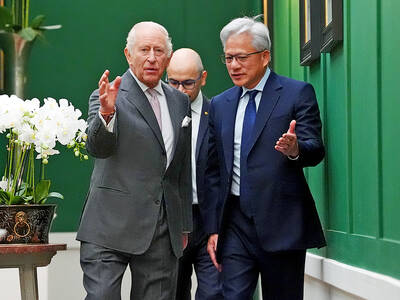
SAFEGUARDING AI: Nvidia CEO Jensen Huang maintained a bullish stance despite concerns about artificial intelligence safety and growing calls for an industry slowdown Nvidia Corp chief executive officer Jensen Huang (黃仁勳) expects to sell twice as many chips in the coming year, fueled by the spread of artificial intelligence (AI) across different industries. AI is of great benefit to a variety of sectors, Huang told reporters on the sidelines of an event convened by King Charles III in Scotland on Thursday. Nvidia is the top seller of AI accelerators, chips used to develop and run AI models. Huang is maintaining his bullish stance at a time when concerns are growing about AI. Industry leaders have discussed slowing down development of the technology over fears that


 RSS
RSS