


Indonesia and the US on Thursday finalized a trade deal to cut US levies to 19 percent from 32 percent on goods shipped from Southeast Asia’s biggest economy, with Jakarta securing tariff exemptions for its top export, palm oil, and several other commodities.
The agreement was signed in Washington by Indonesian Coordinating Minister for Economic Affairs Airlangga Hartarto and US Trade Representative Jamieson Greer after months of negotiations.
“This deal respects the sovereignty of both countries,” Airlangga said during an online news conference, describing the deal as a “win-win” for both countries.
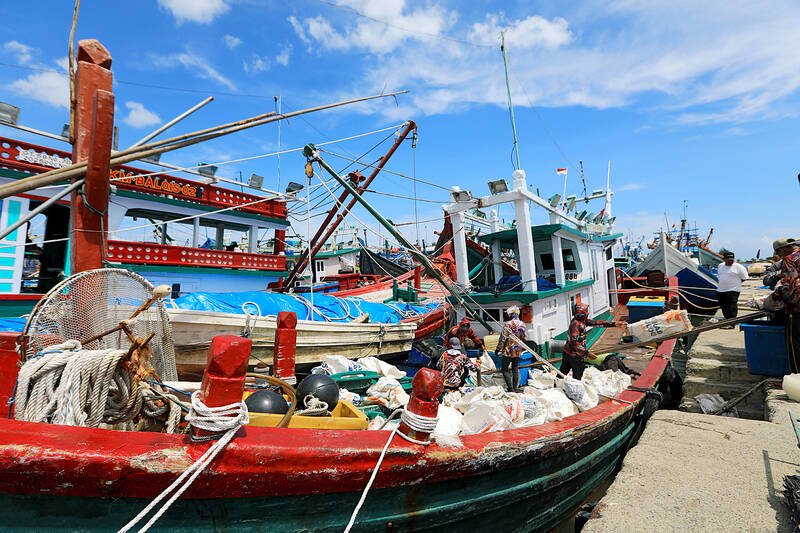
Photo: EPA
Palm oil was a particularly important exemption, accounting for about 9 percent of Indonesia’s overall exports.
Indonesian coffee, cocoa, rubber and spices would also be tariff-free, Airlangga said.
The 19 percent rate is on par with US deals with Southeast Asian rivals such as Malaysia, Cambodia, Thailand and the Philippines. Vietnam has a slightly higher rate of 20 percent.
The deal comes after a rough start to the year for Indonesian markets. Setbacks include last month’s warning from index provider MSCI that the equity market risked a downgrade to “frontier” status over transparency issues, as well as Moody’s cutting of the country’s credit rating outlook two weeks ago that cited reduced predictability in policy making.
Investor confidence in Indonesia could improve if Jakarta uses the US deal as a springboard for further reform, CSIS Indonesia executive director Yose Rizal Damuri said.
Under the deal, textile products from Indonesia would be subject to zero tariffs under a quota mechanism that is still to be discussed. The quota is to be determined by the quantity of US materials such as cotton and manmade fiber used in textiles.
The US dropped requests to add non-economic provisions to the deal, including those related to nuclear reactor development and the South China Sea, Airlangga said.
In return, Indonesia would remove tariff barriers on most US products across all sectors and address a range of non-tariff barriers such as local content requirements, a White House fact sheet said.
It would also accept US product standards on vehicle safety, emissions, medical devices and pharmaceuticals.
The deal also appears to take aim at what analysts have said are concerns in Washington about China’s stranglehold on many critical minerals and the offshoring of Chinese companies’ operations to countries such as Indonesia.
Under the agreement, Indonesia would implement restrictions on “excess production” by foreign-owned mineral processing facilities by ensuring production conforms to Indonesian mining quotas. Such minerals include nickel, cobalt, bauxite, copper and manganese.
Jakarta has also agreed to take action against companies owned or controlled by foreign countries operating within its jurisdiction when their practices harm US trade interests.
Moreover, Indonesia would facilitate US investment in critical minerals and energy resources, as well as cooperate with US companies on expediting development of its rare-earth sector.
The deal is due to take effect 90 days after both sides complete related legal procedures, Airlangga said, adding that changes could still occur if both sides agree.
Indonesian President Prabowo Subianto and US President Donald Trump on Thursday signed a document titled “Implementation of the Agreement Toward a NEW GOLDEN AGE for the US-Indonesian Alliance,” which the White House said would help both countries to strengthen economic security and growth.
Earlier this week, Indonesian and US companies signed deals worth US$38.4 billion.

Netherlands-based semiconductor equipment supplier ASML Holding NV yesterday said that it is planning to hire an additional 1,000 people in Taiwan this year in response to growing demand from clients. ASML had previously planned to recruit 600 people this year, but that the plan has been adjusted upward, ASML vice president and ASML Taiwan general manager Grace Wang (汪佳慧) told reporters. ASML has a workforce of more than 4,500 in Taiwan, accounting for about 10 percent of its global total, Wang said. This year’s recruitment campaign would focus on adding people in the customer support, manufacturing and supply chain domains to assist ASML

UNDER MICROSCOPE: Taiwan detained three people who allegedly conspired to buy servers in Taiwan and export them using fraudulent documentation, prosecutors said Nvidia Corp chief executive officer Jensen Huang (黃仁勳) on Saturday urged Super Micro Computer Inc to tighten up on compliance after Taiwan detained three people this week for allegedly making fraudulent declarations about artificial intelligence (AI) servers made by its US partner. The development marked the nation’s first crackdown on semiconductor smuggling, which grew after the US slapped restrictions on exports of high-end chips such as Nvidia AI accelerators to China. Nvidia is “rigorous” in explaining regulations to all of its partners, Huang told reporters after arriving in Taipei. “Ultimately Super Micro has to run their own company,” he said in response to

Nvidia Corp yesterday announced that CEO Jensen Huang (黃仁勳) would attend an employee meeting in Taipei tomorrow to celebrate the launch of the company’s Taiwan headquarters project. Huang would attend a gathering at the site of Nvidia’s planned headquarters in Beitou Shilin Technology Park (北投士林科技園區), the company said in a statement. After arriving in Taiwan on Saturday last week, Huang told reporters that he plans to meet with Quanta Computer Inc (廣達) chairman Barry Lam (林百里) and Taiwan Semiconductor Manufacturing Co (TSMC, 台積電) chairman C.C. Wei (魏哲家), and would attend the groundbreaking ceremony for Nvidia’s Taiwan headquarters tomorrow. Nvidia has not yet applied
Huawei Technologies Co (華為) said it has come up with a new pathway to shorten its gap with industry leader Taiwan Semiconductor Manufacturing Co (TSMC, 台積電), potentially achieving a breakthrough in making advanced semiconductors without cutting-edge equipment. Right now there is about a five-year gap between what TSMC is capable of and what Huawei, together with its manufacturing partner Semiconductor Manufacturing International Corp (中芯), can produce. Huawei is to start making 1.4-nanometer chips by 2031 with its own “LogicFolding” technology, Huawei semiconductor chief He Tingbo (何庭波) said in a rare public appearance during a chip conference yesterday, while TSMC has


 RSS
RSS