


US artificial intelligence (AI) chip titan Nvidia Corp unveiled tie-ups with Indian computing firms yesterday as tech companies rushed to announce deals and investments at the AI Impact Summit in New Delhi.
Mumbai cloud and data center provider Larsen & Toubro Ltd (L&T) said it was teaming up with Nvidia, the world’s most valuable company, to build what it touted as “India’s largest gigawatt-scale AI factory.”
“We are laying the foundation for world-class AI infrastructure that will power India’s growth,” Nvidia CEO Jensen Huang (黃仁勳) said in a statement that did not put a figure on the investment.
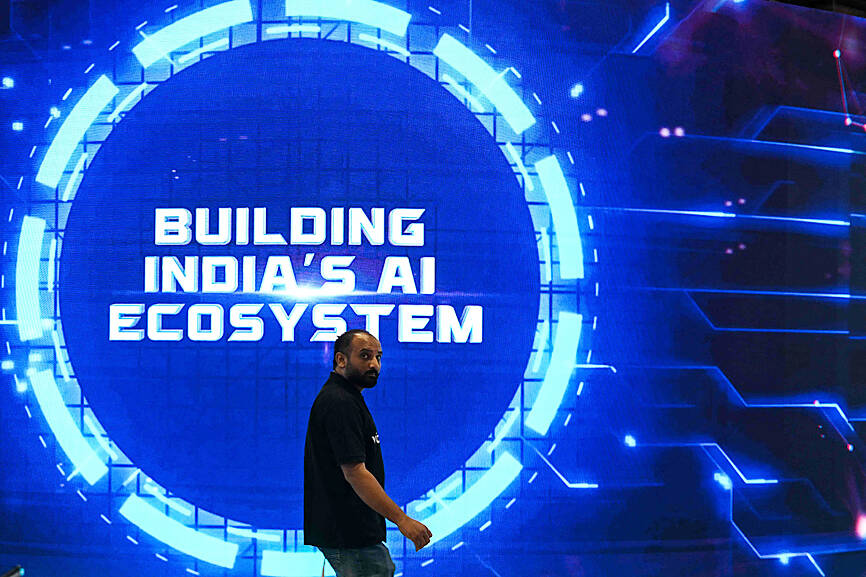
Photo: AFP
L&T said it would use Nvidia’s powerful processors to provide data center capacity of up to 30 megawatts in Chennai and 40 megawatts in Mumbai.
Nvidia said it was also working with other Indian AI infrastructure players such as Yotta Data Services Pvt Ltd, which will deploy more than 20,000 top-end Nvidia Blackwell processors as part of a US$2 billion investment.
Dozens of world leaders and ministerial delegations have come to India for the summit to discuss the opportunities and threats, from job losses to misinformation, that AI poses.
Last year India leapt to third place — overtaking South Korea and Japan — in an annual global ranking of AI competitiveness calculated by Stanford University researchers.
However, despite plans for large-scale infrastructure and grand ambitions for innovation, experts say that the country has a long way to go before it can rival the US and China.
This year’s AI conference has also brought a flurry of deals. On Tuesday, India’s Adani Group said it would invest US$100 billion by 2035 to develop “hyperscale AI-ready data centers,” a boost to New Delhi’s push to become a global AI hub.
Microsoft Corp said it was investing US$50 billion this decade to boost AI adoption in developing countries, while US AI start-up Anthropic PBC and Indian IT giant Infosys Ltd said they would work together to build AI agents for the telecoms industry.
Indian Prime Minister Narendra Modi and other world leaders including French President Emmanuel Macron and Brazilian President Luiz Inacio Lula da Silva are expected to deliver a statement at the end of the week about how they plan to address concerns raised by AI technology.
Experts say that the broad focus of the event and vague promises made at previous global AI summits in France, South Korea and Britain mean that concrete commitments are unlikely.
Nick Patience, practice lead for AI at tech research group Futurum, said that nonbinding declarations could still “set the tone for what acceptable AI governance looks like.”
However, “the largest AI companies deploy capabilities at a pace that makes 18-month legislative cycles look glacial,” Patience said. “So it’s a case of whether governments can converge fast enough to create meaningful guardrails before de facto standards are set by the companies themselves.”

Cairo’s new monorail slices across the city skyline, running above the familiar chaos of blaring horns and aging buses’ exhaust fumes that mark rush hour below. The US$4.5 billion monorail, opened this month, is among Egypt’s most prominent new transport projects, part of a debt-funded infrastructure drive criticized for sapping state finances while bringing limited benefits to most of the country’s 109 million people. “It feels like you’re in a different country,” said Ramy Sayed, a restaurant manager, aboard a driverless Innovia 300 train. “No noise, no traffic, we’re not used to this.” The eastern line runs 56km from the bustling middle-class

Taiwanese firms have increased investment in the Philippines in recent years as Manila’s ties with Washington deepen and global supply chains continue to shift away from China, an expert at the Chung-Hua Institution for Economic Research (CIER, 中華經濟研究院) said yesterday. The Philippines had not been among Taiwanese investors’ top choices in Southeast Asia, CIER Taiwan ASEAN Studies Center director Kristy Hsu (徐遵慈) said at a seminar in Taipei. However, Taiwan’s investment in the country has grown significantly since the COVID-19 pandemic, reaching US $257 million last year, a high in recent years, she said. Although Taiwan’s total investment in the Philippines still lags
Intel Corp regards Taiwan Semiconductor Manufacturing Co (TSMC, 台積電) as a longstanding partner, as the US chipmaker would continue outsourcing production of advanced chips to TSMC, Intel chief executive officer Lip-Bu Tan (陳立武) said yesterday. “I don’t look at people as competitors. I look at the collaboration... Nvidia is also, you know, a good friend,” Tan told a news conference following his keynote speech at the Computex trade show in Taipei. “It’s a very trusted partnership for us... We are a big, top customer for them, and we’re going to continue doing that,” he said, referring to TSMC, the world’s largest foundry
Artificial intelligence (AI) agents would supplant smartphones as the center of people’s digital lives, fundamentally reshaping personal devices and driving a major computing upgrade cycle, Qualcomm Inc CEO Cristiano Amon said yesterday. In his keynote speech for this year’s Computex trade show in Taipei, Amon said that the rise of "agentic AI" — AI systems capable of reasoning, planning and carrying out tasks autonomously — would transform how people interact with technology across phones, PCs, vehicles and wearable devices. Describing the technology as the next major evolution in computing, Amon said that "2026 is the year of agents.” For decades, smartphones have sat


 RSS
RSS