


Some US Federal Reserve officials have begun suggesting in recent days that productivity growth from artificial intelligence (AI) could mean higher interest rates, a view that would put them at odds with US President Donald Trump’s administration and its nominee to lead the US central bank.
“I expect that the AI boom is unlikely to be a reason for lowering policy rates,” Fed Governor Michael Barr said on Tuesday in remarks prepared for a speech in New York.
Barr’s comments followed remarks from Fed Vice Chair Philip Jefferson, who said in a Feb. 6 speech that “all other things being equal, persistent increases in productivity growth are likely to result in an increase in the neutral rate, at least temporarily.”
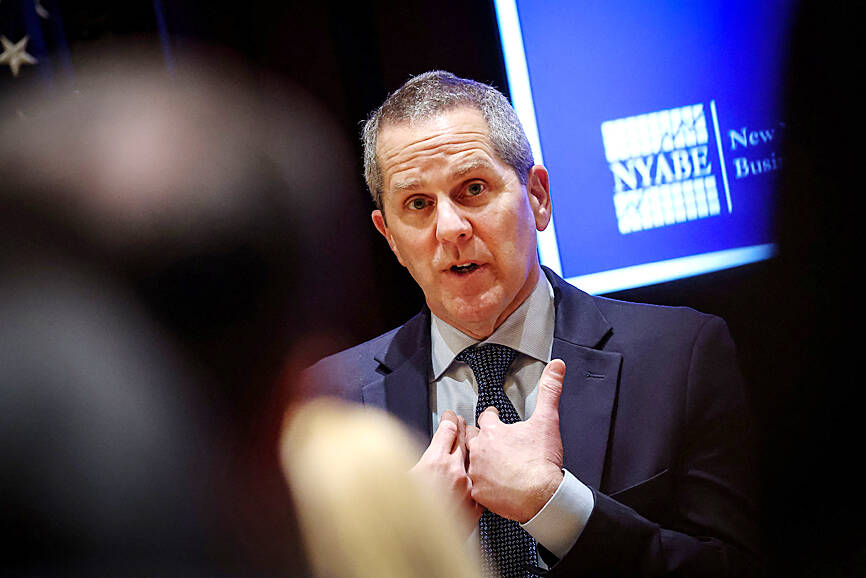
Photo: Reuters
AI and productivity are likely to take on increasing importance this year in debates over interest rates as Trump continues to put pressure on the Fed to reduce borrowing costs.
The central bank cut its benchmark rate three times last year, but held it steady at its policy meeting last month. It is not expected to cut rate before midyear, according to futures traders.
Kevin Warsh, Trump’s nominee to take over as Fed chair when Jerome Powell’s term expires in May, has echoed administration officials in arguing AI could unleash a productivity boom that will allow for non-inflationary growth, and lower rates to accompany it.
In his speech on Tuesday, Barr outlined several reasons why that may not be the case.
“Demand for capital would rise because of the strong business investment required to take advantage of the technology, putting upward pressures on interest rates,” he said. “And household savings could fall due to expectations of stronger real wage growth and thus higher lifetime earnings, also putting upward pressure on interest rates.”
The Fed’s benchmark rate now lies in a range between 3.5 percent and 3.75 percent. Several Fed officials see that as close to neutral for the economy, and have cited that as a reason to slow or stop rate cuts.
San Francisco Fed President Mary Daly, speaking to reporters later on Tuesday after an event in San Jose, California, said an AI-induced acceleration in productivity growth would dictate a higher neutral rate in “the standard model” because “the demand for investment would rise relative to the supply of savings.”
However, the San Francisco Fed chief said any analysis would be far from clear-cut.
“Maybe it raises the neutral rate a little bit,” she said. “We need to be a little humble about what we think the impact on the neutral rate will be.”

Cairo’s new monorail slices across the city skyline, running above the familiar chaos of blaring horns and aging buses’ exhaust fumes that mark rush hour below. The US$4.5 billion monorail, opened this month, is among Egypt’s most prominent new transport projects, part of a debt-funded infrastructure drive criticized for sapping state finances while bringing limited benefits to most of the country’s 109 million people. “It feels like you’re in a different country,” said Ramy Sayed, a restaurant manager, aboard a driverless Innovia 300 train. “No noise, no traffic, we’re not used to this.” The eastern line runs 56km from the bustling middle-class
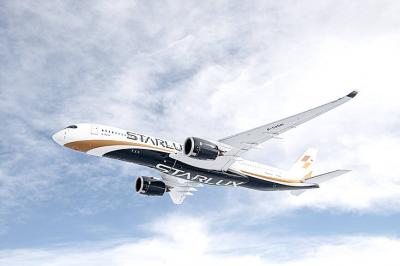
Starlux Airlines Co (星宇航空) today unveiled a long-haul network expansion plan at a shareholders’ meeting in Taipei, including direct flights to Barcelona, Spain, and Zurich, Switzerland, as well as a service connecting Taipei, Sydney and New Zealand. Starlux is to become the first Taiwanese carrier to offer non-stop services to the two European cities, while the inaugural oceanic route is expected to expand transit opportunities within the Australia-New Zealand market, Starlux said. Flight services to Chicago, Dallas, Washington and New York are under evaluation, the airline added. Prior to the shareholders’ meeting, the airline earlier this year announced that it would be
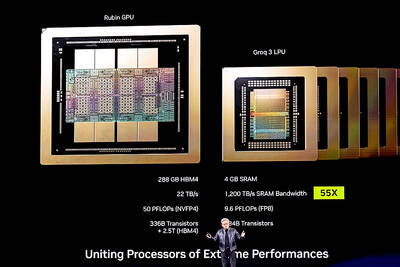
Taiwanese prosecutors suspect that three people successfully smuggled at least one shipment of Nvidia Corp artificial intelligence (AI) chips to China after first exporting them to Japan, people familiar with the matter said. The trio was detained last week by the Keelung District Prosecutors’ Office for allegedly falsifying documents related to exports of Super Micro Computer Inc servers containing advanced Nvidia chips, which the US has barred from sale to China without a license from Washington. The move marked Taiwan’s first public crackdown on AI chip diversion after years of pressure from the US to take a more active role in curtailing
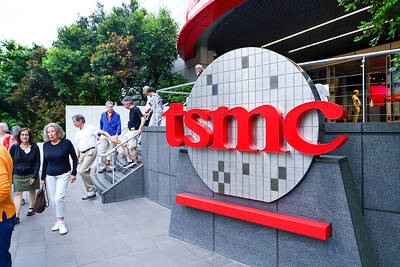
Taiwan Semiconductor Manufacturing Co (TSMC, 台積電) employee bonuses are likely to grow more than 30 percent this year, in line with the past few years as the company’s profits continue to set new records, an anonymous source cited TSMC chairman C.C. Wei (魏哲家) as saying yesterday. TSMC, the world’s largest contract chipmaker, is committed to taking care of its workers, the source said, citing Wei’s meeting with employees yesterday morning. Wei also expressed gratitude to employees for their contribution to the company’s improving bottom line, the source added. Since 2023, TSMC’s employee bonuses have grown at an annual rate of


 RSS
RSS