


Meta Platforms Inc has agreed to deploy “millions” of Nvidia Corp processors over the next few years, tightening an already close relationship between two of the biggest companies in the artificial intelligence (AI) industry.
Meta, which accounts for about 9 percent of Nvidia’s revenue, is committing to use more AI processors and networking equipment from the supplier, according to a statement on Tuesday. For the first time, it also plans to rely on Nvidia’s Grace central processing units (CPUs) at the heart of standalone computers.
The rollout will include products based on Nvidia’s current Blackwell generation and the forthcoming Vera Rubin design of AI accelerators.
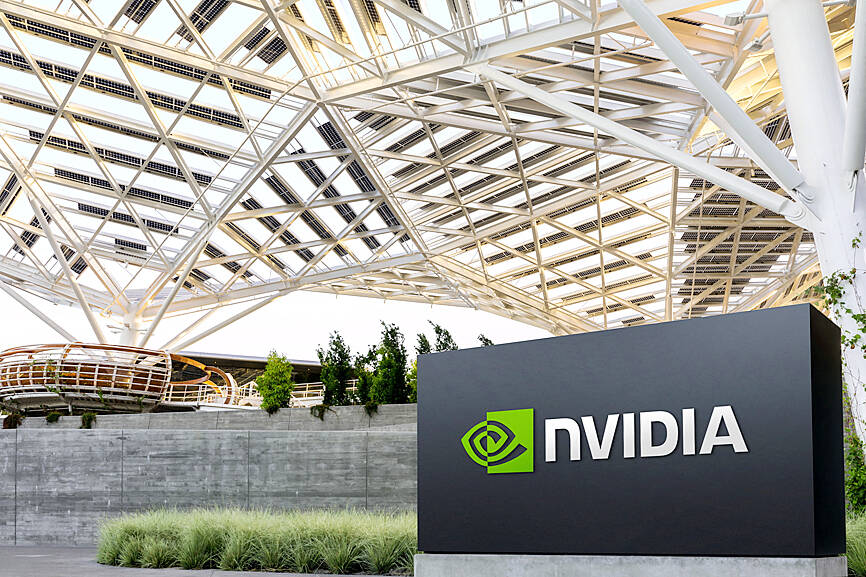
Photo: Courtesy NVIDIA/Handout via REUTERS
“We’re excited to expand our partnership with Nvidia to build leading-edge clusters using their Vera Rubin platform to deliver personal superintelligence to everyone in the world,” Meta chief executive officer Mark Zuckerberg said in the statement.
The pact reaffirms Meta’s loyalty to Nvidia at a time when the AI landscape is shifting. Nvidia’s systems are still considered the gold standard for AI infrastructure — and generate hundreds of billions of US dollars in revenue for the chipmaker. However, rivals are now offering alternatives, and Meta is working on building its own in-house components.
Nvidia’s AI accelerators fetch an average of US$16,061 apiece, according to a recent IDC estimate. That means 1 million of the chips would cost more than US$16 billion — and that does not account for the higher price of newer versions or the other Nvidia equipment that Meta is buying.
Meta was already the second-largest buyer of Nvidia products. It accounted for a total of about US$19 billion in the last fiscal year, according to data compiled by Bloomberg.
Nvidia’s vice president of accelerated computing Ian Buck said the two companies are not putting a dollar figure on the latest commitment or laying out a timeline.
Buck said that only Nvidia is able to offer the breadth of components, systems and software that a company wishing to be a leader in AI needs. Still, it is reasonable for Meta and others to test out other alternatives, he said.
Meta has already projected record spending for this year, with Zuckerberg saying last year that the company would put US$600 billion toward US infrastructure projects over the next three years. Meta is building several gigawatt-sized data centers around the country, including in Louisiana, Ohio and Indiana. One gigawatt is roughly the amount of energy needed to power 750,000 homes.
Buck stressed that Meta will be the first large data-center operator to use Nvidia’s CPUs in standalone servers. Typically, Nvidia offers this technology in combination with its high-end AI accelerators — chips that owe their lineage to graphics processors.
This shift represents an encroachment into territory dominated by Intel Corp and Advanced Micro Devices Inc.
It also provides an alternative to some of the in-house chips that are designed by large data-center operators, such as Amazon.com Inc’s Amazon Web Services.
Nvidia CPUs will be increasingly used for tasks such as data manipulation and machine learning, Buck said.
“There’s many different kinds of workloads for CPUs,” Buck said. “What we’ve found is Grace is an excellent back-end data center CPU,” meaning it handles the behind-the-scenes computing tasks.
“It can actually deliver two times the performance per watt on those back-end workloads,” he said.

Netherlands-based semiconductor equipment supplier ASML Holding NV yesterday said that it is planning to hire an additional 1,000 people in Taiwan this year in response to growing demand from clients. ASML had previously planned to recruit 600 people this year, but that the plan has been adjusted upward, ASML vice president and ASML Taiwan general manager Grace Wang (汪佳慧) told reporters. ASML has a workforce of more than 4,500 in Taiwan, accounting for about 10 percent of its global total, Wang said. This year’s recruitment campaign would focus on adding people in the customer support, manufacturing and supply chain domains to assist ASML

UNDER MICROSCOPE: Taiwan detained three people who allegedly conspired to buy servers in Taiwan and export them using fraudulent documentation, prosecutors said Nvidia Corp chief executive officer Jensen Huang (黃仁勳) on Saturday urged Super Micro Computer Inc to tighten up on compliance after Taiwan detained three people this week for allegedly making fraudulent declarations about artificial intelligence (AI) servers made by its US partner. The development marked the nation’s first crackdown on semiconductor smuggling, which grew after the US slapped restrictions on exports of high-end chips such as Nvidia AI accelerators to China. Nvidia is “rigorous” in explaining regulations to all of its partners, Huang told reporters after arriving in Taipei. “Ultimately Super Micro has to run their own company,” he said in response to

Nvidia Corp yesterday announced that CEO Jensen Huang (黃仁勳) would attend an employee meeting in Taipei tomorrow to celebrate the launch of the company’s Taiwan headquarters project. Huang would attend a gathering at the site of Nvidia’s planned headquarters in Beitou Shilin Technology Park (北投士林科技園區), the company said in a statement. After arriving in Taiwan on Saturday last week, Huang told reporters that he plans to meet with Quanta Computer Inc (廣達) chairman Barry Lam (林百里) and Taiwan Semiconductor Manufacturing Co (TSMC, 台積電) chairman C.C. Wei (魏哲家), and would attend the groundbreaking ceremony for Nvidia’s Taiwan headquarters tomorrow. Nvidia has not yet applied
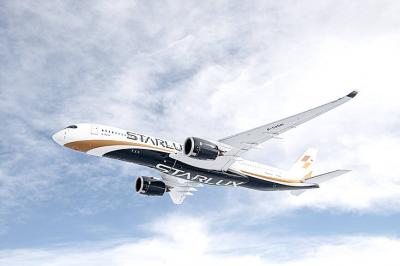
Starlux Airlines Co (星宇航空) today unveiled a long-haul network expansion plan at a shareholders’ meeting in Taipei, including direct flights to Barcelona, Spain, and Zurich, Switzerland, as well as a service connecting Taipei, Sydney and New Zealand. Starlux is to become the first Taiwanese carrier to offer non-stop services to the two European cities, while the inaugural oceanic route is expected to expand transit opportunities within the Australia-New Zealand market, Starlux said. Flight services to Chicago, Dallas, Washington and New York are under evaluation, the airline added. Prior to the shareholders’ meeting, the airline earlier this year announced that it would be


 RSS
RSS