


US President Donald Trump’s administration on Tuesday announced three projects valued at US$36 billion to be financed by Japan, including an oil export facility in Texas, an industrial diamonds plant in Georgia and a natural gas power plant in Ohio.
The projects are the first investments under Japan’s US$550 billion US investment pledge as part of a trade deal that cut Trump’s tariffs on Japanese imports to 15 percent, Trump said on Truth Social. He gave few details about the projects.
US Secretary of Commerce Howard Lutnick said in a statement that the Portsmouth, Ohio power plant, valued at US$33 billion, would be the largest natural gas-fired generating facility in history with a capacity of 9.2 gigawatts.
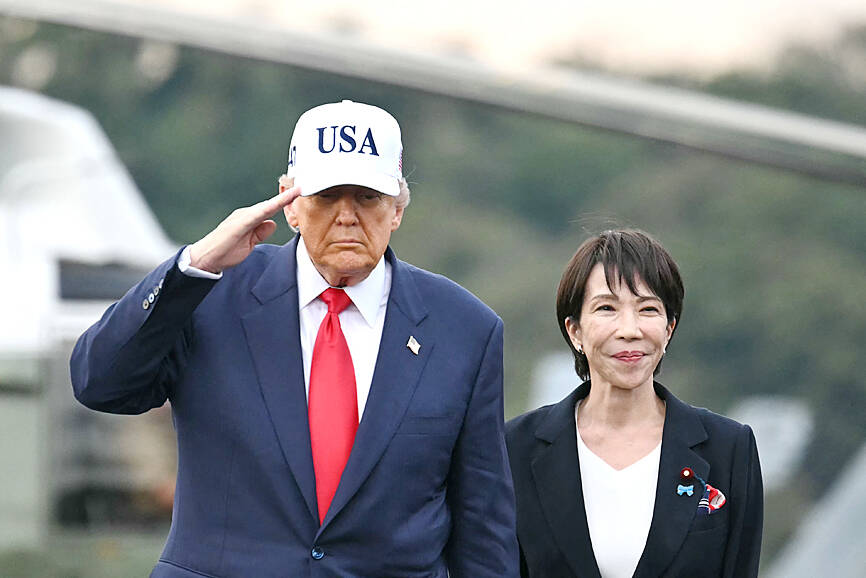
Photo: AFP
The facility, to be operated by SB Energy Corp, a subsidiary of Japanese tech investor Softbank Group Corp, would increase baseload power at a time of fast-growing electricity demand from data centers built to power artificial intelligence (AI) applications.
The White House said Japan would invest in the US$2.1 billion Texas GulfLink LLC deepwater crude oil export facility off the Texas coast.
“This project is expected to generate US$20 billion — US$30 billion annually in US crude exports, secure export capacity for our refineries, and reinforce America’s position as the world’s leading energy supplier,” Lutnick said.
Texas GulfLink, which is being developed by Sentinel Midstream LLC, confirmed that it was part of the initiative and was “honored to be a trusted partner with the US Department of Commerce and the government of Japan.”
Trump said the Texas investments would include a liquefied natural gas project, but Lutnick’s statement and a White House fact sheet did not mention LNG.
Lutnick said the third major project in Georgia was a synthetic industrial diamond manufacturing plant that would satisfy 100 percent of US demand for synthetic diamond grit, a critical input for advanced manufacturing and semiconductor production. The US currently relies largely on China for such supplies.
The high-pressure synthetic diamond plant, valued at about US$600 million, will be operated by Element Six Ltd, the White House said in a fact sheet. The industrial diamond company is a unit of De Beers Group, the world’s largest diamond producer.
It was unclear how much of the projects’ costs would be funded by Japanese entities and under what conditions. Under an earlier US-Japan agreement, profit from the projects was due to be shared 50-50 between the US and Japan until Japan’s initial investment costs were recouped, after which profit would be split 90-10 in favor of the US.
The administration’s announcements followed meetings last week between Lutnick and Japanese Minister of Economy, Trade and Industry Ryosei Akazawa, where they worked out remaining issues before deals could be announced.
“All of these projects involve Japan and the United States working together to build supply chains in strategically important fields,” Akazawa told reporters in Tokyo yesterday.
He also said that Japan would continue to work with the US for more investment deals, adding that Tokyo has pledged investments of up to US$550 billion before the end of Trump’s current term in office.
While declining to comment on the estimated timing for forthcoming deals, Akazawa said he, as a negotiator, “would keep in mind that Prime Minister Sanae Takaichi’s planned US visit [in March] would be fruitful.”
Multiple Japanese firms expressed interest in the three initial projects, according to the Japanese government, including Noritake Co as an off-taker for the diamond project, Mitsui O.S.K. Lines Ltd and Nippon Steel Ltd as suppliers for the crude oil export facility project, and Hitachi Ltd and Toshiba Corp for the power project.
Japan’s investment package would consist of equity, loans and loan guarantees from state-owned agencies Japan Bank for International Cooperation and Nippon Export and Investment Insurance.
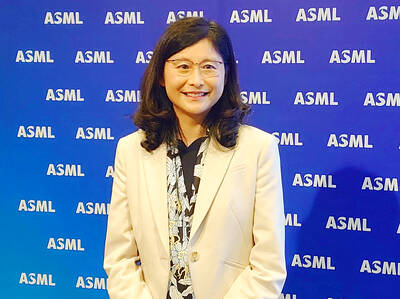
Netherlands-based semiconductor equipment supplier ASML Holding NV yesterday said that it is planning to hire an additional 1,000 people in Taiwan this year in response to growing demand from clients. ASML had previously planned to recruit 600 people this year, but that the plan has been adjusted upward, ASML vice president and ASML Taiwan general manager Grace Wang (汪佳慧) told reporters. ASML has a workforce of more than 4,500 in Taiwan, accounting for about 10 percent of its global total, Wang said. This year’s recruitment campaign would focus on adding people in the customer support, manufacturing and supply chain domains to assist ASML
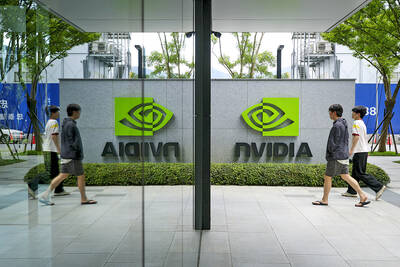
UNDER MICROSCOPE: Taiwan detained three people who allegedly conspired to buy servers in Taiwan and export them using fraudulent documentation, prosecutors said Nvidia Corp chief executive officer Jensen Huang (黃仁勳) on Saturday urged Super Micro Computer Inc to tighten up on compliance after Taiwan detained three people this week for allegedly making fraudulent declarations about artificial intelligence (AI) servers made by its US partner. The development marked the nation’s first crackdown on semiconductor smuggling, which grew after the US slapped restrictions on exports of high-end chips such as Nvidia AI accelerators to China. Nvidia is “rigorous” in explaining regulations to all of its partners, Huang told reporters after arriving in Taipei. “Ultimately Super Micro has to run their own company,” he said in response to
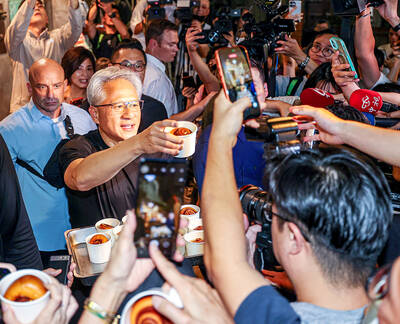
Nvidia Corp yesterday announced that CEO Jensen Huang (黃仁勳) would attend an employee meeting in Taipei tomorrow to celebrate the launch of the company’s Taiwan headquarters project. Huang would attend a gathering at the site of Nvidia’s planned headquarters in Beitou Shilin Technology Park (北投士林科技園區), the company said in a statement. After arriving in Taiwan on Saturday last week, Huang told reporters that he plans to meet with Quanta Computer Inc (廣達) chairman Barry Lam (林百里) and Taiwan Semiconductor Manufacturing Co (TSMC, 台積電) chairman C.C. Wei (魏哲家), and would attend the groundbreaking ceremony for Nvidia’s Taiwan headquarters tomorrow. Nvidia has not yet applied
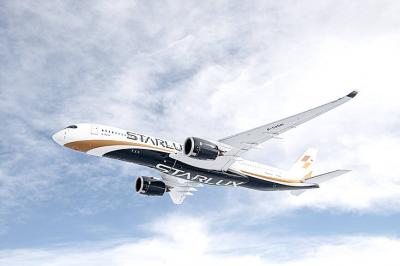
Starlux Airlines Co (星宇航空) today unveiled a long-haul network expansion plan at a shareholders’ meeting in Taipei, including direct flights to Barcelona, Spain, and Zurich, Switzerland, as well as a service connecting Taipei, Sydney and New Zealand. Starlux is to become the first Taiwanese carrier to offer non-stop services to the two European cities, while the inaugural oceanic route is expected to expand transit opportunities within the Australia-New Zealand market, Starlux said. Flight services to Chicago, Dallas, Washington and New York are under evaluation, the airline added. Prior to the shareholders’ meeting, the airline earlier this year announced that it would be


 RSS
RSS