


Switzerland’s economy rebounded at the end of last year, partially shaking off the impact of outsized tariffs inflicted by US President Donald Trump.
GDP adjusted for large sports events rose 0.2 percent in the fourth quarter from the previous three months, when it dropped by 0.5 percent. The result is just below the 0.3 percent median prediction of economists in a Bloomberg survey.
“Growth in the services sector was muted, while the industrial sector stagnated,” the Swiss State Secretariat for Economic Affairs said in a statement on yesterday.
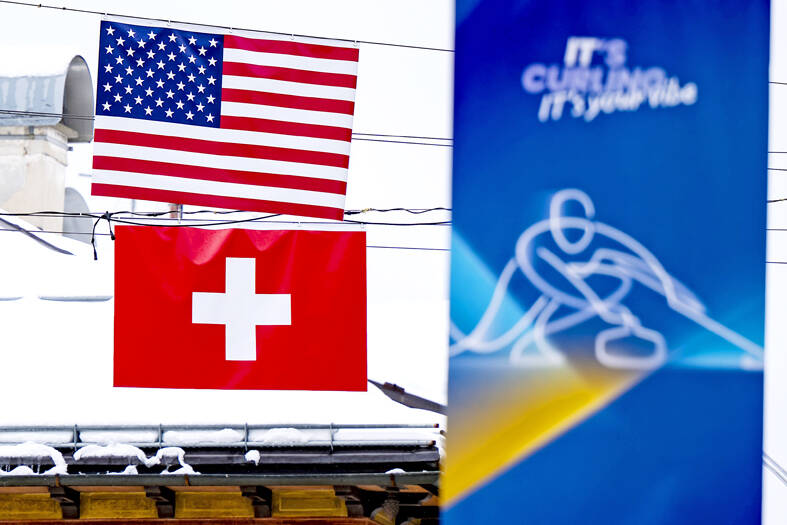
Photo: EPA
The reading suggests resilience in the Swiss economy after the initial shock of Trump’s 39 percent tariff in August last year drove its biggest contraction since the COVID-19 pandemic.
A deal cutting levies to 15 percent as of mid-November last year, with the Alpine nation vowing to invest US$200 billion in the US, had raised hopes that the trade levies’ impact would be limited.
The government subsequently raised its growth forecasts for this year almost back to levels seen before the surcharges took effect, albeit cautioning that uncertainty remains high.
For last year as a whole, GDP growth reached 1.4 percent, matching the government’s prediction and up from 1.2 percent the previous year.
Companies in the export-focused economy are grappling with a strong franc, which climbed to fresh decade highs against the euro and the US dollar in recent weeks. The currency’s strength could force the Swiss National Bank to consider reintroducing negative interest rates after already lowering its benchmark to zero.
While the third quarter of last year marked only the second Swiss contraction since the pandemic — underscoring a more robust economy than many European peers — early signs indicate potentially rough times ahead.
Layoffs are mounting, particularly in the important pharmaceutical sector, which had dragged on growth and is under particular pressure from the White House’s push to cut drug prices in the US.
A number of small and medium-sized enterprises — which employ two-thirds of the Swiss workforce — have also announced job reductions or plans to move production abroad.
Unemployment has been edging up since 2023, although last month saw a slight decrease in the seasonally adjusted figure.
The GDP report excludes data from large sport events, because they can distort the overall picture of the country’s economy.
Switzerland is the home to several global sports bodies, so when for instance the Olympic Games take place — earning revenue for the International Olympic Committee — that boosts the output statistic without benefiting economic activity.
A final growth reading along with further details on its drivers are to be published on Feb. 27.

Cairo’s new monorail slices across the city skyline, running above the familiar chaos of blaring horns and aging buses’ exhaust fumes that mark rush hour below. The US$4.5 billion monorail, opened this month, is among Egypt’s most prominent new transport projects, part of a debt-funded infrastructure drive criticized for sapping state finances while bringing limited benefits to most of the country’s 109 million people. “It feels like you’re in a different country,” said Ramy Sayed, a restaurant manager, aboard a driverless Innovia 300 train. “No noise, no traffic, we’re not used to this.” The eastern line runs 56km from the bustling middle-class
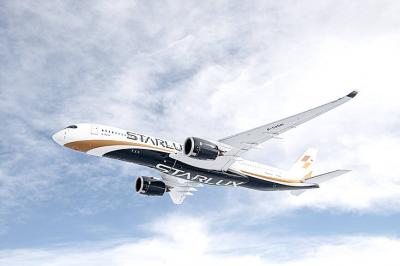
Starlux Airlines Co (星宇航空) today unveiled a long-haul network expansion plan at a shareholders’ meeting in Taipei, including direct flights to Barcelona, Spain, and Zurich, Switzerland, as well as a service connecting Taipei, Sydney and New Zealand. Starlux is to become the first Taiwanese carrier to offer non-stop services to the two European cities, while the inaugural oceanic route is expected to expand transit opportunities within the Australia-New Zealand market, Starlux said. Flight services to Chicago, Dallas, Washington and New York are under evaluation, the airline added. Prior to the shareholders’ meeting, the airline earlier this year announced that it would be

Taiwanese prosecutors suspect that three people successfully smuggled at least one shipment of Nvidia Corp artificial intelligence (AI) chips to China after first exporting them to Japan, people familiar with the matter said. The trio was detained last week by the Keelung District Prosecutors’ Office for allegedly falsifying documents related to exports of Super Micro Computer Inc servers containing advanced Nvidia chips, which the US has barred from sale to China without a license from Washington. The move marked Taiwan’s first public crackdown on AI chip diversion after years of pressure from the US to take a more active role in curtailing
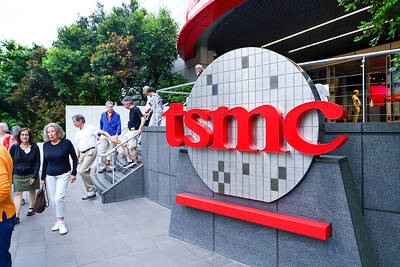
Taiwan Semiconductor Manufacturing Co (TSMC, 台積電) employee bonuses are likely to grow more than 30 percent this year, in line with the past few years as the company’s profits continue to set new records, an anonymous source cited TSMC chairman C.C. Wei (魏哲家) as saying yesterday. TSMC, the world’s largest contract chipmaker, is committed to taking care of its workers, the source said, citing Wei’s meeting with employees yesterday morning. Wei also expressed gratitude to employees for their contribution to the company’s improving bottom line, the source added. Since 2023, TSMC’s employee bonuses have grown at an annual rate of


 RSS
RSS