


India is hosting an artificial intelligence (AI) summit this week, bringing together heads of state, senior officials and tech executives to New Delhi for a five-day gathering highlighting the growing global importance of the technology.
Organizers said the India AI Impact Summit is the first such summit being held in the “Global South” to discuss the technology developed and dominated by wealthy companies based in rich countries. It comes at a pivotal moment as AI rapidly transforms economies, reshapes labor markets and raises questions around regulations, security and ethics.
From generative AI tools that can produce text and images to advanced systems used in defense, health care and climate modeling, AI has become a central focus for governments and corporations across the world.
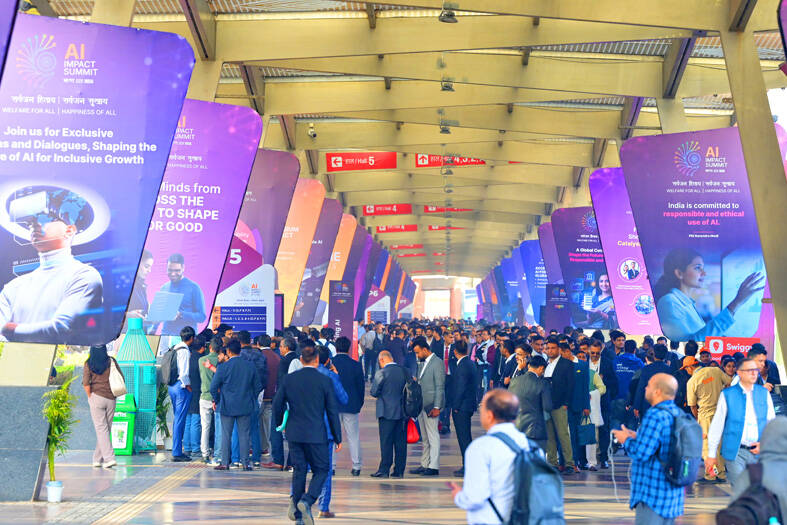
Photo: AP
The summit, previously held in France, the UK and South Korea, has evolved far beyond its modest beginnings as a meeting tightly focused on the safety of cutting-edge AI systems into an all-purpose jamboree trade fair in which safety is just one aspect.
Indian officials said the country’s experience in building large-scale digital public infrastructure, including digital identity and payment platforms, offers a model for deploying AI at scale while keeping costs low.
“The goal is clear: AI should be used for shaping humanity, inclusive growth and a sustainable future,” Indian Minister for Electronics and Information Technology Ashwini Vaishnaw said.
The summit began yesterday, with 20 heads of state and government expected, including French President Emmanuel Macron and Brazilian President Luiz Inacio Lula da Silva.
Indian Prime Minister Narendra Modi is to address a session on Thursday.
Google chief executive Sundar Pichai, Qualcomm Inc CEO Cristiano Amon, OpenAI CEO Sam Altman, Microsoft Corp president Brad Smith and AMI Labs executive chairman Yann LeCun are also expected to attend.
Indian executives are hoping the summit will reflect the country’s recognition as an enabler of national capabilities, economic resilience and long-term capabilities.
“As India continues on the journey to become a developed nation by 2047, AI has a critical role to play in strengthening large-scale systems, from energy and manufacturing to public infrastructure,” Renew Energy Global PLC chief executive Sumant Sinha said.
Like previous editions, the India AI Impact Summit is not expected to result in a joint binding political agreement. It is more likely that the event could end with a non-binding pledge or declaration on goals for AI development.
Last year’s edition, the Paris AI Action Summit, was dominated by US Vice President J.D. Vance’s speech in which he rebuked European efforts to curb AI’s risks by warning global leaders and tech industry executives against “excessive regulation” that could hobble the rapidly growing AI industry.
Ahead of the India meeting, a panel of experts released a second annual safety report on the risks posed by the most advanced AI systems, including through misuse, malfunctions and so-called systemic risks.
AI governance efforts are also under way elsewhere, including at the UN, which last year adopted a resolution to set up two key bodies on AI — a global forum and an independent scientific panel of experts.
“The whole point of this report is to build an international consensus on the state of the science regarding the emerging risks of AI,” said Yoshua Bengio, a prominent scientist known as one of the “Godfathers of AI” who led the study. “It’s really important that the world will continue to have a strong independent scientific evaluation of the risks.”
Like elsewhere, there have been concerns in India about AI’s adverse effect on jobs across technology and allied sectors, but experts point to reskilling to hedge risks.
“There is a lot of genuine concern around this theme, and I don’t want to underestimate this impact. But, from an Indian lens, emphasis is on re-skilling programs and as AI becomes much more mainstream, you will also see newer job roles coming up,” said Sangeeta Gupta, senior vice president at Nasscom, a prominent body representing India’s technology industry.

Netherlands-based semiconductor equipment supplier ASML Holding NV yesterday said that it is planning to hire an additional 1,000 people in Taiwan this year in response to growing demand from clients. ASML had previously planned to recruit 600 people this year, but that the plan has been adjusted upward, ASML vice president and ASML Taiwan general manager Grace Wang (汪佳慧) told reporters. ASML has a workforce of more than 4,500 in Taiwan, accounting for about 10 percent of its global total, Wang said. This year’s recruitment campaign would focus on adding people in the customer support, manufacturing and supply chain domains to assist ASML

UNDER MICROSCOPE: Taiwan detained three people who allegedly conspired to buy servers in Taiwan and export them using fraudulent documentation, prosecutors said Nvidia Corp chief executive officer Jensen Huang (黃仁勳) on Saturday urged Super Micro Computer Inc to tighten up on compliance after Taiwan detained three people this week for allegedly making fraudulent declarations about artificial intelligence (AI) servers made by its US partner. The development marked the nation’s first crackdown on semiconductor smuggling, which grew after the US slapped restrictions on exports of high-end chips such as Nvidia AI accelerators to China. Nvidia is “rigorous” in explaining regulations to all of its partners, Huang told reporters after arriving in Taipei. “Ultimately Super Micro has to run their own company,” he said in response to

Nvidia Corp yesterday announced that CEO Jensen Huang (黃仁勳) would attend an employee meeting in Taipei tomorrow to celebrate the launch of the company’s Taiwan headquarters project. Huang would attend a gathering at the site of Nvidia’s planned headquarters in Beitou Shilin Technology Park (北投士林科技園區), the company said in a statement. After arriving in Taiwan on Saturday last week, Huang told reporters that he plans to meet with Quanta Computer Inc (廣達) chairman Barry Lam (林百里) and Taiwan Semiconductor Manufacturing Co (TSMC, 台積電) chairman C.C. Wei (魏哲家), and would attend the groundbreaking ceremony for Nvidia’s Taiwan headquarters tomorrow. Nvidia has not yet applied

Huawei Technologies Co (華為) said it has come up with a new pathway to shorten its gap with industry leader Taiwan Semiconductor Manufacturing Co (TSMC, 台積電), potentially achieving a breakthrough in making advanced semiconductors without cutting-edge equipment. Right now there is about a five-year gap between what TSMC is capable of and what Huawei, together with its manufacturing partner Semiconductor Manufacturing International Corp (中芯), can produce. Huawei is to start making 1.4-nanometer chips by 2031 with its own “LogicFolding” technology, Huawei semiconductor chief He Tingbo (何庭波) said in a rare public appearance during a chip conference yesterday, while TSMC has


 RSS
RSS