


The introduction of advertisements and sponsored content in chatbots has spawned privacy concerns for artificial intelligence (AI) users as brands scramble to stay relevant in a fast-changing online environment.
ChatGPT developer OpenAI began showing ads in chatbot conversations for free and low-cost users to start balancing its hundreds of billions in spending commitments with new revenue sources.
It was mocked by competitor Anthropic PBC, which claims a reputation for safety and data security.
Photo: AP
Anthropic’s advertisement broadcast during the Super Bowl earlier this month showed a man asking advice from a conversational AI, which then shoehorns advertising for a dating site into its otherwise relevant response.
OpenAI chief executive officer Sam Altman shot back that the clip was “clearly dishonest.”
Beyond OpenAI, Microsoft Corp has been running contextual ads and sponsored content in its Copilot AI assistant since 2023.
AI search engine Perplexity Inc has been testing ads in the US since 2024, while Alphabet Inc’s Google is testing ads in the AI “overviews” its namesake search engine has been offering since last year.
Google has repeatedly denied wanting to run ads in its Gemini chatbot, with Demis Hassabis — head of the search giant’s DeepMind AI arm — saying that ads “have to be handled very carefully.”
“The most important thing” in AI is “trust in security and privacy, because you want to share potentially your life with that assistant,” he added.
OpenAI has sought to reassure users that ChatGPT’s responses would not be modified by the ads, which are shown alongside conversations rather than being integrated into them.
It has promised not to sell user data to advertisers.
AI companies are “concerned that selling ads will scare away users,” US data firm Emarketer analyst Nate Elliott said.
“When it’s free, you’re the product. It’s a risk we’re all more or less aware of already,” AI consultancy Micropole SA innovation director Jerome Malzac said. “We accept it because we find value in it.”
If that proves true, advertisers would be delighted to surf the AI wave as it crashes over the world’s Internet users.
“It’s going to be a game changer for the entire industry,” Direct Online Marketing president Justin Seibert said.
“We’re already seeing how high the conversion rates [interactions resulting in a purchase] are for people that are coming in from ChatGPT and the other LLMs [large language models],” he added.
AI assistants could account for up to two percent of the online advertising market by 2030, HSBC Holdings PLC analysts suggested in a report.
Many brands are already prioritizing visibility on the new channel, including US retailer Target Corp and software maker Adobe Inc.
Beyond buying spots on users’ screens, companies are pushing for their products to appear in chatbots’ organic responses.
The practice is known as GEO (generative engine optimization) — an evolution of the Search Engine Optimization strategy during the era of Google’s dominance over the Web.
“We identified 90 rules that can make sure the content you create is valued by AI and spread to the right places,” French GEO start-up GetMint cofounder Joan Burkovic said.
The company already claims 100 clients, including fashion brand Lacoste.
Malzac highlighted techniques such as including references to scientific papers, adding a “frequently asked questions” section to your Web site and posting information that is structured and regularly updated, Malzac said.
“If your brand isn’t referenced [by chatbots] it no longer exists” for some users, he said.

Netherlands-based semiconductor equipment supplier ASML Holding NV yesterday said that it is planning to hire an additional 1,000 people in Taiwan this year in response to growing demand from clients. ASML had previously planned to recruit 600 people this year, but that the plan has been adjusted upward, ASML vice president and ASML Taiwan general manager Grace Wang (汪佳慧) told reporters. ASML has a workforce of more than 4,500 in Taiwan, accounting for about 10 percent of its global total, Wang said. This year’s recruitment campaign would focus on adding people in the customer support, manufacturing and supply chain domains to assist ASML
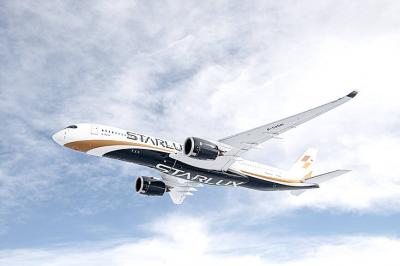
Starlux Airlines Co (星宇航空) today unveiled a long-haul network expansion plan at a shareholders’ meeting in Taipei, including direct flights to Barcelona, Spain, and Zurich, Switzerland, as well as a service connecting Taipei, Sydney and New Zealand. Starlux is to become the first Taiwanese carrier to offer non-stop services to the two European cities, while the inaugural oceanic route is expected to expand transit opportunities within the Australia-New Zealand market, Starlux said. Flight services to Chicago, Dallas, Washington and New York are under evaluation, the airline added. Prior to the shareholders’ meeting, the airline earlier this year announced that it would be

UNDER MICROSCOPE: Taiwan detained three people who allegedly conspired to buy servers in Taiwan and export them using fraudulent documentation, prosecutors said Nvidia Corp chief executive officer Jensen Huang (黃仁勳) on Saturday urged Super Micro Computer Inc to tighten up on compliance after Taiwan detained three people this week for allegedly making fraudulent declarations about artificial intelligence (AI) servers made by its US partner. The development marked the nation’s first crackdown on semiconductor smuggling, which grew after the US slapped restrictions on exports of high-end chips such as Nvidia AI accelerators to China. Nvidia is “rigorous” in explaining regulations to all of its partners, Huang told reporters after arriving in Taipei. “Ultimately Super Micro has to run their own company,” he said in response to

Nvidia Corp yesterday announced that CEO Jensen Huang (黃仁勳) would attend an employee meeting in Taipei tomorrow to celebrate the launch of the company’s Taiwan headquarters project. Huang would attend a gathering at the site of Nvidia’s planned headquarters in Beitou Shilin Technology Park (北投士林科技園區), the company said in a statement. After arriving in Taiwan on Saturday last week, Huang told reporters that he plans to meet with Quanta Computer Inc (廣達) chairman Barry Lam (林百里) and Taiwan Semiconductor Manufacturing Co (TSMC, 台積電) chairman C.C. Wei (魏哲家), and would attend the groundbreaking ceremony for Nvidia’s Taiwan headquarters tomorrow. Nvidia has not yet applied


 RSS
RSS